
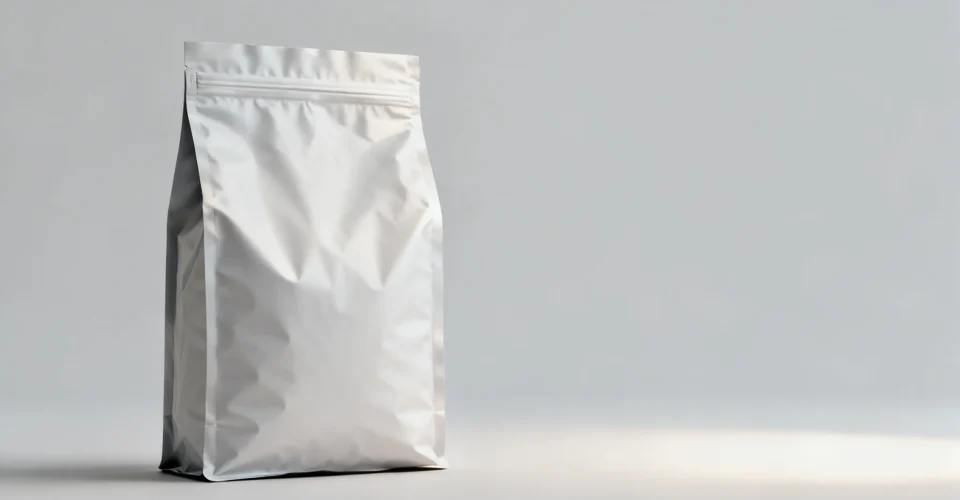
Flat bottom pouches for pet food are chosen when a heavy bag has to stay square on a pallet and still open easily in a kitchen. The format gets that behaviour from a folded base that opens into a rectangle, which spreads the load across four creases instead of concentrating it on one seam. Kibble in the two to eight kilogram range is where the decision usually matters, because that is the weight at which a cheaper bag starts to lean.
This applies to dry kibble, freeze-dried and semi-moist packs above roughly one kilogram, and it applies less clearly to small treat pouches where the base has almost nothing to carry.
Why Do Large Pet Food Bags Need a Flat Bottom Pouch?
A large pet food bag carries three loads at once: the product weight, the stacking weight of the bags above it, and the handling load every time a household lifts it. A stand-up pouch manages the first two only while the fill is light. As the weight climbs, the oval base widens and the bag starts to sag at the seams, and the sag is what leads to a leaning pallet.
A flat bottom pouch changes the geometry rather than the film. Because the base opens into a rectangle, the vertical load passes through four corner creases and a flat base panel rather than through a single curved seam. That is why the format holds its footprint at weights where a stand-up bag has already lost its shape.
What Fill Weight Makes a Flat Bottom Pouch Worth It?
There is no universal threshold, because film gauge, base depth and how the product settles all move it. As a working guide, packs under about one kilogram rarely gain enough from the extra base to justify the cost, and packs above about three kilograms rarely stay stable on a simpler format through a full pallet. The useful test is not a number but a trial: fill at the top of the intended range, leave the bags stacked for several days, and check the base and the corners.
The reason the top of the range matters is that a bag which looks acceptable straight off the line can sag once the product has settled and the stack has stood under its own weight. Sampling at the heavy end of the range, rather than the middle, removes most of the surprise later.
Base Geometry: How a Folded Bottom Carries Stack Load
The bottom of a flat bottom pouch is built from a separate base panel welded into the side walls, which is why the format needs more film and more forming steps than a stand-up bag. In return, the base panel distributes compression across a flat area instead of a curve, so the bag resists the kind of slow crushing that turns a pallet into a lean.
The creases are the weak points. Each corner is a place where film is folded on itself and the seal has to bridge several layers, so seal strength and film stiffness matter more here than raw puncture resistance. Structure and format are easier to compare once the material families are clear, and the site’s flat bottom pouch overview walks through the base constructions used across food categories.
Concept packaging visual generated for editorial use. Not a customer project, not a tested structure.
Which Film Build Suits a Heavy Pet Food Bag?
The film answers the product, not the format. Kibble with a high fat content is the case that most often needs a barrier layer, because fat oxidation shows up as a rancid note long before the bag looks wrong. Freeze-dried and semi-moist products pick up moisture quickly and need the barrier that matches that sensitivity. A dry, low-fat kibble in a short distribution chain may need no barrier beyond a moisture-resistant sealant.
Stiffness is the second requirement, and it belongs to the format rather than the product. A base panel has to hold a rectangle under load, so a film that is soft enough for a small stand-up bag will let a large flat bottom bag slump. The practical consequence is that the laminate is usually specified slightly stiffer than the barrier requirement alone would suggest.
Where Do Flat Bottom Pet Food Bags Fail in Transit?
Failures concentrate at the base corners and along the bottom seal, because those are the areas that carry stacked weight and that get folded during packing. Damage usually appears as a crease that becomes a pinhole rather than as a clean tear, which is why a visual check on a filled pallet often misses it.
The reliable way to settle the question is to test the filled bag rather than the film sample. ASTM D4169 sets out a distribution cycle for shipping containers and systems, and running its compression and drop schedules against production bags at the target weight gives a repeatable comparison between two candidate structures. Testing at the real weight matters, because a bag that survives at half load proves very little.
How the format interacts with weight and route is worked through in the article on pet food packaging solutions by product format, and the moisture and oxygen side of the same decision is covered in the note on freeze-dried pet food packaging.
How Should the Closure Be Specified for Daily Opening?
Above a few kilograms the closure becomes the point of failure in ordinary use, because the bag is opened and closed far more often than it is shipped. A zipper strip that is adequate on a small bag can pull away from the film on a large one, particularly where the product is dusty and settles into the track.
The specification should follow the number of openings expected over the life of the pack and the weight the closure has to hold, not the cheapest strip available. Handles are a functional choice for the same reason: the handle area has to carry the whole bag in one hand, so it changes the film selection rather than merely the artwork.
Where Is a Flat Bottom Pouch the Wrong Choice?
The format is overkill for single-serve and small treat packs, where the base carries almost nothing and a stand-up pouch with the same barrier film delivers the same experience for less. It is also a poor fit where shelf depth is restricted, because the rectangular base consumes front-to-back space and can force a reduction in facings.
Short promotional runs are a third case. Setup waste on a flat bottom line is higher than on simpler formats, so a small seasonal run absorbs a disproportionate share of that cost. A workable alternative is to run the promotion on a format the line already handles well, and keep the flat bottom structure for the standing range.
Key Takeaways
- Choose the format from the fill weight and the pallet pattern, not from a competitor’s pack.
- Test at the top of the intended fill range, because bags that pass at mid-range often sag once settled.
- Specify the laminate for base stiffness as well as barrier, since a soft film lets the base slump.
- Verify the base corners and the bottom seal, which is where stacked load concentrates.
- Match the zipper to the number of openings, not to the unit price of the strip.
Ordering Checklist
- Confirm the fill weight range and the settled height at the top of that range.
- Confirm the pallet pattern and the number of bags per layer, since the base has to carry that load.
- Confirm the closure type against the opening frequency expected in the category.
- Agree which filled-bag tests will be run, at which weight and compression level.
- Confirm that the seal area stays free of ink, because ink in the seal reduces seal strength.
Where the product is a cube-shaped or high-value format, the same load argument leads to a different construction, and the options are set out on the quad seal dog food bag page.
Conclusion
Flat bottom pouches for pet food earn their extra material where the fill weight is high enough that a simpler bag would lean, and where the pallet or the shelf rewards a bag that keeps its footprint. Below that point the structure is cost without benefit, and above it the cheaper format is a false saving that shows up as rejected pallets and returns. Decide from the fill weight and the distribution route, specify the film for base stiffness rather than barrier alone, confirm the closure against the weight it will carry, and run a filled-bag compression and drop test before the artwork is released.
Frequently Asked Questions
At what fill weight should a pet food brand switch to a flat bottom pouch?
Most projects move across somewhere between one and three kilograms, but the figure follows film gauge, base depth and the pallet pattern rather than a fixed rule. The workable approach is to test at the top of the planned range: fill and stack production-sized bags, leave them several days and inspect the base and corners. If the base stays flat, the lighter sizes in the range will be safe with the same structure, without changing the laminate.
Do flat bottom pouches need a thicker film than stand-up pouches?
Often yes, though thickness is only one of the levers. In flat bottom pouches the base carries load through folded creases, so the laminate needs enough stiffness to resist creasing and enough seal strength to bridge several layers at each corner. Adjusting the sealant layer or the base construction can give the same result as increasing overall gauge, usually at lower material cost and without changing the print.
Can the format run on the same line as stand-up pouches?
Seldom without tooling changes. The forming section that creates a separate base panel differs from the hardware used for a stand-up or pillow pack, and the fill sequence may need adjusting so the product settles before the final seal. Confirm the machine capability before the format is fixed, since the tooling has to suit pouches that already exist in the plant.
Are flat bottom pouches suitable for freeze-dried pet food?
They can be, provided the barrier is specified separately from the format. Freeze-dried products are porous and take up moisture quickly, so the film build carries most of the protection while the base contributes stability. Where the pack is small and used up quickly, a stand-up pouch with the same barrier film is usually the more economical answer for a brand weighing two formats.



