
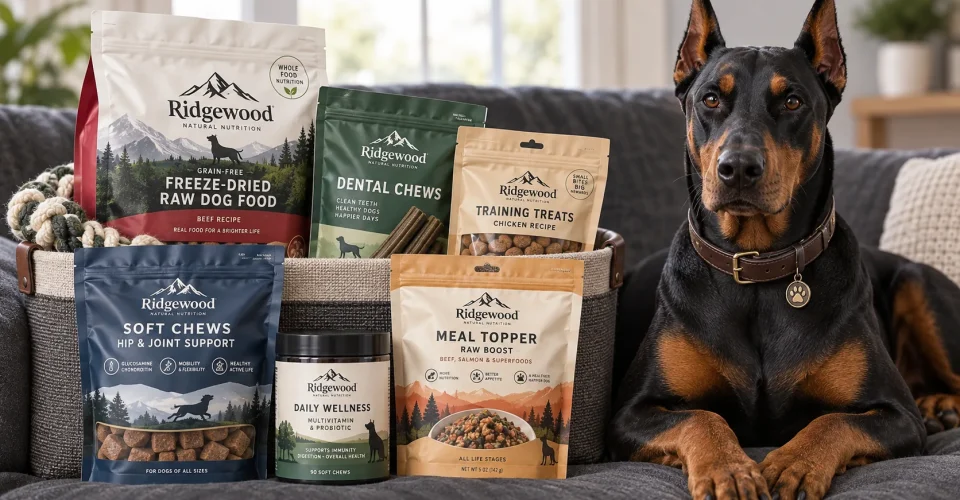
That is why we start these projects with the food and the packing line, not with a favorite pouch style. The useful early conversation covers fat content, water activity, piece shape, fill weight, shelf-life target and distribution. Once those facts are on the table, material and format choices become much less speculative. OMOPACK’s pet food packaging overview shows the available directions; this article explains how to narrow them down.
Pet food does not place one tidy set of demands on a package. A five-kilogram bag of kibble has to survive lifting and stacking. A freeze-dried treat is far more concerned with moisture pickup. A hard chew can damage a film that performs perfectly well around rounded pieces. Meal toppers bring powder into the seal area and are opened again and again at home.
Four products, four different weak points
| Product | Primary risks | Packaging questions to answer |
|---|---|---|
| Dry kibble | Moisture gain, fat oxidation, aroma loss, heavy-pack handling | What barrier is required? Can seals and handles tolerate repeated lifting and distribution? |
| Freeze-dried food and treats | Moisture pickup, rehydration, oxygen exposure, crushing | How low must moisture ingress remain, and will the closure protect the product after opening? |
| Jerky and hard chews | Puncture, abrasion, oil migration, seal contamination | Can sharp edges stress the film or reach the seal during filling and transport? |
| Meal toppers and supplements | Powder migration, aroma loss, inaccurate dispensing, repeated opening | Does the format support clean filling, controlled dispensing and reliable reclosure? |
1. Dry kibble: barrier performance is only half the job
Kibble is often discussed as a barrier problem because moisture and oxygen can affect texture, aroma and fats. Yet larger packs also behave like handled loads. The bottom construction, side gussets, seals and any carry feature must survive stacking, lifting, drops and abrasion. A laboratory barrier value alone says little about a pouch whose seal is damaged in distribution.
Start with the product’s measured sensitivity and target shelf life, then define oxygen- and water-vapor-transmission requirements for the finished structure. Evaluate those requirements under the expected temperature and humidity range. For a multi-serve pack, assess the zipper separately from the production seal: a zipper improves daily use but does not replace the permanent top seal before first opening.
Dry pet food keeps best in a cool, dry place: excess heat or moisture can break down nutrients, and keeping the original packaging preserves traceability information such as lot numbers and best-by dates. Those storage and traceability needs should influence both material selection and information layout. See the AAFCO consumer guidance on pet food labels.
2. Freeze-dried products: design against moisture pickup
Freeze-dried pieces may be shelf stable because they have low water activity, but that does not make the open or damaged pack forgiving. Moisture pickup can change texture and can undermine the condition that made the food stable. Packaging for these products therefore has to prevent rehydration and keep closures free of defects.
This shifts attention to the complete package: film barrier, seal continuity, pinhole resistance, zipper alignment and consumer reclosure. An opaque high-barrier structure may be appropriate for a light-sensitive, fat-rich formula, while another recipe may permit a different construction. We would not sign off that choice until filled samples had been tested.
For the wider regulatory context on the composition and labelling of complete and complementary pet food, see FEDIAF’s nutritional guidelines, the reference used by the European pet food industry.
3. Jerky and hard chews: inspect contact points, not only film thickness
Long chews, bone-shaped pieces and sharp dried edges create concentrated loads. A structure can be thick yet still fail if its layers are poorly matched to flexing and puncture. Run trials with the actual product orientation and the least favorable pieces, then include vibration, drop and compression conditions that reflect real cartons and parcel delivery.
Seal areas deserve equal attention. Product crumbs or oil in the sealing zone can reduce seal consistency. A wider nominal seal does not automatically solve contamination; the filling path, jaw design, seal temperature, pressure and dwell time must work together. For roll-fed lines, use custom rollstock film dimensions and surface properties that match the forming collar and sealing system instead of adapting the line around an unverified web.
4. Meal toppers and powders: control dust and the way the pack is used
Powdered toppers bring two practical issues: fine particles can enter the seal area, and consumers may open the pack many times. The filling trial should check dust generation, headspace and seal cleanliness at normal production speed. If the product is spooned or poured, opening width and pouch stability matter as much as graphics.
For single-use supplements, a three-side-seal pouch or small sachet may reduce repeated exposure. For a household multi-use topper, a stable stand-up pouch with an appropriate reclosure may be easier to handle. Neither format is universally better; serving size and the user’s routine decide.
What we would ask before recommending a structure
- Characterize the food. Record water activity, fat content, aroma sensitivity, particle size, sharp edges and whether oils or fine powders reach the seal.
- Define the route to market. Include warehouse climate, shipping duration, parcel handling, retail display and the number of opening cycles after purchase.
- Set measurable acceptance criteria. Specify barrier, seal, drop, leak and dimensional requirements using methods agreed with the converter and testing laboratory.
- Run line trials. Confirm web tracking, zipper position, seal-window tolerance, cutting and throughput on the intended equipment.
- Test the finished pack. Use production-filled samples for shelf-life and distribution work. Empty-pouch testing cannot reproduce every product-package interaction.
Seal validation should be planned before artwork approval
A technically attractive laminate can still fail when the operating seal window is too narrow. ASTM lists methods commonly used in flexible-package development, including ASTM F88/F88M for seal strength and F1921 for hot tack. The correct methods and acceptance limits depend on the product and process; the important point is to agree on them before commercial production, then document settings and results.
The information that saves time during sampling
- Product type, recipe characteristics and water activity data where available
- Net weight, dimensions and the largest or sharpest pieces
- Target shelf life and storage/distribution climate
- Filling temperature, line type, speed and sealing conditions
- Need for zipper, tear notch, handle, window or degassing feature
- Required tests and pass/fail criteria
- Target markets and applicable food-contact and labeling requirements
With those facts, sampling can focus on two or three credible structures instead of a long list of guesses.
Questions we hear during pet-food projects
Does every freeze-dried pet food need an aluminum-foil pouch?
No. The required structure depends on moisture and oxygen sensitivity, light exposure, target shelf life and distribution conditions. Foil, metallized and transparent high-barrier options have different trade-offs. Test the chosen structure with the actual food.
Is a zipper enough to keep pet food fresh after opening?
A zipper can reduce exposure between servings when it is used correctly, but it does not restore the unopened package condition. Zipper fit, contamination, headspace and household storage all affect performance.
Which pouch is best for large bags of kibble?
Flat-bottom, quad-seal and gusseted formats are often considered because they offer useful volume and panel area, but the best format depends on fill weight, handling, pallet pattern and filling equipment. Load and drop trials should decide.
Can the same film run across kibble, treats and toppers?
Sometimes a common platform is possible, but only after the barrier, puncture, seal and machining needs of every SKU are compared. Standardization should follow testing, not precede it.
A good sample is not the one that merely looks finished. It is the one that runs on the intended line, survives the intended journey and keeps the actual food within its agreed limits. Product and process data should decide the construction; the pouch format comes afterwards.



