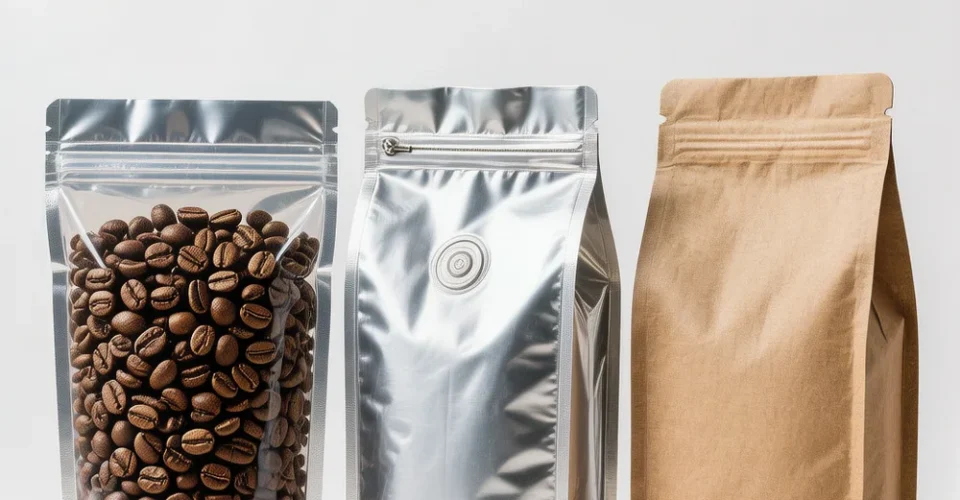
Custom printed coffee bags are decided by four things at once: the film structure, the valve, the closure, and the print method. Change one and the others usually move with it. A roaster who settles on a foil laminate and then asks for the cheapest possible print run will find that artwork and finishing behave differently on that substrate; a brand that picks digital printing to avoid plates should expect a narrower finishing range. This guide covers the materials and options side of that decision — what each layer does, which barrier is worth paying for, and what has to be ready before a printer can quote.
What Materials Go Into Custom Printed Coffee Bags?
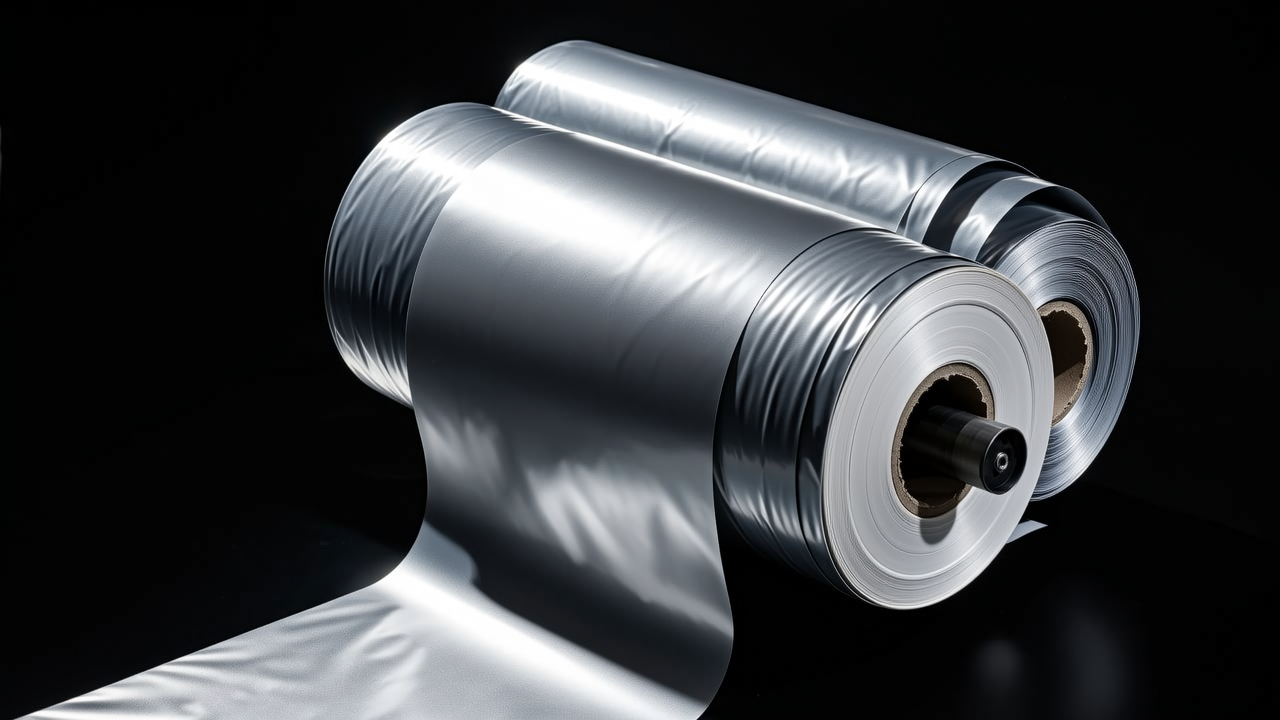
A coffee bag is a laminate, not a single film. It is normally built from a printed outer layer, one or more barrier layers, and a heat-seal inner layer, bonded with laminating adhesive. Each layer is chosen for a different job, and the same nominal structure can behave differently depending on layer thickness and the adhesive used.
For custom printed coffee bags the outer layer carries the print and the handling strength, the middle layers slow oxygen and moisture, and the inner layer has to seal reliably on the filling line at a temperature the film can tolerate. Roasted coffee adds a fourth requirement that most other dry foods do not have: the pack must release carbon dioxide after filling, so a valve or a permeable path is part of the structure rather than an accessory.
Film Structures and What Each Layer Does
The table below lists common candidate structures. The layer roles are standard practice; the thickness and the exact grade are project-specific and should be fixed against a filling line trial rather than copied from another product.
| Structure | Outer layer | Barrier layer | Seal layer | Typical direction |
|---|---|---|---|---|
| PET / foil / PE | PET, printable | Aluminium foil | PE | Long distribution, whole bean and ground |
| PET / metallised PET / PE | PET, printable | Metallised PET | PE | Mid-length shelf life, lighter pack weight |
| PET / EVOH / PE | PET, printable | EVOH-containing layer | PE | Barrier without foil, clearer pack |
| Kraft paper / foil / PE | Kraft paper | Aluminium foil | PE | Natural surface look, premium specialty |
| Mono-material PE | PE, printable | Coating / high-barrier PE | PE | Recyclability targets, faster turnover |
Data nature: structural options compiled from supplier technical literature and industry practice. It is not a guarantee of shelf life, and none of the rows should be treated as interchangeable without a trial on the actual filling line.
Two practical points sit behind the table. First, the barrier layer does the protecting, so paper or a decorative outer layer changes the look and the feel but not the oxygen resistance. Second, print quality depends on what the ink sits on, which is why the same artwork can look sharper on PET than on a textured kraft paper surface. Our overview of custom coffee bags shows how these structures are grouped into finished formats.
Which Barrier Layer Does Your Coffee Need?
The barrier requirement follows the product, not the price bracket. Whole beans still protected by their own structure tolerate a wider range than ground coffee, which releases aroma quickly once the cell walls are broken. Longer distribution and slower turnover both push the required barrier up, because the pack has to hold its protection for longer under more temperature swings.
Oxygen is the main cause of staling and moisture damages both texture and aroma, so oxygen transmission is the property to check first. ASTM D3985 is the standard test method for oxygen gas transmission rate through plastic film, and quoting a structure on a measured value is more useful than quoting it on layer names. Foil gives the highest practical barrier; metallised and EVOH structures sit below it; mono-material PE depends on the coating it carries.
Valves, Zippers and Closure Options
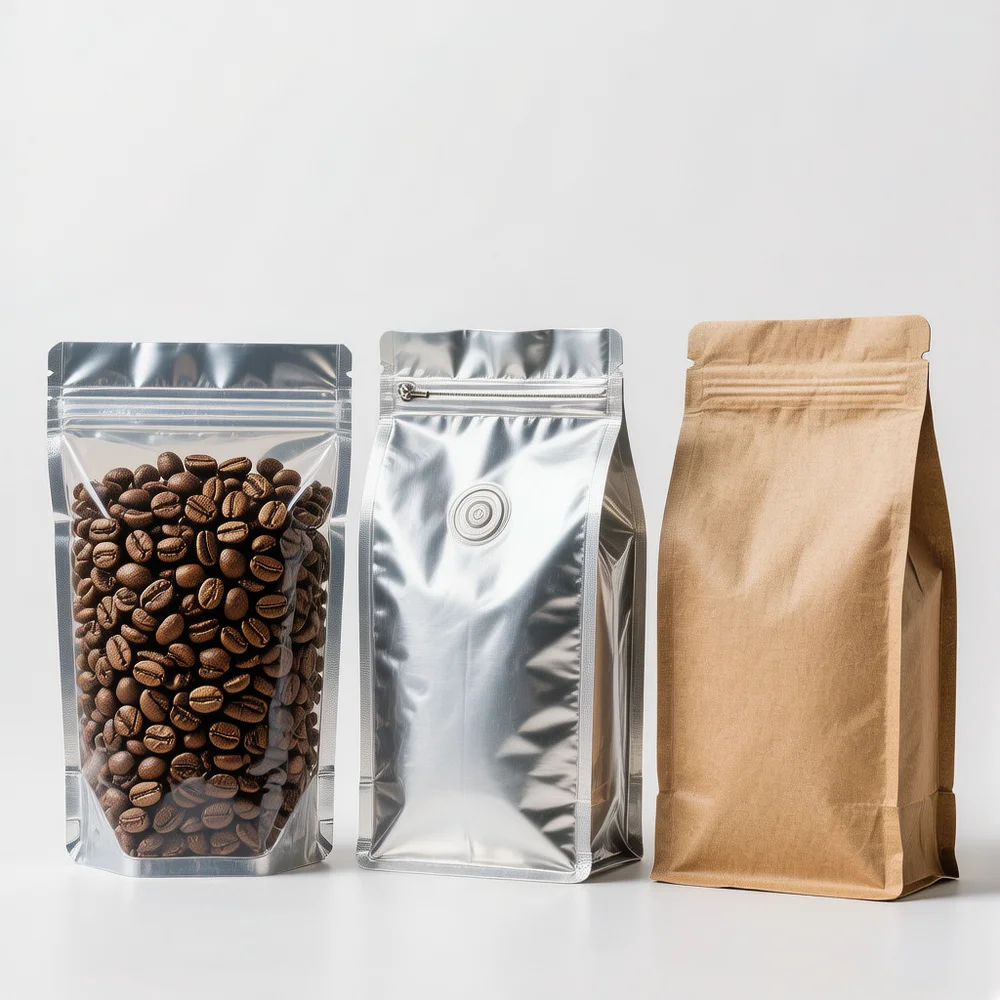
Roasted coffee keeps releasing carbon dioxide for days after roasting. Sealed without an outlet, that gas builds pressure until the seams distort or the pack balloons. A one-way degassing valve vents the gas while blocking oxygen, which is why valve choice belongs in the material conversation rather than the accessory list. The mechanics are covered in more detail in our guide to the coffee bag degassing valve.
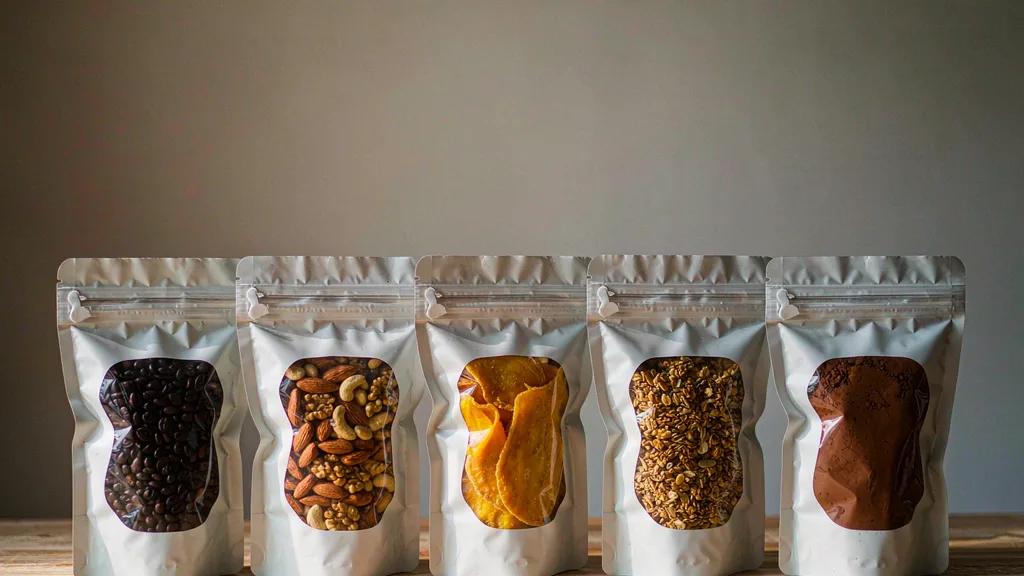
Closures are the other half of the option set. A zipper suits formats that are opened more than once, which in practice means most retail packs above a small single-serve size. A tear notch or laser score decides how the pack is opened. A transparent window shows the bean but costs barrier area, so it is a trade rather than a free addition. Each of these is specified together with the format, because a valve placed on a printed panel or inside a seal area creates a defect that only shows up in production. Formats that already incorporate these features are listed on our custom coffee bean packaging bags page.
Which Print Method Fits Your Run Size?
Gravure printing gives the highest colour saturation and the most consistent result across a long run, and it spreads its plate cost across the volume. Digital printing removes the plates and the associated lead time, which makes it the practical choice for a new SKU, a limited edition, or a brand testing several origins at once. Flexo sits between them and is often used for simpler artwork on roll stock.
The decision is not permanent. Many brands start a product on digital to test demand, then move the volume to gravure once the artwork is stable and the annual meterage justifies the plates. Keeping the same artwork file for both avoids a second round of proofing.
How Does Print Method Change the Artwork?
Artwork that survives a screen proof can still fail on a press. Fine reversed-out type and thin metallic lines tend to fill in at speed, especially on foil laminates, so type has to stay above the practical minimum for the process. Large solid dark areas show roller marks on some presses, and gradients print differently on a textured kraft surface than on a smooth film.
This is why the print method has to be fixed before the artwork is finalised. Approving a design before the print method is fixed usually sends it back for a second version, and on gravure that means a second set of plates.
What Should Be Checked Before the First Print Run?
Four items are worth locking down before the first production run. The film structure and its thickness, agreed against a filling line trial rather than a data sheet. The valve type and position, confirmed against the actual pack layout. The print method and finishing, confirmed against the quantity. And the artwork file, supplied in the printer’s required format with bleeds and safety margins set to the finished pouch dimensions.
Food-contact compliance belongs on the same list. Any material intended to contact food has to be documented for the target market, and the requirement differs between destinations, so the destination market has to be stated at the quoting stage rather than after the plates are made.
Key Takeaways
- Custom printed coffee bags are a laminate decision: the barrier layer controls protection, and the outer layer only controls print and handling.
- Barrier should be chosen from the product and the distribution route, then verified by an oxygen transmission test rather than by the layer name.
- The valve is structural, not optional, for coffee packed soon after roasting.
- Print method should be fixed before the artwork is final, because proofing a design for the wrong process wastes a version.
Where These Options Apply
This applies to whole-bean and ground retail packs, to foodservice and private-label formats, and to gift and subscription packs where the print carries more of the brand. It applies less to very small single-serve envelopes, where the outer envelope is mostly a barrier and a label rather than a printed display panel.
One boundary is worth stating. A material recommendation from a supplier tells you what the structure is capable of, not what your pack will achieve. The achievable shelf life depends on the fill, the headspace, the seal quality and the storage conditions, so the structure has to be confirmed by testing the actual product in the actual pack. Our custom coffee and tea packaging projects page shows the range of formats this applies to.
Testing References for Barrier and Seal Performance
When a coffee bag fails in the field, the argument is usually about materials, and the way to settle it is to measure rather than to debate. Oxygen transmission is measured by ASTM D3985, and material intended for food contact in the European market is covered by the EU framework that the European Food Safety Authority summarises in its food contact materials topic page. Both are worth keeping as reference points when a structure is proposed.
A supplier should be able to state the structure, the thickness of each layer, and the basis on which the barrier claim is made. If a proposal only names the layers without stating a test method or a target, treat the numbers as unverified until your own trial confirms them.
Conclusion
Choosing materials and options for custom printed coffee bags works when the four decisions are made together rather than in sequence: structure first against the product and the route, then valve and closure against the pack layout, then print method against the quantity, and finally artwork against the process. Starting from the product and the distribution distance keeps the structure tied to a requirement instead of a preference. For a full specification on a coffee, tea, or private-label format, the practical next step is to run a filling line trial on the candidate structure and measure the pack, not the data sheet.
Frequently Asked Questions
Does every coffee bag need a degassing valve?
Yes, if the pack is sealed soon after roasting. Roasted beans release carbon dioxide for days, and without an outlet that gas pressurises the pack and can distort the seams. Degassing the coffee before packing, or using a structure that vents gas, are the alternatives, but both trade away some aroma. Custom printed coffee bags that are filled well after roasting can in principle use a plain barrier laminate, so the filling schedule is the fact that decides it.
Is a foil laminate always the better choice?
No, not always. Foil gives the highest practical oxygen and light barrier, which suits long distribution and slow turnover. For product sold locally and turned over quickly, a metallised or EVOH structure can meet the requirement at lower pack weight, and a coated mono-material can suit brands with recyclability targets. The deciding evidence is an oxygen transmission value measured on the candidate structure and compared with the shelf life you need.
How many film structures should one brand run?
Fewer is usually better. Each additional structure means another set of seals to validate, another line setting to record, and another colour to keep consistent across the range. A brand with several roast levels and pack sizes can often cover most of the range with two structures, and reserve a high-barrier laminate for the products with the longest route. Reducing the count is one of the few changes that lowers cost without touching quality.
What has to be ready before a printer can quote?
Four items. The pack format and fill weight, the target market for food-contact compliance, the print method you intend to run, and the artwork file in the printer’s required format all have to be settled. Missing any one of these turns a quote into an estimate and delays proofing. If the print method is still open, say so at this stage — quoting a gravure job and a digital job against the same artwork produces two different numbers and two different lead times.