
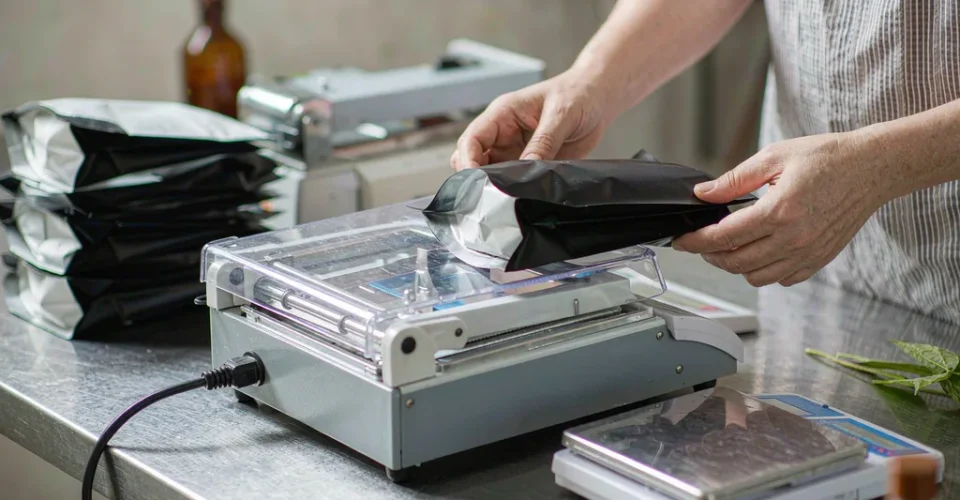
Pouch filling and sealing equipment should be bought against your monthly bag count, not against ambition. A hand impulse sealer handles a few hundred bags a day at under a few hundred dollars; a continuous band sealer covers a few thousand; an automatic premade pouch machine only pays off once tens of thousands of identical bags run every month.
What Actually Changes When Bag Volume Grows
Volume changes three things at once: how many seals one operator makes per hour, how consistent those seals are, and how much product you lose to rework. Below roughly 500 bags a month the risk is inconsistency; between 5,000 and 50,000 bags it is downtime; above that it is changeover time between SKUs.
A useful rule of thumb: sealing labour overtakes material cost somewhere around 2,000 to 3,000 bags per month. Below that point, a second pair of hands is cheaper than a second machine.
How to Choose Pouch Sealing Equipment: Three Output Bands
Under 500 bags a month: hand impulse sealer
An impulse sealer heats a nichrome wire only while the jaw is closed, so it draws power for a second or two per seal and needs no warm-up. Typical bench units cost 50 to 300 USD, seal widths of 2 to 5 mm, and handle films up to about 0.3 mm total thickness.
Reality check on speed: one operator with a hand sealer realistically closes 300 to 500 bags per day once you include weighing, filling and settling. Seals are repeatable only if the operator holds the jaw down for the same dwell each time, which is why the first upgrade most brands make is a foot pedal or a timer-controlled jaw.
500 to 5,000 bags: continuous band sealer with a filler
A band sealer moves the pouch top through heated jaws on a conveyor at a fixed speed, so dwell and temperature stop depending on the operator. Entry-level horizontal band sealers run 500 to 2,000 USD and close roughly 10 to 20 bags per minute depending on bag width and product settling.
At this band the filler, not the sealer, becomes the bottleneck. Pair the sealer with the filler that matches your product:
- Free-flowing dry goods (coffee beans, granola, tea, nuts): a volumetric cup filler or a small auger filler with a foot-pedal dosing head
- Powders that dust or bridge (drink mixes, spices, protein powder): an auger filler with a dust skirt, because dust in the seal area is the single most common cause of leaking powder bags
- Liquids and pastes (sauce, puree, oil): a piston or peristaltic filler, plus a pouch held upright in a jig while filling
- Fragile or irregular pieces (cookies, jerky strips, dried fruit): a multihead or bench scale with hand placement, because no filler protects a brittle product from itself
Above 50,000 bags: automatic premade pouch machine or FFS
Automatic premade pouch machines pick, open, fill and seal at roughly 30 to 60 bags per minute and cost 15,000 to 60,000 USD installed. Form-fill-seal machines make the pouch from rollstock inline and suit one dominant SKU running for weeks.
Both only make sense when long runs amortise the changeover cost. With twelve SKUs running two days each, a semiautomatic cell usually beats one automatic machine on weekly output. Check the stand-up pouch sizing guide before you shop.
Seal Settings: Temperature, Dwell, Pressure and Jaw Geometry
Every pouch sealing problem traces back to four variables. Set them in this order:
| Variable | Typical starting range | What goes wrong when it is off |
|---|---|---|
| Jaw temperature | 120 to 180 °C, depending on sealant layer | Too low gives a seal that peels; too high thins the film at the seal edge |
| Dwell time | 0.5 to 2.0 s | Too short leaves a cold seal; too long shrinks and wrinkles the film |
| Jaw pressure | Medium, enough to emboss the seal pattern evenly | Uneven pressure leaves channels across the seal |
| Seal width | 3 to 10 mm, wider for heavy or liquid products | Narrow seals fail in drop and transit |
Two structural details matter more than the numbers. The zipper area is thicker than the rest of the bag top, so one pass often seals the film but not the zipper profile: use a preheat bar or a longer dwell there. Sealing through product contamination (sugar dust, oil, sauce) fails even with perfect settings, because the product carbonises and leaves a channel — 欧姆包装 sees this on seasoning and jerky lines more often than any film defect.
The heat seal parameters guide covers temperature, dwell and pressure troubleshooting in more depth.
What Seal Quality Should You Actually Verify
Do not judge a seal by how flat it looks. Three checks catch almost every real failure:
- Seal strength by peel test: cut a 15 mm strip and pull it. A well-made retail pouch seal typically holds well above 20 N per 15 mm on a standard laminate; the number to watch is the spread between six samples, not the average. ASTM F88 is the common test method.
- Leak check: submerge the bag under water in a clear tank and press gently. A steady stream of bubbles marks the leak path. Empty bags with the seal only, pressurised slightly, show leaks faster than full bags.
- Squeeze and drop: fill, seal, drop from 1 m onto concrete on the seal corner, then squeeze. Seals that survive but leak at the corner were sealed too hot or too narrow.
Run these checks when a new pouch shipment arrives and after any jaw, film or product change. Empty pouches also degrade in storage — the packaging film storage guide explains why film stored warm or in sunlight seals differently months later.
Cost and Payback: When Upgrading Makes Sense
| Stage | Equipment spend | Bags per month | Realistic output per operator |
|---|---|---|---|
| Hand sealer | 50 to 300 USD | Under 500 | 300 to 500 per day |
| Band sealer plus filler | 1,500 to 5,000 USD | 500 to 5,000 | 10 to 20 per minute |
| Automatic premade pouch machine | 15,000 to 60,000 USD | Over 50,000 | 30 to 60 per minute |
Payback is driven by rework, not by speed: a leaking bag costs the product, the bag, the freight and the refund. Above a 2 percent leak rate, upgrading the sealer usually pays back before the speed gain does.
Common Mistakes When Buying Pouch Filling Equipment
- Buying the machine before the bag: the sealant layer and thickness decide the jaw type
- Ignoring dust: powders need a filler that keeps the seal area clean
- Forgetting gas flushing: it rules out most hand impulse sealers
- Over-specifying at launch: at 300 bags a month, depreciation beats labour
- Skipping the retail requirement: closures must show evidence of opening, see the tamper-evident packaging guide
FAQ: Pouch Filling and Sealing Questions
Can I seal stand-up pouches with a regular household heat sealer?
A household bag sealer can close thin PE bags but usually cannot reach the temperature and pressure a laminated stand-up pouch needs, so the seal peels open. A bench impulse sealer rated for laminate, with at least 3 mm seal width, is the minimum for retail pouches.
What temperature should I use to seal a coffee pouch?
Start at the low end of the film supplier’s range, typically around 130 to 160 °C for a PET/AL/PE or PET/PE laminate, then raise it in 5 °C steps until the seal holds a peel test without thinning at the edge. The inner sealant layer, not the outer print film, sets the temperature.
How do I stop powder from ruining the seal?
Fill below the seal zone, wipe or air-knife the seal area, and use an auger filler with a dust collection shroud. Powder trapped in the seal creates a channel that leaks even when the temperature and dwell look correct.
Do I need a vacuum or gas-flush sealer for coffee?
Only if you are selling whole bean coffee with a long ambient shelf life and no degassing valve. Most roasters use a valve in the bag instead of vacuum sealing, which keeps the pack line simple and avoids compressing the bag.
Why do my seals look fine but leak later?
Late leaks usually come from a seal that was made too hot, too narrow, or through product contamination. The seal holds at first inspection and then fails after transport vibration or a temperature change. Peel testing six samples per run catches the trend before it reaches customers.
Is nitrogen flushing worth adding to a small line?
It helps most with high-fat or high-surface-area products such as nuts, chips and ground coffee, but it needs a sealer that closes under gas flow, so it is normally added at the band sealer stage.



