
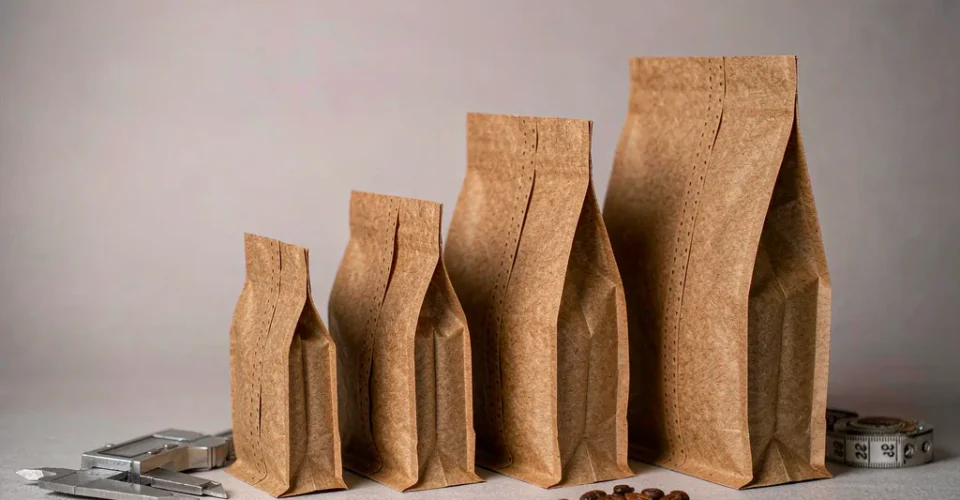
Stand-up pouch sizing starts with one number most buyers skip: bulk density. Divide your fill weight by the product’s bulk density to get the volume you need, add 20–35% headspace, and only then match that volume to a pouch width, height and bottom gusset. Buyers who order by weight alone typically end up with pouches that look half-empty or split at the gusset.
What Do Stand-Up Pouch Sizes Actually Mean?
When a supplier quotes a stand-up pouch, the size is written as three numbers: width × height + bottom gusset, in millimetres. A 120 × 200 + 60 mm pouch is 120 mm across the face, 200 mm from the top seal down to the gusset fold, with a 60 mm gusset that expands when the pouch is filled.
Two things matter here: the stated height includes the top sealing area, so usable fill height is roughly 30–40 mm shorter, and the gusset is what makes the pouch stand — a wider gusset adds volume without adding face width.
Because of this, comparing stand-up pouch sizes across suppliers only works if all three numbers are quoted. A “120 × 200 pouch” without a gusset figure is not a specification — it is a guess.
How Do You Convert Product Weight Into Pouch Volume?
The conversion is a two-step calculation that takes about five minutes.
Step 1: find the fill volume. Volume (mL) = fill weight (g) ÷ bulk density (g/mL). Bulk density is how tightly your product settles, and it varies more between products than most buyers expect. Granulated sugar sits around 0.85 g/mL, medium-ground roasted coffee around 0.36–0.45 g/mL, and puffed snacks as low as 0.05–0.08 g/mL, according to standard bulk density reference data such as the Engineering ToolBox materials tables.
Step 2: add headspace and match to a pouch. A filled pouch needs empty space at the top so it can be sealed without product in the seal zone, and coffee needs extra gas volume if you nitrogen-flush. In practice:
- Dry free-flowing products (sugar, rice, salt): add 15–20% headspace
- Ground coffee without gas flush: add 20–30% headspace
- Whole bean coffee with nitrogen flush: add 35–50% headspace, because the gas layer displaces product volume
- Puffed or fragile snacks: add 40–60% headspace to protect the product from crushing
The headspace allowance for coffee also serves a compliance purpose: roasted coffee is typically packed to a residual oxygen target of 2–3% or lower, consistent with the Specialty Coffee Association’s freshness guidance, and the gas layer occupies exactly the space you must budget for.
As a worked example: 250 g of whole bean coffee at 0.38 g/mL needs about 658 mL of product volume. With a 40% headspace for nitrogen flush, you need roughly 920 mL of usable pouch capacity. That typically corresponds to a 140 × 240 + 70 mm pouch — but you confirm it with a fill test, not with the calculator.
Which Pouch Sizes Fit Which Fill Weights?
The table below is a starting point for medium-density dry goods (0.3–0.5 g/mL, which covers most coffee, tea and powdered drink mixes). Always treat it as a shortlist for sampling, not a final answer.
| Fill weight | Suggested pouch size (W × H + gusset) | Typical use |
|---|---|---|
| 50–100 g | 90 × 140 + 45 mm | Tea samples, spice refills |
| 150–250 g | 120 × 200 + 60 mm | Retail ground coffee, tea |
| 250–340 g | 140 × 240 + 70 mm | Whole bean retail bags |
| 500–1000 g | 180 × 300 + 90 mm | Value packs, bulk tea |
| 1–2 kg | 220 × 350 + 110 mm | Food service, small pet food |
If your product is oily, sticky or flaky, its real bulk density is lower than a reference table says, which pushes you one size up.
Why Does the Same Weight Fit Differently in Different Pouch Shapes?
Because gusset depth, not just width and height, decides the volume. Two pouches with identical face dimensions can differ by 30% in capacity:
- A wider bottom gusset (say 80 mm instead of 60 mm) adds volume in the only direction that does not cost shelf-facing width.
- A flat-bottom (box-bottom) pouch holds roughly 15–25% more than a standard stand-up pouch at the same face size, because both side panels also fold out.
- A pouch with rounded corners loses a small but real amount of volume — usually 3–5%.
This is why experienced buyers ask suppliers for the internal capacity in millilitres, measured on a filled sample, instead of relying on dimensions alone.
How Do You Confirm Sizing Before Ordering a Full Production Run?
Order blank sample pouches in the shortlisted size and run a real fill test on your actual product, at your actual filling station. The test answers three questions that no spreadsheet can:
- Seal cleanliness: does product dust or oil end up in the seal zone at your chosen fill height? If yes, increase headspace or adjust your filling method.
- Stand and display: does the filled pouch stand stable on a shelf at retail temperature, and does it fit your planned carton or shipper with the expected stacking pattern?
- Oxygen and gas behaviour: for coffee, does the flushed pouch puff to a reasonable shape rather than ballooning, and does the degassing valve sit clear of the product bed?
A fill test costs one courier shipment and a few hours, and skipping it is the most common reason first-time pouch orders get reprinted. If you are still choosing between bag formats, our guide to flat bottom versus stand-up coffee pouches covers how shape changes both capacity and shelf behaviour, and our whole bean coffee packaging guide walks through the full specification from roaster to customer.
What Are the Most Common Stand-Up Pouch Sizing Mistakes?
The same four mistakes appear again and again in first orders:
- Sizing from a competitor’s photo. A photo hides the gusset and the fill level. Ask for dimensions instead.
- Forgetting the seal zone. The stated height includes the top seal, so a 200 mm pouch gives you around 165–170 mm of fill height.
- Ignoring bulk density changes. A coarser grind, a new supplier or a different roast level all shift density by 10–20%, which is often the difference between two pouch sizes.
- Over-sizing “to be safe.” An oversized pouch costs more per unit, looks half-empty on shelf, and lets fragile product migrate and crush during shipping.
If you are weighing pouch formats against closures as well, the zipper, easy-tear and spout pouch selection guide on this site breaks down how closure choice interacts with pouch size and filling method.
Sizing and material choice are decided together: a thicker barrier structure needs a slightly larger pouch. PURESTPACK’s guides to aluminium foil in flexible packaging and switching to mono-material PE pouches cover the barrier trade-offs behind the dimensions.
FAQ
How many grams fit in a 120 × 200 + 60 mm stand-up pouch?
For medium-density dry goods around 0.35–0.45 g/mL, a 120 × 200 + 60 mm pouch holds roughly 180–250 g depending on headspace. Nitrogen-flushed whole bean coffee fits closer to 180–200 g. Always confirm with a physical fill test.
What does the gusset number mean in pouch sizes?
The gusset number is the depth of the folded bottom panel in millimetres. It expands outward when the pouch is filled and contributes a large share of the total volume. Two pouches with the same width and height can differ by 30% in capacity if their gussets differ.
How much headspace should I leave in a coffee pouch?
Leave 35–50% headspace for nitrogen-flushed whole bean coffee and 20–30% for unflushed ground coffee. The headspace absorbs the gas layer, keeps product out of the seal zone and prevents the sealed pouch from looking over-inflated on shelf.
Are stand-up pouch sizes the same across all suppliers?
No. Dimensions are usually quoted in millimetres as width × height + gusset, but some suppliers quote height without the seal area or omit the gusset entirely. Always request all three numbers plus the measured internal capacity in millilitres before comparing quotes.
Can I use the same pouch size for two different products?
Only if their bulk densities are close. Sugar at 0.85 g/mL and ground coffee at 0.40 g/mL need very different pouch volumes for the same weight. When in doubt, calculate each product’s volume separately and size each SKU on its own numbers.
Does a bigger gusset cost more than a bigger width?
Usually yes: material usage rises with total surface area, and a wider gusset adds less area per millilitre of volume. The practical limit is the standing stability of very deep gussets, which is why 60–90 mm is the common retail range.



