
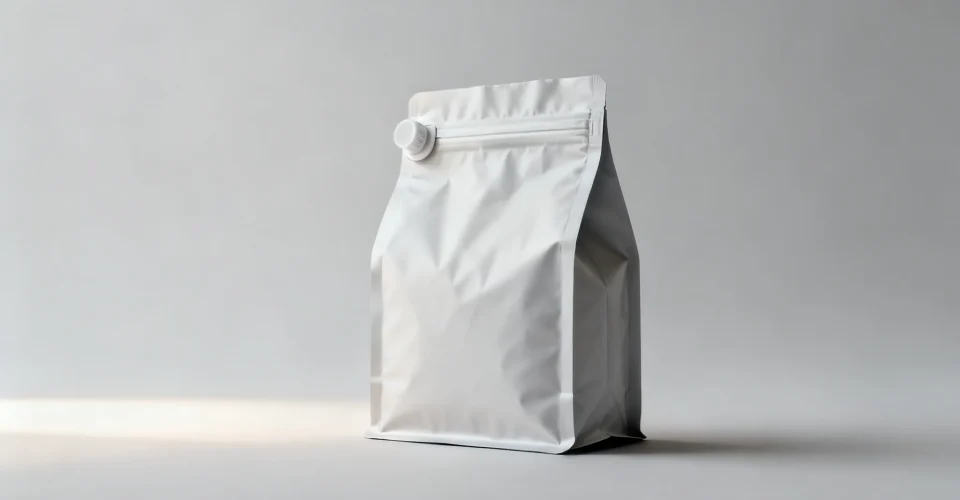
Freshly roasted coffee keeps working after it leaves the roaster. For days or weeks it releases carbon dioxide, and that single fact shapes most coffee packaging decisions: seal it too early in a fully airtight bag and the bag inflates or bursts; leave it open to air and the aroma it worked so hard to keep is gone. The one-way valve exists to sit exactly on that line, and yet it is also one of the most misunderstood components in the bag — overspecified by some brands, and blamed for problems it was never designed to solve by others.
What a One-Way Valve Actually Does
A coffee bag degassing valve is a small polymer check valve, usually heat-applied to the inside of the film. It opens when pressure inside the bag exceeds the valve’s cracking pressure and lets gas escape outward; when the pressure equalizes, it closes and blocks outside air from flowing back in. That is the entire mechanism. It does not extract oxygen already inside the bag, it does not actively “pump” the bag dry, and it does not extend freshness on its own — it simply gives CO₂ a controlled exit so the bag can stay sealed. Everything a valve does well follows from that narrow job, and everything it is wrongly asked to do fails for the same reason.
When the Valve Earns Its Place
The clearest case for a valve is coffee that goes into its final retail packaging soon after roasting. Coffee kept in bulk for a degassing rest before packing puts far less gas into the bag, but whole bean and ground coffee packed within a day or two of the roast will keep releasing CO₂ for a considerable time, and an unvalved airtight bag has nowhere to put it. The practical symptoms of that mismatch are familiar: domed or pillow-hard bags on the shelf, seals that split along the fin, and, in the worst cases, bags that open themselves in a courier carton. A valve also matters more as the pack gets bigger — a 1 kg bag holds proportionally more headspace gas than a 250 g one — and for e-commerce channels, where a bursting bag is discovered by the customer rather than by the packing line.
What the Valve Does Not Fix
The valve’s limits matter just as much as its function, because several common complaints get routed to the valve when the real cause is elsewhere. It does not remove the oxygen trapped in the headspace at sealing; if the line skips gas flushing or vacuum, that oxygen stays in and staling proceeds regardless of how well the valve works. It does not stop aroma from escaping through the film itself over time — that is a barrier-layer question, governed by the laminate structure rather than the valve. And after the bag is opened at the customer’s kitchen, the valve does nothing at all: resealing quality, zipper design and how the consumer stores the pack take over from that point. Brands that treat the valve as the freshness feature tend to underinvest in exactly the parts of the bag that carry freshness for most of the product’s life.
Concept packaging visual generated for editorial use. Not a customer project, not a tested structure.
Valve, Rest Period, or Both
The line-level decision is really about where the gas goes. Packing lines that rest coffee in bulk bins after roasting let most of the CO₂ leave before filling; those bins, not the bag, do the degassing work, and the valve becomes a safety margin rather than the primary path. Lines that pack directly off the roaster rely on the valve to carry much more of the load, and should treat valve capacity, placement and the bag’s ability to tolerate early inflation as real specification items. Neither route is wrong — what is wrong is mixing them unknowingly, for example by switching from bulk-rested to fresh-packed coffee without revisiting the valve and headspace assumptions. Whichever route a brand runs, the check is the same: fill a pilot bag, record how the bag’s firmness changes over the first days, and confirm the valve releases before the seals or the film are stressed.
Selection Points That Actually Matter on the Line
For buyers specifying the bag rather than the roasting process, a few valve-related details are worth pinning down. Placement should sit above the coffee bed and below the seal area, on a flat panel where the patch bonds cleanly; placement on or near a gusset crease is a recurring cause of poor adhesion. The valve is applied as an extra converting step, so it needs to be agreed before artwork and dielines are finalized, not retrofitted. On premade pouch lines the valve usually arrives pre-applied by the pouch maker; on roll-film lines it is applied inline, which adds a station and a quality check to the process. And because the valve is a mechanical part as well as a material one, sample bags should be squeezed and inspected to confirm the valve seats correctly — a valve that leaks inward or not at all fails the bag in ways that are easy to spot at sampling and expensive to find after shipping. Brands comparing finished structures can look at dedicated coffee bean packaging bags to see how valve placement and format work together in practice.
A Practical Order for the Decision
Decide in this sequence: first, how fresh the coffee will be at filling, because that determines the gas load; second, whether the bag needs a valve at all, or whether the rest period handles degassing; third, the barrier structure for aroma and oxygen over the intended shelf period — a separate discussion from the valve; and fourth, the closure and reseal behavior after opening. Projects that run smoothly tend to discover that the valve question was decided by the first item, not by preference. For brands that want to see how these choices combine across formats, the coffee and tea packaging projects page collects worked examples, and standards work from bodies such as the Specialty Coffee Association offers useful context on how freshness is discussed across the industry.
Conclusion
A degassing valve solves one problem — the pressure freshly roasted coffee creates inside a sealed pack — and it solves it only when the rest of the structure is sound. Where the pack is opened soon after roast, a defined rest period before sealing may replace it. Where shelf life is measured in months, specify the valve and the barrier together, and verify the headspace gas instead of assuming it.
Frequently Asked Questions
If a bag has a degassing valve, can we skip the degassing rest before packing?
Usually the valve makes early packing possible, but the two do different jobs, so the answer depends on how fresh the coffee is at filling. Coffee packed within a day or two of roasting releases enough CO₂ that the valve becomes the main exit path, which means valve capacity, placement and early bag firmness all need checking at sampling. Coffee that rests in bulk for days puts much less gas into the bag, and the valve then works as a safety margin. Confirm with a pilot fill: record bag firmness over the first days and check the valve releases before seals are stressed.
How can we tell whether a valve on a finished bag is working correctly?
Three simple checks cover most failure modes. Squeeze a sealed sample bag gently: a working coffee bag degassing valve releases gas outward and the bag softens, while a blocked valve makes the bag go firm. Place the bag under light pressure or brief vacuum and watch for air moving inward, which signals a valve that no longer closes. Finally, inspect the patch edges around the valve for lifting or creases, since poor adhesion — often from placement on a gusset fold — is a more common fault than the valve body itself. Do these checks on bags from the real filling run, not on hand-made samples.
Does every coffee bag need a one-way valve?
No — the requirement follows the gas load, not the product category. A bag can go without a valve when the coffee is rested long enough in bulk before filling that residual CO₂ is low, or when the format tolerates a short rest inside the pack, such as some retail setups where bags are vented or packed to order. Valves matter most for coffee packed soon after roasting, in larger pack sizes, or shipped by courier where a burst bag reaches the customer directly. Decide by measuring how much the sealed bag firms up in the first days, then add a valve if that firmness is approaching what the seals or film can tolerate.
We added a valve but bags still go flat and stale quickly — is the valve to blame?
Usually not on its own; the more likely causes sit in the barrier structure or the sealing process. A valve only manages CO₂ leaving the bag — it does not stop oxygen entering through a weak barrier layer, and it does not remove the air trapped at sealing if the line skips gas flush. Check the laminate specification against the intended shelf period, verify the seals are free of coffee dust contamination at the fin, and only then evaluate the valve itself. A systematic review of structure, seal quality and headspace gas will separate the real cause far faster than replacing the valve.



