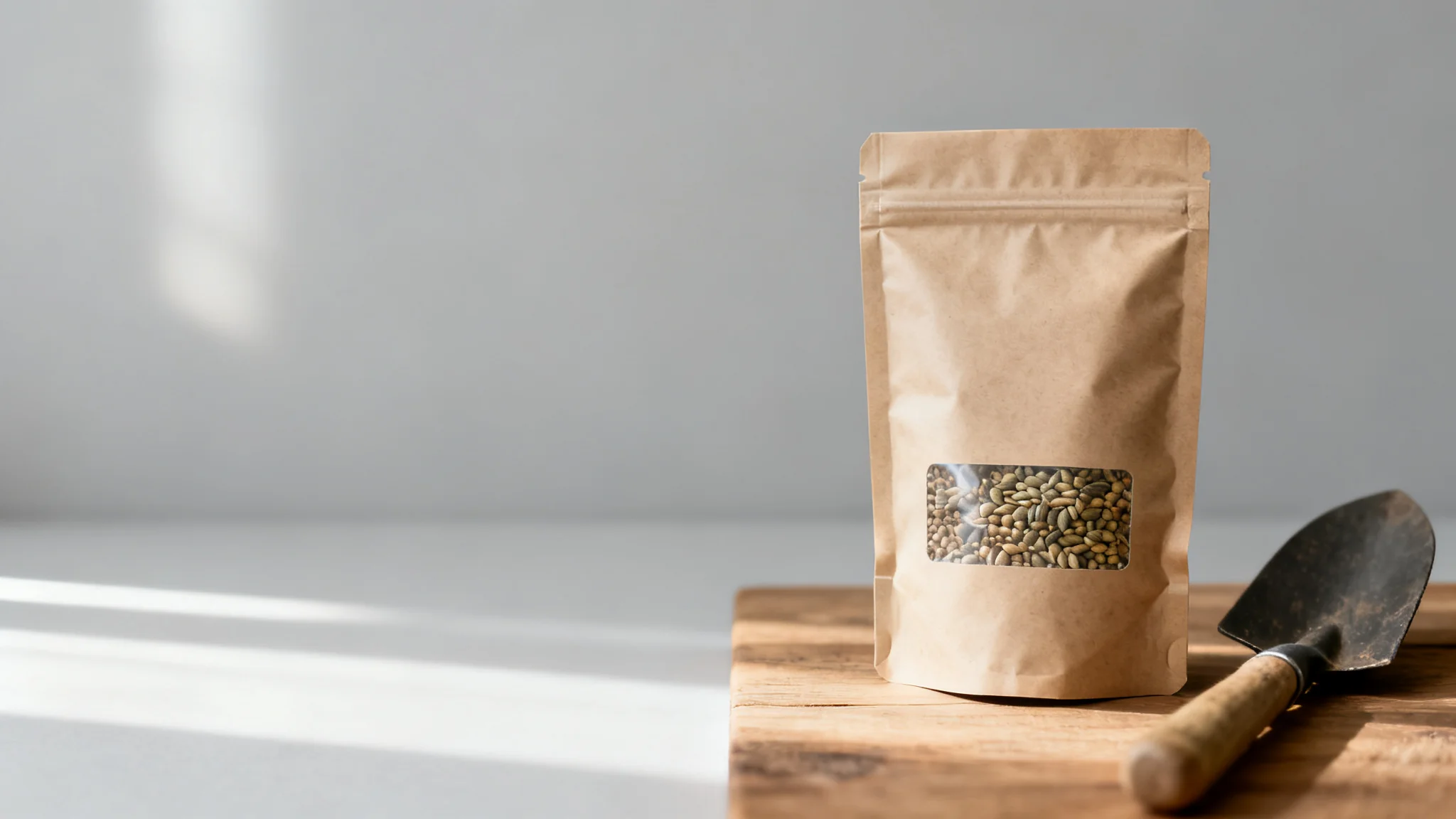
A clear window pouch is not a small hole in a barrier — it is an area-weighted average of two very different films, and the arithmetic is unforgiving. A 250 g stand-up pouch with a 15% window in a metallised body goes from 0.5 to 12.4 cc/m²/day total OTR, a 25-fold increase in oxygen ingress, and it does so while looking like a minor design change. This page gives the formula, the numbers at 10–25% window area, and the placement rules that keep a window from becoming the weak point of an otherwise sound structure.
Quick answers:
- How much does a window reduce shelf life? At 15% window area in a metallised pouch, total OTR rises 25×; a 12-month claim usually becomes 6–9 months.
- What is the maximum window size? 10–20% of the front panel. Above 25% the barrier penalty grows faster than the merchandising benefit.
- How far should a window sit from a seal? At least 8–10 mm of printed film between the window edge and any seal or zipper line.
A window is an area-weighted average, not a hole
The rule is simple and worth writing down, because it turns a design argument into a calculation:
OTR_total = (A_barrier × OTR_barrier + A_window × OTR_window) ÷ (A_barrier + A_window)
The same equation applies to moisture, with MVTR substituted for OTR. What makes it counter-intuitive is the ratio between the two numbers: a metallised barrier runs below 0.5 cc/m²/day while the clear window film runs 80–120. The window is not 20% worse — it is 200 times worse per unit area, so even a small window dominates the total.
| Window area (250 g pouch, 700 cm²) | Body OTR | Window OTR | Total OTR | Multiple of opaque |
|---|---|---|---|---|
| 0% | 0.5 | — | 0.5 cc/m²/day | 1× |
| 10% | 0.5 | 80 | 8.5 | 17× |
| 15% | 0.5 | 80 | 12.4 | 25× |
| 20% | 0.5 | 80 | 16.4 | 33× |
| 25% | 0.5 | 80 | 20.4 | 41× |
Read the 10% row twice. A window covering only a tenth of the pouch already raises total OTR seventeen-fold. The reason is arithmetic, not physics: 70 cm² of film at 80 cc/m²/day contributes 5,600 units of transmission, against 315 units from the 630 cm² of barrier body.
What a 15% window does to a 12-month claim
The absolute ingress matters more than the rate. On a 700 cm² pouch, 12.4 cc/m²/day means about 0.87 cc of oxygen per day entering the pack, against 0.035 cc/day for the same pouch with no window. Over 12 months that is roughly 317 cc against 13 cc — and 317 cc is enough to take a high-fat product through rancidity well before the printed date.
| Product | Window share | Practical claim | Why |
|---|---|---|---|
| Granola, 3-month rotation | 15% | 3 months, unchanged | Low fat, fast turn, margin is ample |
| Freeze-dried fruit | 20% | 6–9 months | Low fat, appearance-driven purchase |
| Pet treats, visible chunks | 15–20% | 6 months | Fat content decides, not the window |
| Nuts, 12-month target | 0% | 12 months | High fat; 317 cc breaks the claim |
| Coffee, whole bean | 0% + valve | 12 months | Aroma and light dominate |
| Colourful pasta | 20% | 9 months | Low fat, colour is the claim |
The pattern is that fat content, not window size, decides whether a window is viable. A 20% window on freeze-dried fruit is a good decision; a 10% window on walnuts is not, even though the second window is half the size.
Light is the overlooked variable
Gas transmission gets measured; light usually does not. Visible and UV light drive photooxidation of fats and pigments, and a clear panel is transparent across the whole visible band.
| Structure | Visible light transmission | Oxygen ingress | What light does |
|---|---|---|---|
| Foil laminate | 0% | below 0.1 | Nothing — light is fully blocked |
| Metallised PET | below 1% | 0.1–1 | Nothing measurable |
| Clear PET/PE window | 88–92% | 30–120 | Fades colour, oxidises surface fat |
| Clear high-barrier (SiOx, AlOx) | 85–90% | 1–2 | Same light problem, less oxygen |
The clear high-barrier row is the one brands underrate. An AlOx-coated film solves the oxygen number and does nothing about light, so a coffee bag with a “high-barrier” window still fades. Light testing is covered by ASTM G154 for UV exposure, and it is worth requesting when the product’s claim depends on colour.
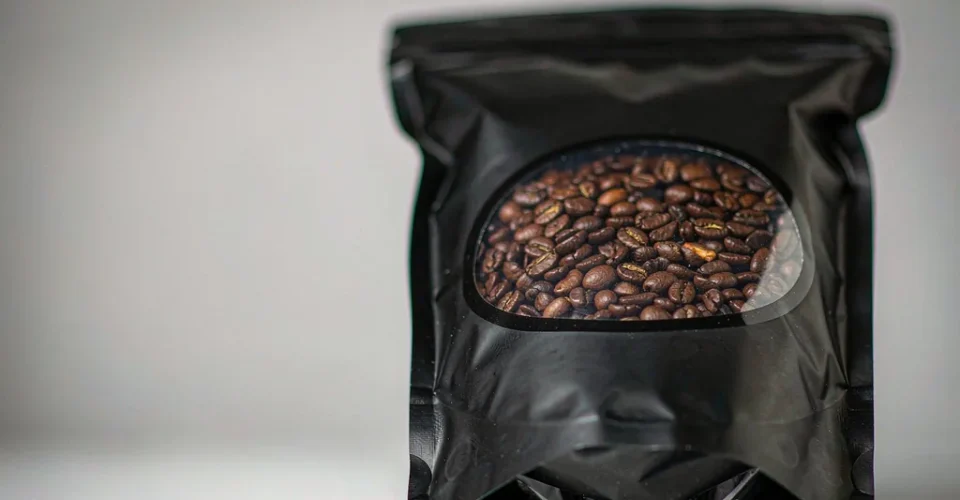
Roasted coffee is the clearest case: light exposure is one of the three drivers of staling alongside oxygen and moisture, which is why most specialty roasters either skip the window entirely, or place it on the back panel where it stays out of retail lighting.
Three rules for sizing and placing a window
| Rule | Value | Consequence of breaking it |
|---|---|---|
| Window area | 10–20% of front panel | Below 10% no shelf impact; above 25% barrier penalty outruns the benefit |
| Distance to seal | 8–10 mm printed film | Wrinkle-prone corners, leak path at the top seal |
| Corner geometry | Rounded, radius 5–8 mm | Stress concentration, pinhole at the drop test |
| Distance to zipper | 10 mm minimum | Track deformation and a leak beside the zipper |
The 8–10 mm rule is the one that most often gets broken by artwork. A designer working to the print bleed will place the window visually balanced and leave 4 mm to the seal, which is enough for the pouch to look right and not enough for the seal bar. The result is a wrinkle at the window corner that only appears after filling.
Placement matters as much as size. A window on the back panel keeps the front free for brand blocking while still letting a shopper inspect the product when they pick the bag up — which is why premium pet treat packs commonly window the back, not the front.
Window or opaque: the decision table
| Your situation | Better choice | Reason |
|---|---|---|
| High-fat product, 9–12 month claim | Opaque, no window | Window takes the claim from 12 to 6 months |
| Colourful product, under 4-month rotation | Window at 10–20% | Visibility drives trial; margin is ample |
| Coffee, whole bean or ground | Opaque + one-way valve | Aroma and light dominate the purchase |
| Premium pet treats | Window at 15–20% on the back | Real chunks justify the price gap |
| Nuts or seeds, 12-month target | Opaque | Rancidity arrives before the date |
| Freeze-dried fruit | Window at 20% | Texture is the claim, fat is low |
| Anything with free oil on the surface | Opaque | Oil stains the clear panel within weeks |
The last row is a merchandising failure rather than a barrier one. A clear panel against an oily product shows staining long before the product is actually spoiled, and the consumer reads the stain as spoilage.
Recyclable mono-PE with a window
A mono-material PE pouch can be recyclable in PE collection streams, and adding a window usually does not change that, because the window film is drawn from the same PE family. What changes is the barrier: mono-PE already sits around 2,000–4,000 cc/m²/day OTR for a typical build, and a window does not make it meaningfully worse — it was never the barrier structure.
That reframes the decision. On a mono-PE pack the window is nearly free in barrier terms, and the shelf-life limit comes from the base structure rather than the window. On a foil or metallised pack the window is expensive in barrier terms and cheap in materials. The two cases should be evaluated separately, not with one rule.
Where to go next
- Foil and metallised barrier compared: high-barrier packaging material guide
- Structure index across 25 formats: custom pouch materials
- Stand-up pouch structures and sizing: stand-up pouch complete guide
- Recyclable mono-PE structures: mono-material recyclable packaging
- All structural data in one table: packaging facts
FAQ
Does a clear window reduce shelf life?
Yes, whenever the window replaces an opaque barrier layer. At 15% window area in a metallised pouch, total OTR rises from 0.5 to 12.4 cc/m²/day — about 25 times more oxygen ingress. For low-fat, fast-turn products the loss is negligible; for high-fat or long-shelf-life products it has to be engineered for.
Can a window be high-barrier without foil?
Partly. Clear high-barrier films — transparent EVOH laminates, SiOx- or AlOx-coated PET — reach OTR of about 1–2 cc/m²/day while staying see-through. They cost more than standard clear PET/PE and less than abandoning the window, but they do not block light, so a colour-critical product still fades.
Where should the window be placed on a stand-up pouch?
On the back panel or the lower front, at least 8–10 mm from every seal edge and 10 mm from the zipper line, with rounded corners at 5–8 mm radius. Corners are where drop stress concentrates, and a sharp corner is the most common origin of a pinhole in a windowed bag.
Are window pouches still food-safe?
Yes. The window uses the same food-contact sealant layer as the rest of the bag interior, so compliance with FDA, EU 10/2011 or GB 4806 is unchanged. Only barrier and light-blocking performance differ from the opaque area.
How big should a clear window be?
Between 10% and 20% of the front panel for most products. Below 10% the visibility gain is lost at shelf distance; above 25% the gas and light ingress rises faster than the merchandising benefit, and the shelf-life claim usually has to be rewritten.
Can I add a window to a recyclable mono-material pouch?
Usually yes, because the window film comes from the same PE or PP family as the body. The barrier barely changes, since mono-PE was never a high-barrier structure — but confirm the finished structure’s total transmission with your supplier, because the sealant layer is often the weakest link in the stack.