Registration drift on film rarely starts at the print cylinder. It starts where the web is stretched: at the unwind brake, inside a dryer, or across a film whose gauge is not uniform. The register mark is the symptom; the web path is usually the cause. Buyers who understand that split can tell a real corrective action from a polite explanation.
This matters beyond the press room. The answer a converter gives decides what gets changed — the film, the drying profile, the tension setpoints or the plates. If the drift is blamed on artwork, nothing moves. If it is traced to a gauge band or a tension zone, the run changes and the plates stay usable.
Key Takeaways
- Registration drift is a length change between print stations, so any factor that stretches or shrinks the web can produce it.
- Tension should be written per unit width, not as a single machine figure, because the same brake force means different elongation on different films.
- A drift that appears only at high speed usually points to tension dynamics or drying, not to a worn plate cylinder.
- Ask for the first-hour record sheet; a drifting job leaves evidence in tension setpoints and automatic register correction values.
Registration drift patterns on a running web
Three patterns cover most cases. A slow walk means the error grows steadily over hundreds of metres and keeps growing in one direction. A step change means the register jumps once and then holds. A single-colour offset means one station is out while its neighbours stay true.
The pattern narrows the cause faster than any instrument. A walk points to creep, progressive drying or a roll that is unwinding into a different tension; a step points to a splice, a roll change or a cylinder that has shifted; a single-colour offset points to that station, its plate, its impression setting or its own register mark.
Why does tension change the register?
Registration is a length comparison. Station one prints a mark, station two prints over it, and the distance between the two impressions must stay fixed. That distance is a length of film, and a length of film changes when the tension pulling it changes.
Elongation under tension depends on the film’s modulus and its thickness, so the useful number is tension per unit width rather than total force. A 300 mm web and a 1,200 mm web need very different brake forces to reach the same elongation. When a job moves to a narrower web and the machine keeps the old force, the web becomes over-tensioned and stretches; the register then walks as the roll diameter falls and the tension drifts with it.
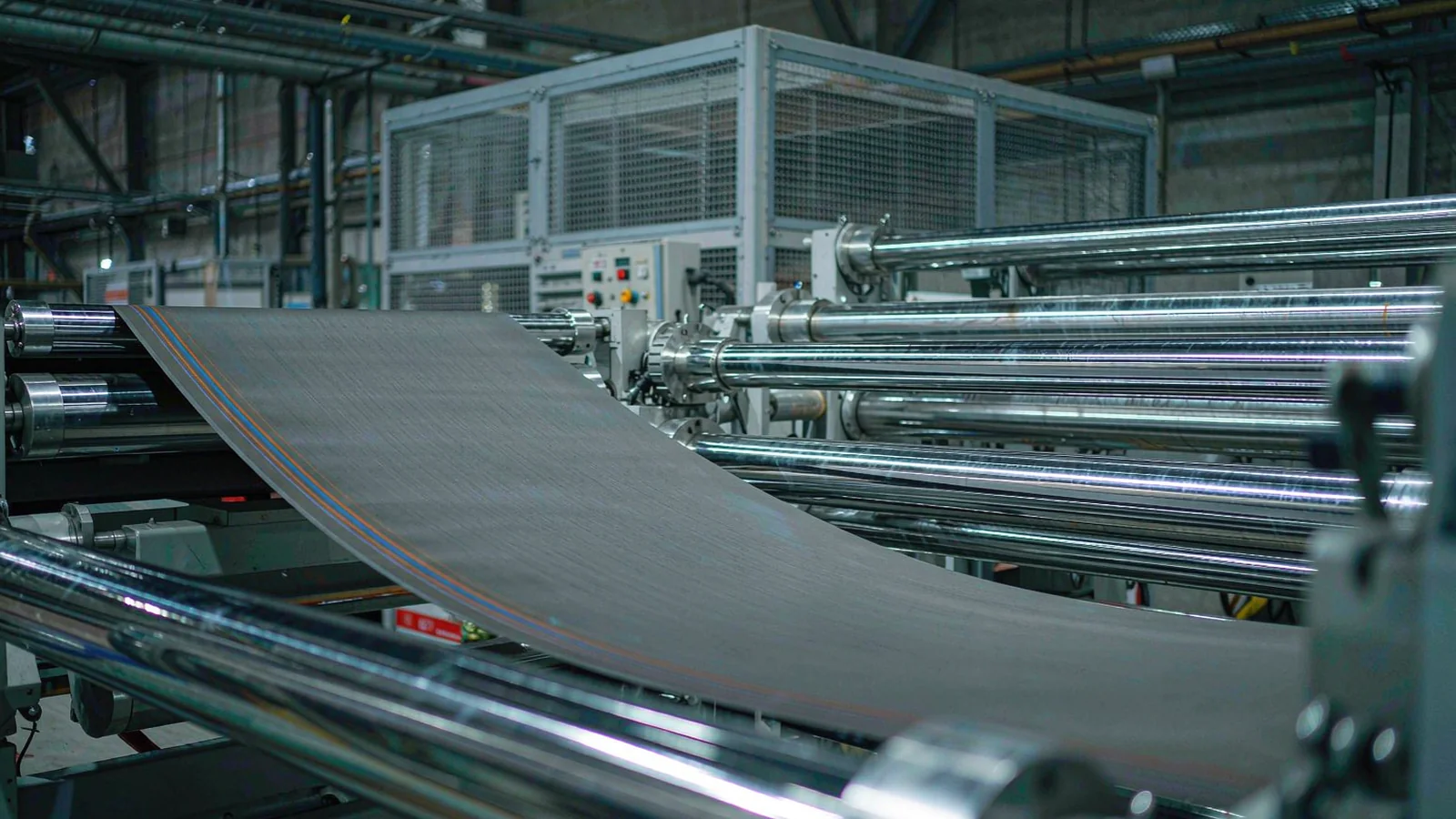
Concept illustration for editorial use, not a customer project.
How film behaves differently from paper
Paper reacts to moisture; film reacts to heat and to time under load. A film that is pulled tight through a dryer relaxes as it warms, so it arrives at the next station slightly longer than it left. Some of that relaxation is recovered later, which is why a drift can appear to cure itself at low speed and return when the press is ramped up.
Film also creeps. Held at a constant tension, a polyethylene web keeps extending for a while before it settles, which is one reason the first hundred metres of a run behave differently from the rest of the roll. A converter who quotes a register figure from the first few metres is quoting the easiest part of the job.
Which print unit shows the drift first?
Usually the station farthest along the web path from the reference mark, because it accumulates every length change that happened before it. In a press with a long dryer between the first and second units, that is often station three or four rather than the last one.
There is a second case worth knowing: the station that carries the register mark itself. If the mark is printed at a unit whose tension is unstable, every later station is chasing a moving target, and the operator ends up correcting colours that were never at fault. Moving the mark to a more stable station is a plate change, which is why it is rarely offered after the artwork is approved.
Print order and the error budget
Every pass through a dryer is a heat cycle, and each cycle changes the web length a little. A job that lays a heavy white down first and then four colours on top of it runs the later colours on a web that has already been heated four times. Reverse the order and the same artwork can behave differently, which is why the print sequence belongs in the discussion, before the plate file is signed off.
Ink coverage matters as well. A full-bleed panel removes more solvent through the dryer than a small logo, and the energy that goes into evaporating it is energy the web also absorbs. This is the practical reason a job that ran clean as a sample can drift in production: the sample often had a lighter coverage than the saleable print.
What should be recorded in the first hour of a run?
Ask for five items: tension setpoints for unwind, infeed and rewind, together with any taper; web temperature or dryer settings per zone; register readings per station at set intervals; the roll or batch identification; and the automatic register correction values if the press has them. A splice event should be noted with its position.
The correction values are the most useful and the least often shared. Modern presses log how far the system has moved each station to hold register. A steadily rising correction trend means the system is compensating for something the operator cannot see, and it will eventually run out of adjustment. That trend is the earliest warning a buyer can get short of standing at the press.
Which corrections hold, and which only hide the drift?
Corrections that hold change the web’s behaviour: resetting tension per unit width from the film supplier’s data, pre-conditioning rolls in the press room instead of moving them from a cold store straight to the unwind, trimming the dryer profile, or tightening the gauge specification on the next order. These act on the cause and survive a speed change.
Corrections that hide it keep the register inside tolerance for the length of the run without changing anything: continuous manual offset, running the press slower than the job is quoted at, or over-tensioning to pull a wavy web flat. All three consume the machine’s adjustment range, and the job returns to trouble the next time speed or film changes. See the flexible packaging solutions overview for how print requirements vary by product type, and the packaging printing services page for what is normally confirmed at approval.
For the grade of film that makes this easier to control, the rollstock film range sets out what can be specified on gauge and winding. The FTA’s FIRST specification is a useful reference for how flexographic print tolerances, including register, are defined and measured, which is the language to use when a tolerance is argued. When the problem is misalignment on the filling line rather than on the press, the cause is different and is covered in printing problems on automatic packaging lines.
Where It Applies, and Where It Does Not
This applies to web-fed printing on flexible film: gravure and flexo on polyethylene, polypropylene, polyester and their laminates, including surface-printed and reverse-printed work. It also applies to coating and lamination lines where a printed web is registered to a pattern.
It does not explain registration on sheet-fed offset, label presses or shrink-sleeve gravure, where the substrate path and the handling are different. It also does not cover misalignment that happens after printing, in a form-fill-seal machine, where the film path, the eye-mark reader and the sealing jaws are the variables rather than the press.
Conclusion
Treat registration drift as a length problem and ask which length changed. Tension per unit width, dryer heat cycles and gauge uniformity account for most of it, and the print order decides how much of each the web collects before the last station. Buyers get better answers by asking for the first-hour record and the automatic correction trend than by asking for a guarantee, because the record shows if the cause was addressed or only compensated.
Frequently Asked Questions
Is registration drift a printing problem or a film problem?
Usually both, and the film sets the window. A film with uniform gauge and consistent winding gives the press something stable to control; a film with gauge bands or a soft roll removes that stability before the first cylinder is engaged. Start by running the same job on a different roll from the same batch: if the drift disappears, ask about the film, and if it stays, look at the press.
Why does drift appear only when the press speeds up?
Because speed changes the time the web spends under tension and inside the dryer. At higher speed the tension control loop has less time to correct a disturbance, and the heat history per metre changes as dryer settings are pushed to keep the ink dry. Neither effect shows up at the speed used for setting up, so a job that passes at low speed can still fail the production run.
How tight a register tolerance should be written into the approval?
Tight enough to protect the design, loose enough that the press can hold it across a full run rather than only at the start. Ask the converter for the register capability demonstrated on the same press, film and artwork, then set the acceptance figure from that evidence. A tolerance copied from another job on a different substrate is the most common reason two parties disagree at goods-in.
Does automatic register control remove the need to monitor drift?
No. Automatic control holds the printed result inside tolerance, but it does so by moving plates and rollers, and the amount of movement is a measurement of how much the web is changing. Monitoring the correction trend tells you when the system is near its limit. Ignoring it means the first sign of trouble is a run that can no longer be corrected.