
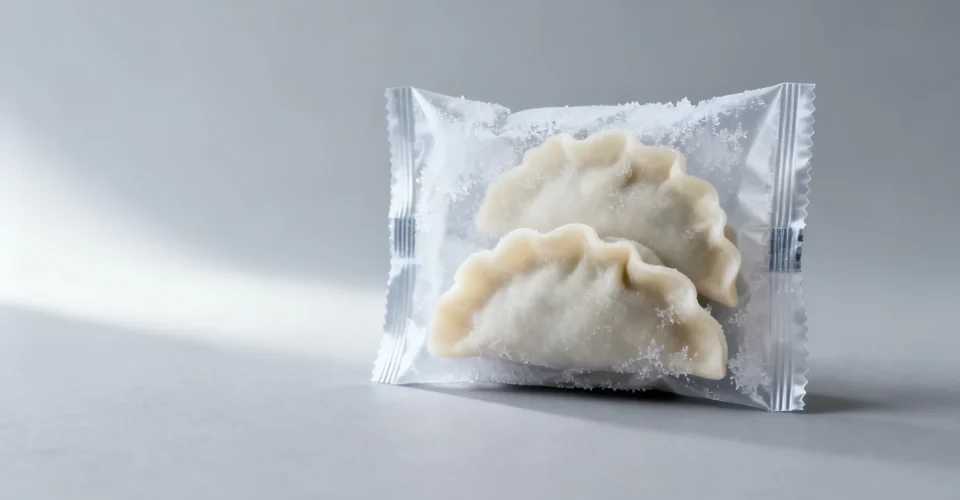
Frozen dumpling packaging usually fails at the seal, not across the film. A dumpling is dense, irregular and frozen hard, with a folded edge that behaves like a small blade once the pouch is vibrated, dropped or stacked. Movement inside the bag abrades the inner seal and pushes filling, flour or oil into the seal channel. The practical answer is a pouch that limits product movement, keeps the seal zone clean and still holds strength at freezer temperature, rather than a film that only looks tougher on a data sheet.
What actually damages frozen dumpling packaging during transit?
Damage rarely comes from one hard hit. It accumulates. Vibration on a truck causes an enormous number of small contacts between dumpling edges and the inner film, and that is what thins a seal or rounds off a corner before anything visible happens.
The weakest location is usually the seal edge and the strip of film beside it. The material is thinner there after heat sealing and sits under residual stress from the jaw. Filling caught in that channel creates a leak path long before the carton is dropped.
Scope and boundaries of this guide
This covers frozen dumplings, wontons and similar frozen filled products packed in flexible pouches or rollstock at industrial filling speeds. It does not cover rigid trays, skin packs or modified-atmosphere trays, and it does not replace a line trial. Every material direction below is a candidate to test against your own product, filler and cold chain.
Key Takeaways
- The seal edge, not the pouch face, is the failure point for most frozen dumpling complaints.
- Controlling product movement inside the pouch does more for seal survival than upgrading film thickness.
- A clean seal zone is a line discipline, not a purchasing decision.
- Test seal strength and leak resistance at freezer temperature, because room-temperature results hide cold brittleness.
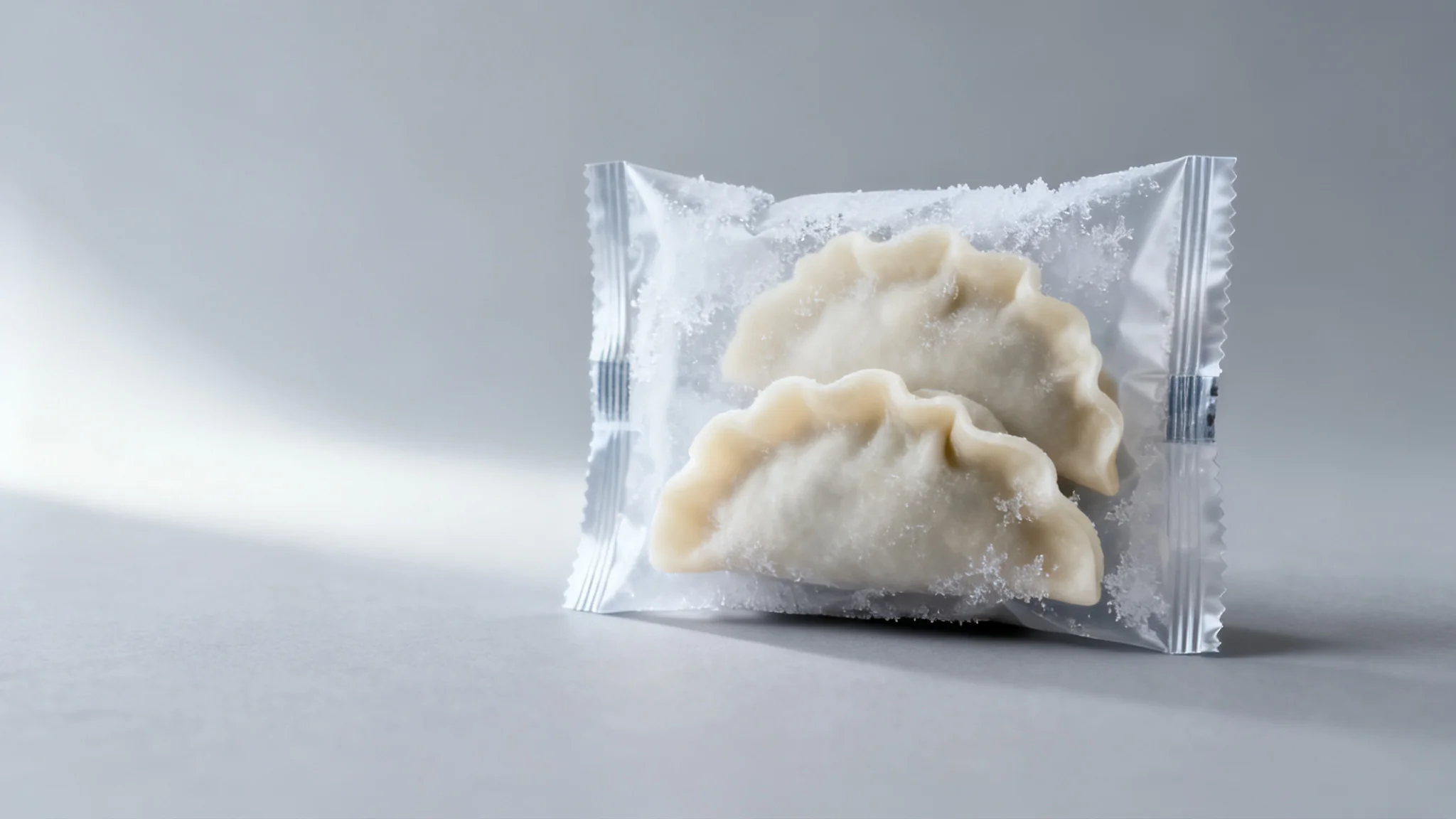
Concept packaging visual generated for editorial use. Not a customer project, not a tested structure.
Which pouch format fits your filling line?
The format decision is normally settled by the filling line and the retail pack, not the other way round. Three common directions behave differently on the same product.
- Premade stand-up pouch: good shelf presence and a stable base for stacking, but top-loading leaves the seal area exposed to product at higher fill rates.
- Three-side seal or flat pouch: simple geometry and fast on a premade pouch filler, with the trade-off that a dense dumpling can settle onto the bottom seal.
- Rollstock on a form-fill-seal line: lowest cost per pack at volume and the most control over seal width, provided the film runs cleanly at your line speed and sealing window.
Ask the filler supplier which format the machine was commissioned for. Retrofitting a heavy frozen product onto a machine built for light snacks is where most seal defects begin.
Why dumpling fill reaches the seal — and how to reduce it
Filling, flour dust and moisture reach the seal channel through three routes: splash during the drop, dust carried on static, and product resting on the seal jaw when the pouch is presented. None of these are film problems, and none are solved by a thicker laminate.
Practical countermeasures are mechanical. A wider seal bar with a shorter dwell can push a small amount of flour aside, a vibratory settling step after filling lets product drop clear of the seal, and a short air knife before sealing keeps the channel clean. Where a product is greasy, a slight increase in headspace and a settling pause usually reduces channel contamination more than a change of film.
Film directions worth trialing for frozen dumplings
Work from the failure mode backwards. If the complaint is seal creep in the freezer, the sealant layer and its sealing window matter most. If the complaint is puncturing at the dumpling fold, the outer or core layer needs more toughness. If the complaint is freezer burn or surface drying on the dumpling skin, the moisture barrier deserves attention.
Common candidate directions include laminates with a tough nylon or cast-polypropylene core for puncture resistance, and sealant layers selected for a wide sealing window rather than peak strength on one setting. These are starting points to trial, not recommendations, because cold performance depends on the exact resin, thickness and your sealing equipment.
How should seal integrity be tested before scaling up?
Test the seal as its own component, at temperature, and in the state the consumer receives it. A workable sequence is:
- Seal a trial run at the low, middle and high ends of the machine’s sealing window.
- Condition the samples in the freezer for the storage period you actually need before testing.
- Pull seals to the ASTM F88/F88M seal strength method and record failure mode, not just force.
- Run a leak check on filled, frozen packs rather than empty film.
- Put a carton through a distribution cycle such as ASTM D4169 to see how the whole pack behaves in transport.
Failure mode is the useful output. A seal that peels cleanly, a seal that tears the film beside it and a seal that fails at the sealant-to-core bond point to three different fixes.
Does cold-chain handling change the pouch you should choose?
Yes, and mostly through brittleness rather than barrier. Many sealants lose flexibility as temperature falls, so a pouch that survives a drop at ambient can crack at the fold after a night in a chest freezer or on a frozen shelf.
This is why freezer testing belongs in the qualification, not in after-sales. Ask for samples conditioned at the lowest temperature in your actual cold chain, then handle them the way a consumer would, including a short drop and a hand squeeze. Where a product is distributed through home delivery with dry ice, note that the pouch may see colder conditions in transit than in the store.
Specification mistakes to avoid
Three mistakes show up again and again. The first is choosing a pouch from a catalogue photo without checking the filling line. The second is writing a seal-strength target without a test temperature, which makes the number meaningless. The third is treating a leaking pack as a film problem when the cause sits in the filling room.
Conclusion
For frozen dumplings, start from the seal and the product movement around it. Match the pouch format to the filling line, keep the seal channel clean, and choose film directions that hold up at freezer temperature rather than on a flat table. Then confirm the whole pack through freezer-conditioned seal tests and a distribution cycle before committing to a large order. If you want to compare structured options for this product family, review the frozen food packaging solutions overview and the relevant frozen food packaging category, and read the companion notes on flex cracking and seal behaviour in freezer handling plus low-temperature packaging materials.
Frequently Asked Questions
Why does a frozen dumpling pouch usually fail at the seal rather than the film?
In frozen dumpling packaging, most failures begin at the seal: that is where the film is thinned by the jaw and where filling, flour or oil can sit. Vibration then works the weakened edge until it leaks. The film face is usually thicker and more uniform, so it survives contact that the seal does not. Check the seal channel first: if you can see product trapped in the sealed area, fix the filling and settling step before changing the laminate.
Does a dumpling pouch need a high-barrier film?
Not always. Barrier matters most when the complaint is freezer burn, surface drying or a change in texture over a long frozen shelf life. Where the product is protected by a tight fold and sold quickly, a moderate barrier may be enough, and the money is better spent on seal consistency and puncture resistance. Decide from your actual shelf life target and the failure you are seeing, not from a general preference for thicker structures.
How do I check seal integrity without running a full transit test?
You can catch most problems with a small, disciplined test. Seal at three points across the machine window, freeze the samples, then pull the seals and record where each one fails. Add a leak check on filled packs. This combination exposes a cold sealant that cracks, a channel contaminated by filling and a sealing window that is too narrow. It will not replace a distribution test, but it costs little and removes most seal defects before a large order is placed.
What should I prepare before asking for a frozen dumpling pouch quote?
Send the details that decide the structure. Useful items include dumpling size and weight, filling type and fat or moisture level, the filling machine and its speed, the pouch format you want, your freezer and storage conditions, and the failures you are trying to avoid. Photos of a failed pack help more than a description. With those inputs a supplier can propose a few film directions to trial instead of guessing, but the final choice still depends on your line trial.



