A seed packaging pouch has to protect a living product, which is why it behaves nothing like a food bag. Seeds stay viable inside a narrow moisture window, they are eaten by insects that can bore through thin film, and they must survive handling in warehouses and mail-order parcels before a grower ever opens the bag. This guide covers what a seed packaging pouch has to hold back, which pack formats suit retail and bulk seed trade, and how to test a pouch before committing to a print run.
Why Does Moisture Matter More for Seeds Than for Food?
Seeds are hygroscopic: they equilibrate with the water vapor around them. Expose a seed packaging pouch to humid air and the seed moisture content climbs until it matches the environment, and once it climbs, two things happen at the same time. Respiration accelerates, consuming stored energy the seedling will need at germination, and the risk of fungal growth rises. Both effects accumulate quietly and only show up months later as a germination test that misses its certification threshold.
The counterintuitive part is that dryness has a floor as well. Seed stored below roughly five percent moisture can suffer internal damage, particularly in large-seeded legumes and in seed that is chilled afterwards, so the goal is a controlled band rather than “as dry as possible.” A well-specified seed packaging pouch holds the seed inside that band instead of chasing the lowest number on a data sheet.
Temperature interacts with all of this. Every ten degrees of storage temperature roughly halves the rate at which seed deteriorates, which means a pouch that performs acceptably in a temperate warehouse can fail in a hot, humid distribution lane. Barrier selection is therefore a question about the actual route to the customer, not about a generic humidity figure.
How Moisture Moves Through a Sealed Pouch
Vapor does not respect the printed claims on a bag. It enters through three routes at once: the film body, the seal lines, and any interruption such as a window edge or a valve. On a flat panel the film dominates; on a finished pouch the seals and edges account for a disproportionate share of total transmission, because the sealing layer is thinner than the body laminate and the heat-and-pressure process can thin it further at the corners.
This is why barrier data measured on flat film routinely overstates the performance of a finished pack. A film that reports a low transmission rate can still produce a seed packaging pouch that gains moisture faster than expected, simply because the back seal was run at the wrong temperature for the line speed. Our guide to moisture-resistant pouch specification walks through the same review sequence for other moisture-sensitive products.
The Four Failure Modes That Matter
Four failure modes account for most complaints in this category, and they rarely appear alone:
- Water vapor ingress through the film body, the back seal and any window cut into the front panel.
- Insect penetration, from beetles and weevils that chew through thin film, or from larvae already present in the seed lot.
- Puncture and abrasion, especially where pouches rub against each other in a carton or move through parcel sorting equipment.
- Odour and chemical transfer, where printing solvents or an incompatible sealing layer leave a residue that reduces germination.
Each failure has a different fix, and the fixes conflict. Adding a clear window helps a gardener judge the seed, but the window is usually the weakest barrier point in the pack. Thickening the film improves puncture resistance while making the pouch stiffer and more expensive to print. Getting the seed packaging pouch right means deciding which of these four risks dominates your product, and accepting a trade-off on the rest.
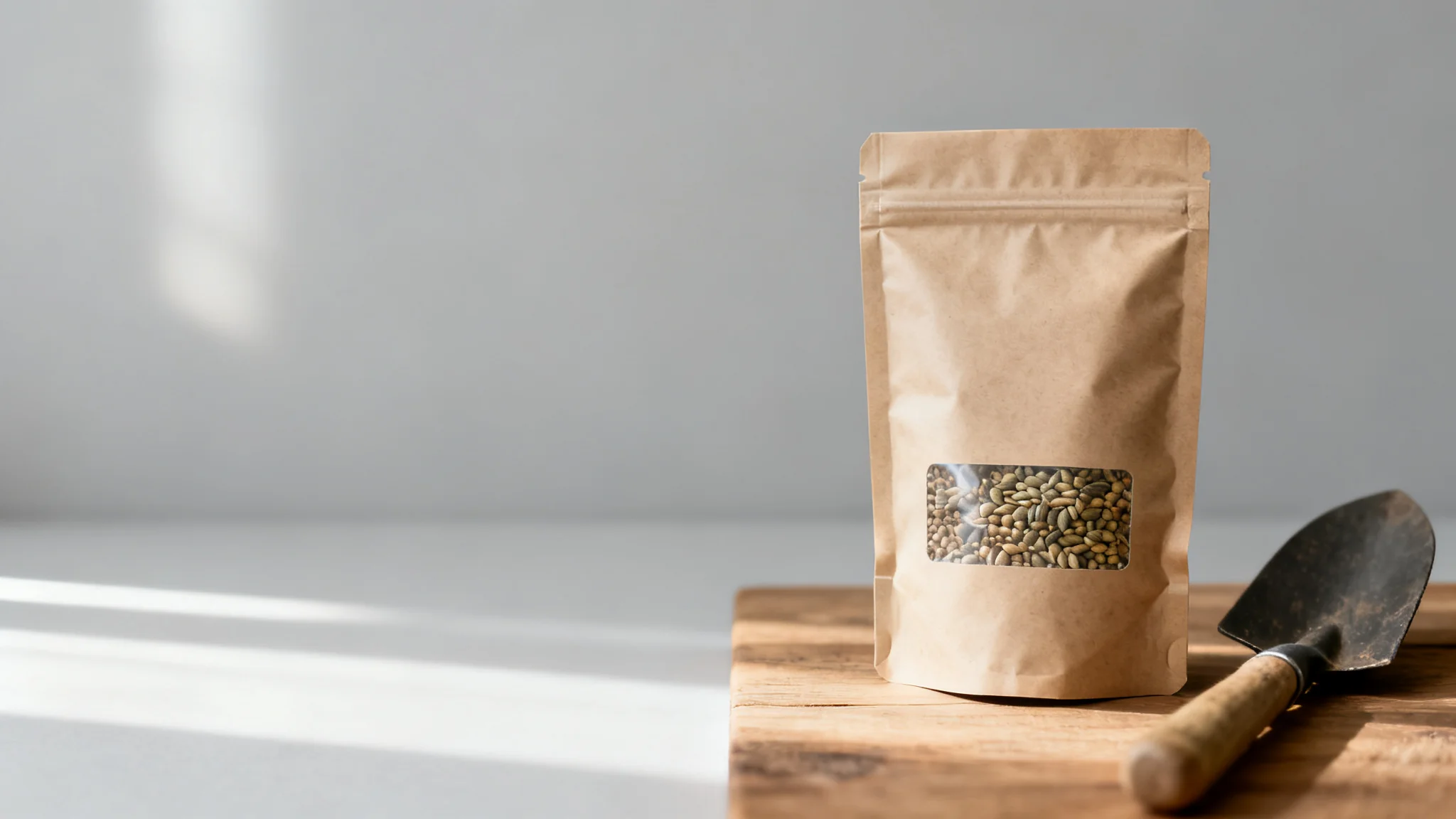
Concept packaging visual generated for editorial use. Not a customer project, not a tested structure.
Which Film Structure Suits Which Seed?
Three families cover most of this category. Metallized polyester laminates offer a good balance of moisture barrier, light blocking and cost, and they are the default for vegetable and flower seed sold through garden retail. Aluminium foil laminates push water vapor transmission far lower and are the usual choice for high-value genetics, breeder stock and seed held for more than one season. All-plastic structures without metallization are the weakest on moisture but the easiest to recycle and the cheapest, and they fit short-cycle products sold into markets where the pouch is opened within weeks.
Water vapor transmission is measured with methods such as ASTM F1249, and a film’s moisture barrier only becomes meaningful in a seed packaging pouch when it is measured at the temperature and humidity your seed actually meets. Ask suppliers for transmission data at a stated condition and treat a bare number without a test condition as marketing rather than a specification.
Clear Windows: The Barrier Cost of Showing the Seed
A window sells seed. Shoppers want to see size, colour and cleanliness before they buy, and a printed sow-by date on an opaque pouch does less work than a glimpse of the seed itself. The engineering problem is that the window material is chosen for transparency, not for barrier, and every square centimetre of window raises the vapor transmission of the whole pack.
The practical compromise is a small window backed by a metallized or coated transparent film, placed on the front panel where it is least exposed to folding and abrasion. A pouch with a window that covers a third of the face is a marketing decision with a shelf-life consequence, which is why the window area belongs in the specification alongside the laminate. Our note on what a clear window costs in barrier sets out the arithmetic for food packs, and the same logic applies here.
How Should Retail Packs Differ From Bulk Seed Packs?
Retail and bulk seed trade pull in opposite directions. A retail seed packaging pouch is a small unit, often between a few grams and a few hundred grams, and it is judged on shelf presence, resealability and the clarity of the growing instructions. Its barrier requirement is real but its exposure time is short, because the pack is designed to be sold and sown within a season.
Bulk seed moves in 5 to 25 kilogram units, frequently in multi-wall paper sacks or woven polypropylene bags with a separate liner. Here the seed packaging pouch logic shifts to the liner: a metallized or foil liner inside a structural outer bag gives barrier where it is needed and mechanical strength where it is needed, and the two layers can be specified independently. Sowing-rate accuracy, stack stability and pallet efficiency matter more than shelf appeal, because the buyer is a distributor or a cooperative, not a shopper.
Between those two ends sit the intermediate formats — 1 to 5 kilogram pouches for farm-saved seed exchange, treatment-ready lots and trial packets. These often use a stand-up or flat-bottom structure with a heavy-gauge seal, and they are the segment where a seed packaging pouch specification is hardest to standardise, because the same product can be sold in three sizes to three different customers. Formats borrowed from grain trade, such as the four-side-sealed handheld grain pouch, usually need a stronger seal and a firmer film before they can carry seed.
How Do You Test a Seed Packaging Pouch Before Ordering?
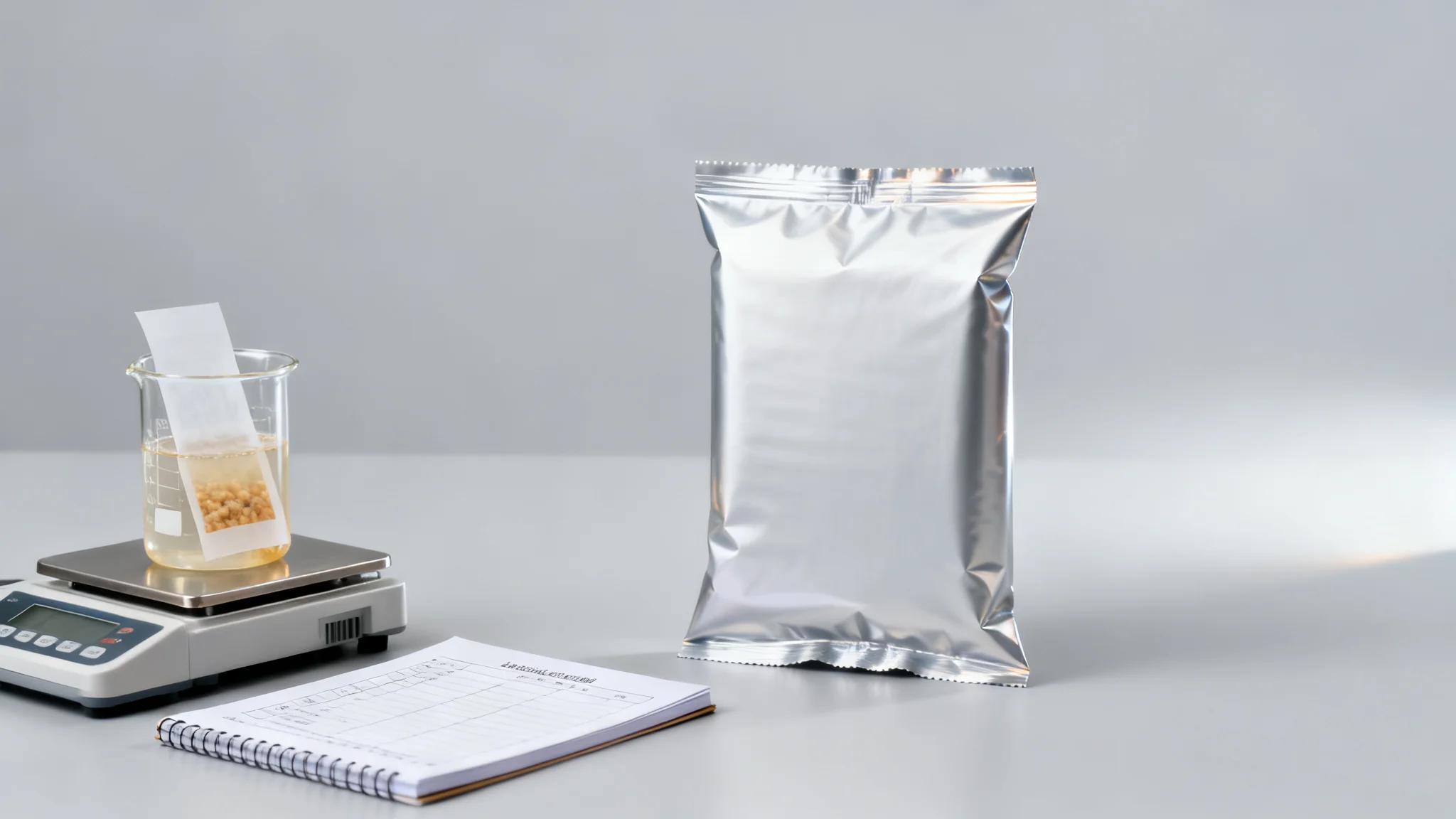
Testing splits into pack performance and seed performance, and both are needed. On the pack side, ask for water vapor transmission data at your storage condition, seal strength values, and a drop or compression test result at the filled weight you will actually ship. On the seed side, fill real pouches with real seed, store them under conditions that match your worst distribution lane, and test germination at intervals against the standard your certification body applies. Seed testing laboratories work to methods published by bodies such as ISTA technical committees, and aligning your internal trial with those methods makes the result comparable with a certification test rather than a private experiment.
A common mistake is to test a laminate coupon and stop there. Folds, back seals, window edges and gussets all change the effective barrier of a finished seed packaging pouch, so the only meaningful sample is a filled, sealed, printed pouch taken from a production run.
Scope: Where This Applies and Where It Does Not
This applies to agricultural and horticultural seed sold as dry, cleaned and usually treated lots: vegetable, flower, cereal, forage and cover-crop seed in retail packets, farm-scale pouches and bulk liners. It applies less directly to seed that is sold wet, such as some aquatic and tropical species, where the pack has to retain moisture instead of exclude it, and to live plant material such as tubers and cuttings, which need ventilation rather than a barrier.
It also does not replace the treatment decision. A fungicide or insecticide seed treatment changes the compatibility question entirely, because the treatment chemistry sits against the sealing layer for the whole storage period. If the seed is treated, the seed packaging pouch specification should start from the treatment’s solvent and pH profile rather than from a generic barrier table.
What Belongs in a Pouch Order Specification?
Bring these details to a supplier and the quotation becomes comparable:
- Seed type, lot size and the germination standard you must meet.
- Target shelf life and the temperature and humidity of your worst storage lane.
- Pack weight or volume, and if the pack will be resealed after opening.
- Window requirement, and how much of the panel it may cover.
- Print method, artwork readiness and expected annual volume by size.
A seed packaging pouch quotation that lists only a price per thousand without a laminate code, a transmission figure and a seal specification is not comparable with anything. Agricultural formats share tooling and film with other produce packs, and our overview of agricultural produce packaging shows how much of the structure can be reused across categories.
Key Takeaways
- Seed needs a moisture band, not maximum dryness; both too wet and too dry reduce germination.
- Insect penetration and puncture are as important as moisture in a seed packaging pouch specification.
- A clear window is a barrier decision, not just a design choice.
- Retail packets and bulk liners should be specified separately, often with different laminate logic.
- Test filled, sealed pouches under your real storage conditions before committing to volume.
Conclusion
A seed packaging pouch is a shelf-life device for a living product, and the specification should follow the seed rather than the film catalogue. Decide which risk dominates — moisture, insects, puncture or chemical transfer — then pick a laminate and a window area that answer it, and confirm the choice on filled pouches aged under your own distribution conditions. Get the transmission data with its test condition attached, and treat retail packets and bulk liners as two separate projects.
Frequently Asked Questions
Does a seed packaging pouch need to be completely moisture proof?
No, and trying to reach zero is the wrong goal. Seed has an optimum moisture band, roughly between five and eight percent for many agronomic species, and pushing below the lower edge damages the embryo, especially if the seed is later chilled. What a seed packaging pouch should do is hold the seed inside that band through storage, which means controlling the rate of vapor movement rather than blocking it outright. Specifying a barrier that maintains the band is cheaper and safer than specifying the lowest transmission figure available.
Can insects get into a sealed seed packaging pouch?
Yes, through the film itself if it is thin enough and the species is strong-jawed. Beetles and weevils can chew small holes in low-gauge polyethylene, and larvae already in the lot will continue developing whatever the pack. A metallized or foil laminate with a tougher outer layer resists this far better than plain PE, but the barrier is not the only control; lot cleanliness before filling and temperature management in storage do as much work. Screen the laminate against your actual insect pressure instead of assuming a seal ends the problem.
What information should I give a supplier for a seed packaging pouch quote?
Five items make quotations comparable: seed type and lot size, the germination standard you must meet, target shelf life with your worst storage lane, pack weight and reseal requirement, plus any window requirement with the panel area it may cover. Add annual volume by size and your print method. Without the storage lane and the shelf-life target, suppliers are guessing at the laminate, and the price difference between quotes usually reflects that guess rather than a real cost gap.
Is a stand-up pouch or a flat pouch better for seed?
It depends on who opens the pack. A stand-up seed packaging pouch displays well on a garden-centre shelf and holds its shape when part of the contents are removed, which suits retail packets up to about a kilogram. A flat or three-side-seal pouch packs tighter, ships more efficiently in cartons and costs less per unit, which suits mail-order, trial packets and any product where shelf presence does not drive the sale. Many seed brands use both formats across one range rather than standardising on one.