
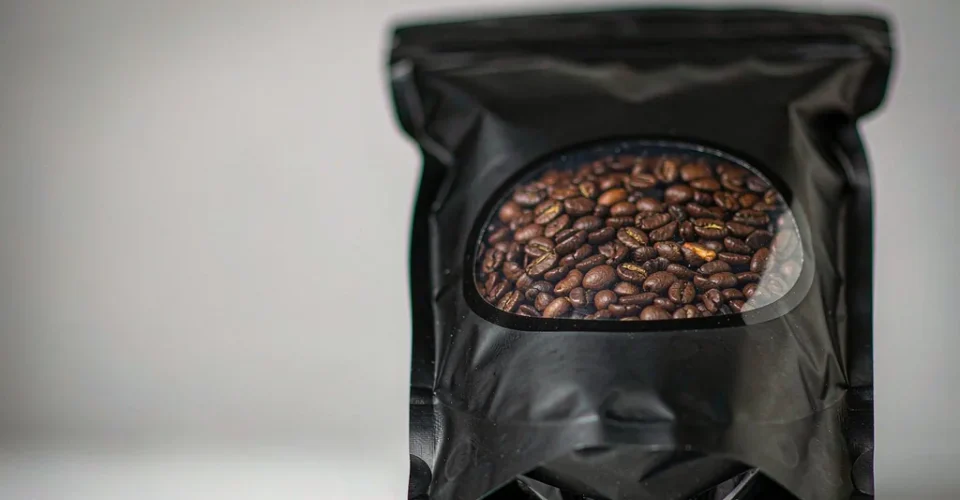
A clear window pouch shows the product through a transparent panel built into an otherwise opaque bag, and it is one of the fastest ways to lift shelf appeal for coffee, snacks, pet treats and granola. The trade-off is real: the window removes the opaque barrier layer exactly where the product faces outward, so oxygen ingress, moisture pickup and light exposure all rise with window area. The good news is that the effect is predictable, and brands that size the window to the product’s actual sensitivity get visibility without giving up shelf life.
What Is a Clear Window Pouch?
A clear window pouch is a flexible bag — usually a stand-up pouch or flat-bottom pouch — in which part of the front (and sometimes back) panel is left transparent while the rest is printed on opaque film. The window is created by leaving an unprinted, die-cut area in the opaque layer, or by laminating a clear film section into the structure. The product-facing sealant layer and the outer printable layer remain the same food-contact-compliant materials used elsewhere in the bag, so a window does not change what touches the food.
What changes is the barrier stack. In a fully opaque metallized or foil pouch, the aluminum layer blocks both light and most gas transmission across the entire surface. A window substitutes clear film for that layer over its whole area, and the total gas entering the pouch becomes roughly the area-weighted average of the barrier panel and the window panel. That simple area-weighting rule is what makes window decisions manageable: double the window area and you roughly double its contribution to total ingress.
How a Window Changes Oxygen and Moisture Barrier
The numbers make the point better than adjectives. A typical clear PET/PE laminate transmits on the order of 30–120 cc of oxygen per square meter per day, while a metallized PET structure measures well below 1 cc/m²/day under the same ASTM D3985 test method. Water vapor follows the same pattern: clear laminates commonly sit between 3 and 15 g/m²/day on the ASTM F1249 test, versus under 0.5 for foil-based structures.
| Structure (window area) | Typical OTR (cc/m²/day) | Typical WVTR (g/m²/day) | Light block |
|---|---|---|---|
| Foil laminate, no window | under 0.1 | under 0.1 | near 100% |
| Metallized PET, no window | 0.1–1 | 0.3–1 | 98%+ |
| Clear PET/PE (the window itself) | 30–120 | 3–15 | almost none |
Now apply the area rule. A pouch with a window covering about 15% of its surface has a total oxygen transmission roughly 15% window OTR plus 85% barrier OTR. Against a metallized body, that can still mean a jump from under 1 cc/day to 5–10 cc/day for the whole pouch — enough to matter for a high-fat product over a 9–12 month shelf life, and marginal for a low-fat granola sold within three months. If you want the full method for judging whether a film change preserves shelf life, the same logic film buyers apply during a new film qualification applies here.
Light Is the Overlooked Variable
Gas transmission gets the attention, but light often does more damage through a window than oxygen does. Visible and UV light trigger photooxidation of fats and pigments: roasted coffee fades from deep brown to flat brown and loses aroma volatiles, nuts and seeds turn rancid faster, and naturally colored pet treats and spice blends bleach noticeably.
The Specialty Coffee Association’s storage guidance treats light exposure alongside oxygen and moisture as the three drivers of roasted coffee staling, and a windowed coffee bag concedes the light battle entirely — which is why most specialty roasters window only the back panel, or skip windows and invest in one-way valves plus opaque film instead. For products whose first purchase is driven by aroma and freshness claims rather than appearance, an opaque structure usually wins. For products bought on looks — colorful pasta, freeze-dried fruit, layered pet kibble blends — the visibility gain typically outweighs a shortened best-by window, as long as the packaging spec was set with that shorter window in mind from the start, the way a whole bean coffee packaging spec separates roaster-side and shelf-side requirements.
When a Window Pays Off — and When It Backfires
Windows earn their place when appearance drives the purchase or proves quality claims:
- Products where texture is the selling point: freeze-dried fruit, cookies, granola clusters, dehydrated vegetables — customers cannot judge crispness from a photo.
- Products where color is the claim: spinach pasta, beet crackers, blended kibble with visible ingredient pieces.
- Blind-category differentiators: premium pet treats, where seeing real meat chunks justifies the price gap.
Windows backfire when the product degrades visibly through the window. Coffee beans show oil migration and fading within weeks. Potato chips arrive greasy-looking if the bag is squeezed in transit. Anything with a high-fat content will show oil staining on the inside of the clear panel long before the product is actually bad.
How to Size and Place a Window
Three practical rules keep windows safe and cheap to produce:
- Keep the window at 10–20% of the front panel area. Below 10% the visibility effect is lost on a retail shelf; above 25% the barrier penalty grows faster than the merchandising benefit.
- Keep the window away from all seal zones and the zipper line. A window that touches the top seal or the zipper track creates wrinkle-prone corners and leak paths; leave at least 8–10 mm of printed film between the window edge and any seal.
- Use rounded corners on the die-cut. Sharp window corners concentrate stress during drop handling and are the most common origin point for pinhole leaks in windowed bags.
Placement matters as much as size. A window centered on the back panel keeps the front free for brand blocking while still letting shoppers inspect the product when they pick the bag up — the pattern used across most premium pet treat packaging. If pouch geometry is still undecided, size the window after fixing the pouch dimensions, because the area percentage shifts quickly with bag size, as covered in this stand-up pouch sizing guide.
Window Pouch vs Fully Opaque: A Quick Decision Table
| Your situation | Better choice | Why |
|---|---|---|
| High-fat product, 9–12 month shelf life | Opaque, no window | Light + oxygen through the window shorten shelf life visibly |
| Colorful product, under 4-month rotation | Window, 10–20% | Visibility drives trial; shelf-life margin is ample |
| Coffee, whole bean or ground | Opaque + valve | Aroma and light sensitivity dominate the purchase |
| Premium pet treats | Window on back panel | Proof of quality without front-panel clutter |
| Mono-material recyclable target | Window only if barrier holds | See the caveat below |
One note on sustainability: fully clear mono-material PE pouches can be recyclable in store drop-off streams, but adding a window rarely changes that — the window is usually the same PE family. The harder question is whether the recyclable structure’s barrier is high enough for your product at all, which is exactly the trade-off analyzed in this mono-material PE pouch switch guide from PURESTPACK, a food-factory-focused producer.
FAQ
Does a clear window reduce shelf life?
Yes, whenever the window replaces an opaque high-barrier layer. Oxygen and moisture transmission rise with window area, and light exposure rises sharply. For low-fat, fast-turn products the loss is negligible; for high-fat or long-shelf-life products it must be engineered for, not ignored.
Can a window be high-barrier without foil?
Partially. Clear high-barrier options exist — transparent EVOH-containing laminates and SiOx- or AlOx-coated clear films reach OTR values near 1–2 cc/m²/day while staying see-through. They cost more than standard clear PET/PE but far less than abandoning the window idea entirely.
Where should the window be placed on a stand-up pouch?
On the back panel or the lower front, always at least 8–10 mm away from every seal edge and the zipper line. Rounded window corners reduce the risk of stress cracking during shipping and handling.
Are window pouches still food-safe?
Yes. The window uses the same food-contact sealant layer as the rest of the bag interior, so food safety compliance is unchanged. Only the barrier and light-blocking performance differ from the opaque area.
How big should a clear window be?
Between 10% and 20% of the front panel area for most products. Smaller than 10% loses shelf impact; larger than 25% raises gas and light ingress faster than it raises sales.
Can I add a window to a recyclable mono-material pouch?
Usually yes, because the window film can be drawn from the same PE or PP family as the body. Verify the finished structure’s total transmission with your supplier before committing, since the recyclable sealant layer is often the weakest barrier in the stack.



