
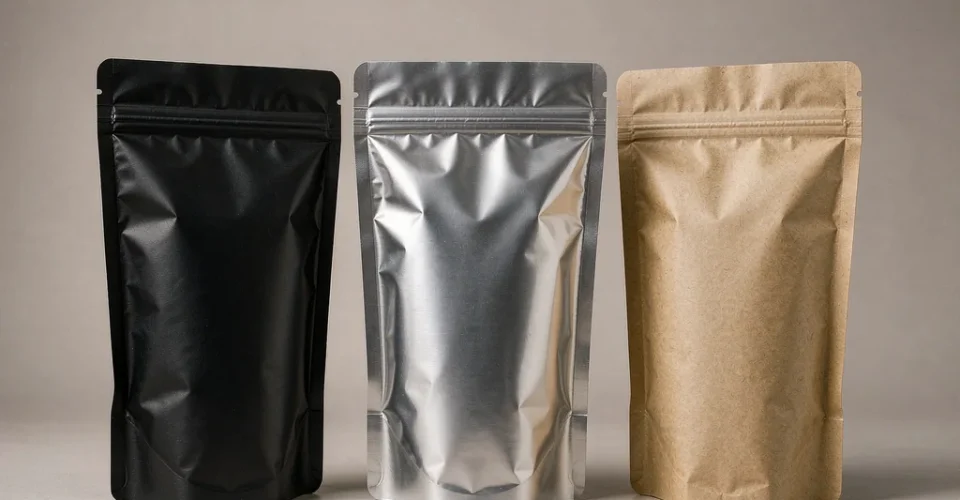
A pouch finish is the surface treatment that controls how light reflects off your packaging: a matte film, a matte varnish, a gloss layer or a soft-touch coating. Matte and soft-touch finishes remove glare and feel more premium, but they usually add cost and can lower recyclability. Gloss gives the sharpest colour at the lowest price and scuffs the easiest.
What Is a Pouch Finish, Exactly?
A finish is not a colour and not a print method. It is the outermost layer of the laminate — the surface your customer’s hand touches and the surface that catches light on a shelf. Finishes are measured objectively with a gloss meter at a 60° angle, following ASTM D523. A typical gloss film reads 70–90 gloss units (GU). A matte film reads below 10 GU. A soft-touch finish reads low like matte but has a rubberised, warm-drag feel created by additives in the coating.
This matters because finish is one of the few packaging decisions that changes shelf perception, machine behaviour and end-of-life handling at the same time. In practice, brand teams decide it late and factories pay for it early.
The Three Main Finishes Compared
| Property | Gloss | Matte | Soft-touch |
|---|---|---|---|
| 60° gloss reading | 70–90 GU | < 10 GU | < 5 GU |
| Perceived impression | Bright, value, high contrast | Calm, premium, modern | Tactile, luxury |
| Cost premium over base film | Baseline | +5% to +15% | +12% to +25% |
| Scuff and rub visibility | High | Low | Low to medium |
| Fingerprint visibility | Medium | Medium | High |
| Print colour depth | Sharpest, widest gamut | Slightly muted, flatter | Muted, matte |
| Effect on recyclability | Generally neutral | Often unfavourable if a separate PET/OPP layer is added | Least favourable |
The single most common mistake is assuming matte is simply a different ink. It is usually a different film.
How Each Finish Is Actually Made
There are three routes to a matte look, and they behave differently in the factory.
- Matte BOPP or matte PET lamination. A separately produced matte film becomes the outer layer. This gives the most consistent matte surface, and it is the main reason matte can push a pack away from mono-material recyclability.
- Matte varnish over print. A matte lacquer is printed on top of the artwork. Cheaper, but thinner, less durable, and it can polish or wear at the pouch shoulders on a high-tension line.
- Soft-touch coating. A matte base plus a fine additive that creates friction against the skin. Looks premium immediately, but the additive raises surface friction and changes how the film runs.
Gloss is usually the natural surface of the printed outer film, which is why it is cheapest.
Which Finish Costs What, and Why
If two quotes look illogical, the difference is almost always the outer layer, not the printing.
- A matte outer film typically adds 5–15% to film cost, depending on substrate, thickness and order volume.
- Soft-touch coatings commonly add 12–25%, because the coating is a specialty product and often requires slower printing.
- Matte varnish sits between the two and is the cheapest route to a matte look — and the least durable.
- Because all three routes involve a setup step, the premium is charged on the whole order. At low volumes, choose the finish you actually want, because setup dominates. At high volumes, treat finish as a percentage line item and negotiate it separately from the film structure. If your region charges an extended producer responsibility (EPR) fee based on weight and material, extra coating weight is also a fee line.
Finish, Surface Friction and Machine Performance
Finish also changes the coefficient of friction (COF) of the film, measured under ASTM D1894.
- Gloss films generally have moderate, predictable slip.
- Matte films sit in a wide range: a heavily matte surface can be grippier, and with low slip additives the film may drag, telescope or misalign on the filler.
- Soft-touch is the grippiest of the three, by design.
- Matte specified with too much slip additive still looks matte but prints with visible streak marks where the additive migrates.
Whenever you change finish, tell your converter what machine the film will run on — vertical form-fill-seal, horizontal form-fill-seal, or hand-loading. Finish and the slip package must be tuned together, so a finish change should trigger a fresh trial, not just a re-quote.
Finish and Recyclability in a Mono-Material World
Under the EU Packaging and Packaging Waste Regulation, packaging placed on the market must be designed for recycling by 2030, and flexible packaging is one of the hardest categories to convert.
- A matte PET or matte BOPP outer layer breaks a mono-polyethylene structure. If you want an all-PE pouch that fits PE recycling streams, a matte PE-based outer layer is the better choice.
- Heavy coatings, metallic lacquers and soft-touch additives complicate the sorting and washing steps recyclers rely on.
- Design-for-recycling guidance such as CEFLEX generally favours minimising non-PE layers, keeping coatings light, and limiting incompatible adhesives and inks.
The practical conclusion: if recyclability is part of your brand promise, choose matte only where the matte layer can stay within the same polymer family as the rest of the structure. This mono-material PE packaging overview explains what changes when you remove the aluminium or PET layer.
How to Choose the Right Finish
- Where will the pack be sold — shelf, hanging rack or e-commerce? Matte photographs better for listings; gloss dominates a brightly lit shelf.
- Premium or value? Coffee, tea and supplements carry matte and soft-touch well. Snacks and value ranges usually need gloss to read vivid.
- Automatic filler? Request finish and COF data together, and test a trial roll.
- All-polyolefin required? Then restrict matte options to PE-based outer layers.
- Run length? Under roughly 10,000 units the premium is small in absolute terms; above 100,000, model it as a percentage.
- Artwork designed for the finish? Fine hairlines and thin white type disappear in matte, which also flattens contrast, so colours usually need a small saturation lift.
A screen or flat proof cannot show finish. Ask for a laminated sample pouch in the exact structure and finish before approving artwork — the cheapest way to avoid paying for 50,000 pouches that look wrong under a shop light. Two useful references from outside your category: the design rules that make flexible packaging recyclable and the practical switch away from multi-layer laminate. If a redesign is already on the table, read these packaging upgrade mistakes first.
FAQ
Are matte pouches more expensive than glossy pouches?
Yes, usually. A matte outer film typically adds 5–15% to film cost, and a soft-touch coating commonly adds 12–25%. Gloss is the baseline because it is the natural surface of the printed outer film and needs no extra lamination or coating step.
Is gloss or matte better for shelf impact?
It depends on the shelf. Gloss delivers higher contrast and wider colour gamut under bright retail lighting. Matte removes glare, reads as more premium, and photographs better for e-commerce listings.
Do matte finishes reduce recyclability?
They can. A matte PET or BOPP outer layer breaks an otherwise mono-polyethylene structure, and heavy coatings and metallic lacquers complicate sorting and washing. Matte can be designed for recycling if the matte layer uses the same polymer family as the rest of the pouch.
What is soft-touch packaging?
Soft-touch is a matte surface with additives that create a rubberised, warm-drag feel. It reads as luxury immediately and carries the highest cost premium of the three common finishes, typically 12–25% over base film.
Does changing the finish affect how the film runs on a packing machine?
Yes. Finish changes surface friction, measured as coefficient of friction under ASTM D1894. Soft-touch is the grippiest finish and matte varies widely, so any finish change should be paired with a fresh machine trial and a review of slip additives.
How do I measure whether a pouch is really matte?
Use a gloss meter at a 60° angle following ASTM D523. A gloss film typically reads 70–90 gloss units, a matte film below 10, and a soft-touch finish below 5.



