
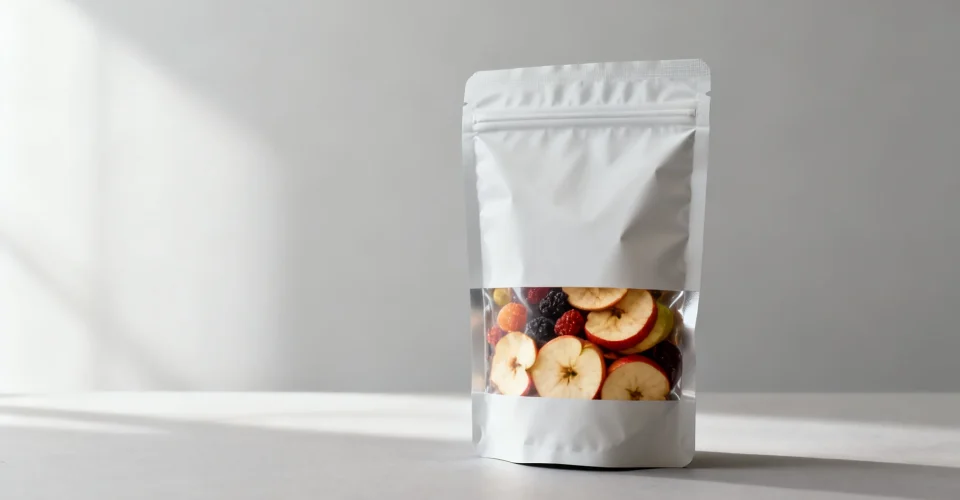
Dried fruit packaging is usually decided in the wrong order. Buyers start from a barrier number and try to work backwards to the product. It is more reliable to start from water activity and from the texture you are trying to protect, then choose the least complex structure that holds that texture for the shelf life you actually need. Sticky apricots and crisp apple chips can look similar on a purchase order, but they fail in different ways, and the film, seal width and line settings that keep them in specification differ too.
This guide is written for buyers and product developers specifying pouches, rollstock or a mixed programme. It applies to stand-up pouches, rollstock and premade formats, and to fruit sold in dry, humid and transit-exposed markets. It sets out the decision order, the points where the packing line changes the answer, and the checks that turn a candidate structure into a confirmed one.
Key Takeaways
- Water activity and the target texture define how much moisture movement the pack can tolerate. The film follows from that tolerance, not the other way round.
- A higher barrier is not automatically safer: it also holds moisture and aroma inside, narrows the seal window, and can remove an SKU from a mono-material recycling stream.
- Most dried fruit complaints trace back to the seal area rather than the film. Sugar dust, fruit residue and cold flow at the jaws often decide whether the pack stays closed.
What water activity tells you before you choose a film
Water activity describes how available the water in the product is rather than how much water it contains, and in dried fruit it moves during storage as moisture redistributes between the fruit, the sugar on its surface and the headspace. Soft, sticky fruit such as dried apricots, dates or figs generally sits at a higher water activity than a hard, brittle apple chip. A product sitting near the top of its acceptable range has less room to take up moisture before the texture changes.
The useful output of a water activity measurement is therefore not a film grade but a tolerance: how much moisture this product can gain before a consumer notices that something is wrong. That tolerance has to be established on your own fruit, because a moisture sorption curve run across the humidity range you expect in storage says far more than a single reading taken on the day of packing.
Why a higher barrier is not automatically better
A metallised or foil-containing laminate reduces moisture and oxygen ingress, and for some products that is exactly what is needed. For others it introduces problems a simpler structure would not have. Moisture already inside the pack, including moisture that condensed when warm fruit was packed, is held in place by a strong barrier instead of equalising. Aroma compounds behave the same way, which is why a bag that protects the fruit can also concentrate an off-note that would otherwise have escaped.
Higher barrier laminates also change sealing behaviour. They usually need a wider seal window, more heat and longer dwell, which affects line speed and increases the risk of marking the print or the film near the jaws. Where an SKU carries a mono-material or store-facing recyclability commitment, adding a foil or metallised layer may conflict with it. The barrier number is one input, not the decision.
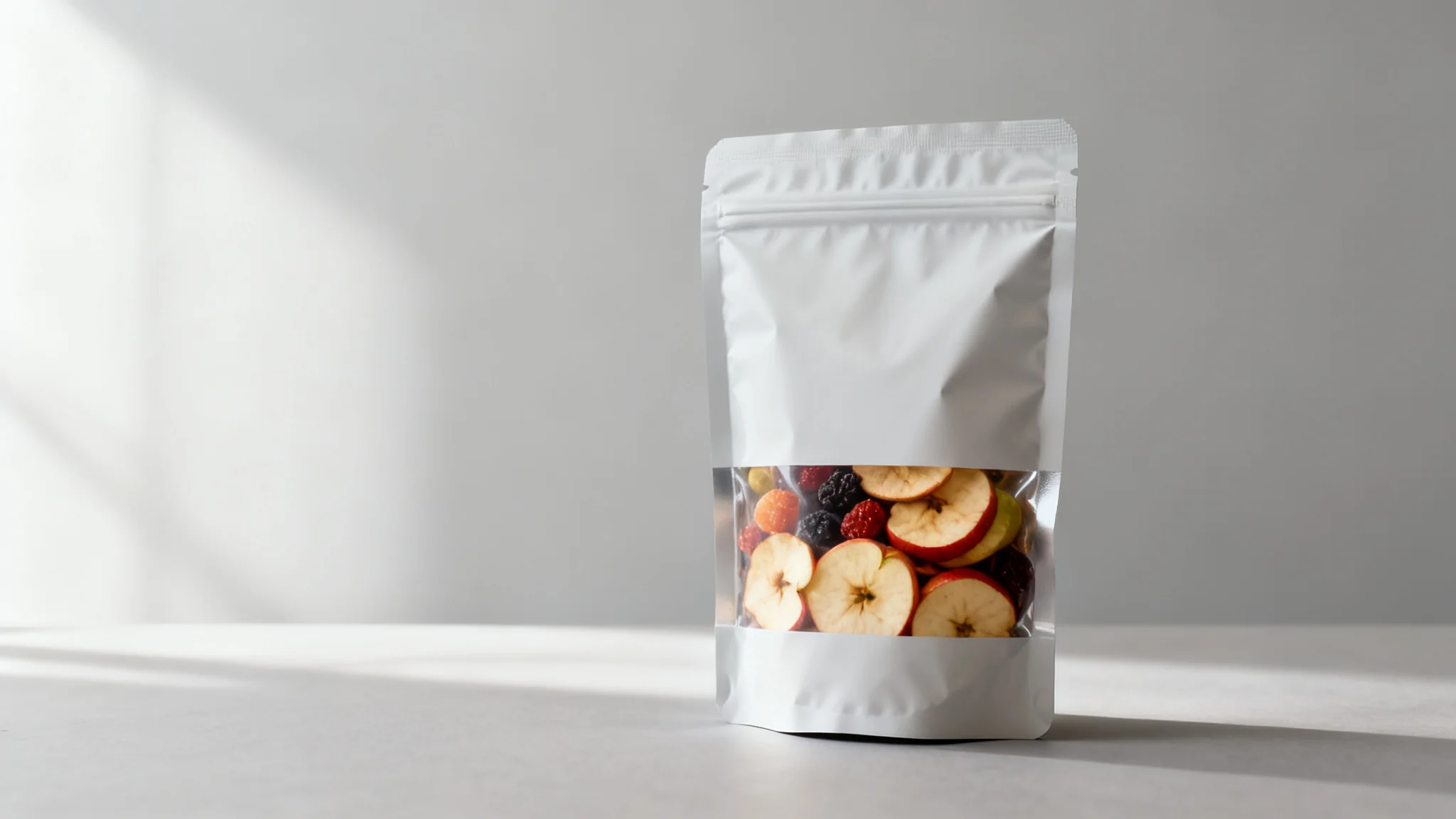
Concept packaging visual generated for editorial use. Not a customer project, not a tested structure.
Match the structure to the fruit, not to the category
Generic advice about dried fruit packaging is rarely useful, because the risk profile changes with the fruit. A crisp chip has more to lose from moisture gain; a sugar-rich, sticky fruit has more to lose from surface tackiness, sugar migrating into the seal area, and the way pieces settle into a solid block under stacking pressure. Separating two or three qualitative directions before looking at film data keeps the trial programme small.
| Fruit character | Dominant risk | Structure direction to explore | What must be confirmed |
|---|---|---|---|
| Crisp, low water activity (apple chips, freeze-dried formats) | Moisture gain and breakage | Moisture-barrier film with enough stiffness and cushioning | Texture after ambient and humid storage; drop and stack performance |
| Soft, sugar-rich (apricots, dates, candied peel) | Surface tackiness, sugar at the seal, cold flow | Smooth food-contact layer, wider seal area, generous headspace | Seal integrity with dust present; how the fruit releases from the film |
| Oil-coated or chocolate-coated pieces | Oxidation, aroma loss, print rub | Oxygen barrier plus light protection where the market expects it | Sensory panel over shelf life; rub resistance on the line |
For crisp formats, a stand-up pouch with custom sizing and a clear window is often preferred because the consumer needs to see the product. A custom dried fruit pouch built for apple chips is a useful reference for that shape, because the seal geometry and headspace are already tuned for brittle pieces. Sticky formats pull in a different direction: the priority shifts from barrier to how the fruit behaves at the jaws and how easily the consumer can reopen and reseal the bag.
Where does the packing line limit the options?
Film data that looks ideal on paper can fail on a vertical form-fill-seal machine running sticky fruit. Sugar dust and fruit fragments accumulate on the sealing jaws, and a contaminated seal is a weak seal regardless of the laminate. Dust also changes the friction of the film as it travels over the forming collar, which shows up as tracking problems and off-centre print. Zippers and resealable features need a flat, dust-free strip of film to attach to, so a fruit that crumbles has to be handled before it reaches the zipper station.
Line speed interacts with everything above. Increasing dwell time to close a higher-barrier laminate reduces output, and reducing seal temperature to protect the print can leave a seal that only passes a visual check. The practical approach is to trial candidate structures on the actual line with the actual fruit, and to record seal temperature, pressure, dwell and jaw condition across the run instead of only at the start.
How do ambient and transit conditions change the answer?
A structure validated in a dry inland warehouse is not automatically validated for a humid coastal market or a container that cycles through high temperatures. Moisture moves towards the drier side of the film, so the direction of the gradient changes which layer matters most. Asking two questions early saves rework: where will this SKU be stored, and what humidity and temperature range will it see on the way there?
Comparing moisture barrier between candidate films only makes sense if the measurement conditions are the same. Water vapour transmission rate under ASTM F1249 is reported for a defined temperature and relative humidity, and two suppliers quoting the same number under different conditions are not quoting the same film. Ask for the test conditions with the number. Food-contact compliance for the layers you finally choose is a separate check, and the EFSA food contact materials topic page is a reasonable starting point for the European market.
How to validate a candidate structure before you commit
- Write down the target texture in measurable terms, and agree how it will be assessed at each storage interval.
- Set a realistic shelf life with the commercial team, then add the conditions the pack will see in transit and in store.
- Build two or three candidate structures rather than one, and keep the current pack as a control.
- Trial on the production line with real fruit, recording seal parameters, dust build-up and speed.
- Store samples at representative conditions and evaluate texture, tackiness, seal integrity and aroma at intervals.
- Confirm food-contact compliance for the final layer combination, and re-check the seal after transport simulation.
If a candidate structure cannot be produced on your line without compromising speed or seal quality, that is a finding worth acting on before the artwork is commissioned. The moisture and barrier essentials for freeze-dried and dried food cover the same validation logic from the product side, which helps when a dried range is extended with a new fruit.
Conclusion
Start from water activity and the texture you are protecting, choose the least complex structure that meets that tolerance, and treat the packing line as part of the specification rather than a detail to be solved later. Where the fruit is sticky or sugar-coated, spend the early effort on the seal area and on dust control; where the fruit is crisp, spend it on moisture barrier, cushioning and headspace. For a range that spans both, an agricultural and dried fruit packaging programme can be structured so the two formats share artwork and line time without sharing a film that suits neither.
Frequently Asked Questions
Does dried fruit always need a high-barrier film?
No, not always. A high-barrier film is justified when the product is sensitive to moisture or oxygen across the shelf life you are claiming, or when the distribution chain is long and humid. For a fast-turning SKU sold in a dry market, a simpler moisture-barrier structure with a well-controlled seal area often performs better than an over-specified laminate, because it seals more easily and keeps the pack in a mono-material direction. The decision should follow from the tolerance you measured, not from the category.
How do I choose between a metallised structure and a clear one?
Choose on the risk you are managing, not on appearance alone. Metallised and foil-containing structures bring light and oxygen protection, and they are worth considering when the fruit is oil-coated, chocolate-coated, or expected to sit on a shelf for a long time. Clear structures win when the consumer needs to see the product and when the shelf life is short, but they need a separate look at light exposure and aroma barrier, because the two do not move together. Test both with the same storage protocol.
Why do pouches fail at the seal when the film passed its own tests?
The first thing to check is the seal area itself, because film certificates are measured on clean film. Sugar dust, fine fruit fragments and oil from coated pieces sit between the layers and prevent the polymer surfaces from bonding, so the seal looks continuous but peels under load. Check the jaws for build-up during the run, confirm the fill system is not dropping product into the seal zone, and evaluate seals from the middle and end of a production run rather than from the start.
What should I prepare before asking for dried fruit packaging samples?
Prepare the product data first, because samples built without it tend to be guesses. Useful inputs are the water activity range of the finished fruit, the moisture or texture limit you cannot exceed, the pack size and format you intend to run, the shelf life you are targeting, the storage climate, and any requirement for a resealable feature or a clear window. Add the line details, including machine type and the speed you need, together with any recyclability commitment the SKU has to meet. With those on the table a converter can propose two or three structures worth trialling rather than one.



