
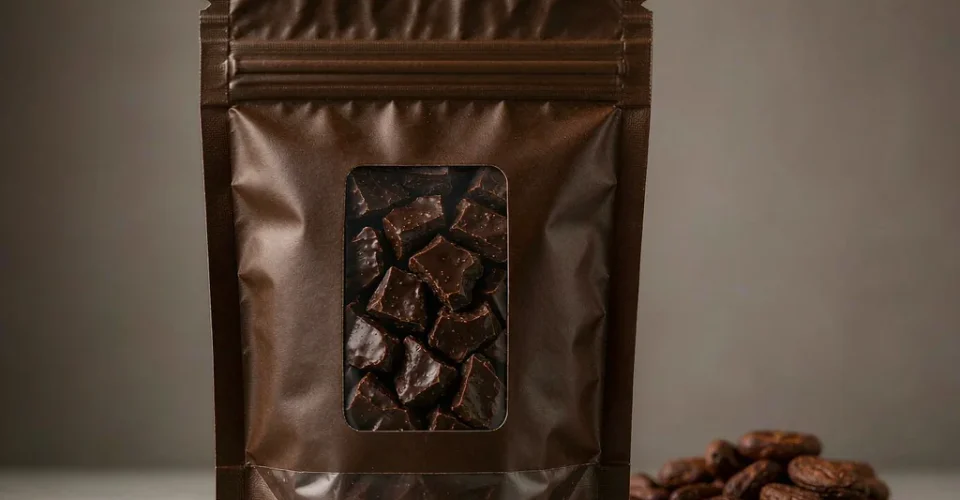
Chocolate packaging bags exist to do three jobs at once: block oxygen and moisture, hold aromatic compounds in, and keep outside odors out. Chocolate is unusually sensitive because cocoa butter absorbs odor molecules and melts at roughly body temperature. Get the film, the seal and the storage temperature wrong, and a visually perfect product can still taste stale, chalky or “fridge-like” within weeks.
This guide explains what actually damages chocolate inside a flexible pouch, which film structures prevent it, and what to write into a packaging specification before you order.
What Is Fat Bloom and Why Does It Happen?
Fat bloom is the gray-white streaks or dusty film you see on chocolate after storage. It is not mold. It is cocoa butter that has melted and recrystallized into a different, less stable form, pushing fat to the surface where it appears as visible crystals.
Cocoa butter can solidify into six different crystal forms. Only Form V, which melts at about 33.8°C, gives chocolate its gloss and snap. When the product experiences temperature swings above roughly 25°C, unstable forms melt first, migrate to the surface, and re-solidify as bloom. This is why the single most important storage rule is a stable temperature between 15°C and 18°C, not a low one.
Packaging contributes in two ways:
- Insulation. A foil-bearing or high-barrier laminate slows down how fast ambient temperature changes reach the product, smoothing out daily swings that drive bloom.
- Condensation risk. If cold product is packed in a warm, humid room, moisture condenses on the surface, dissolves surface sugar, and leaves sugar bloom after the water evaporates.
Which Barrier Films Protect Chocolate Best?
Chocolate needs low oxygen transmission (to slow oxidation of cocoa fats) and, in humid climates, meaningful moisture protection. It is less oxygen-sensitive than roasted coffee but more sensitive than most baked snacks.
| Structure | Typical WVTR / OTR behavior | Best for |
|---|---|---|
| PET / AL foil / PE | Excellent barrier against oxygen, moisture and light | Premium bars, long export routes, hot climates |
| PET / metallized PET / PE | Very good barrier, lower cost than foil | Retail bars, pouches, seasonal lines |
| PET / PE (clear) | Moderate barrier, visible product | Short shelf life, local distribution |
| Kraft paper / PE | Light protection, modest moisture barrier | Eco-positioned lines with fast turnover |
Two practical notes. First, light accelerates fat oxidation and surface bloom, so opaque structures outperform clear films at equal thickness. Second, per ASTM F1249 and ASTM D3985, WVTR and OTR figures are measured under specific temperature and humidity conditions; a film quoted at 23°C/50% RH will not behave the same at 38°C/90% RH, which is why export buyers should always request data at conditions close to their real distribution chain.
Why Does Chocolate Pick Up Odors Through Packaging?
Cocoa butter is an effective solvent for volatile aroma compounds. That is a benefit when you want coffee or vanilla notes to stay in, and a problem when the pouch sits next to onions, detergents or strong-smelling cartons in a mixed container.
Odor transfer happens when volatile compounds permeate the film or survive inside it after conversion. Three controls matter:
1. Choose high-barrier layers. Foil and EVOH-containing structures block volatile permeation far better than mono-PE film. 2. Control solvent residues. Inks and adhesives from the printing and laminating process must be residual-solvent controlled; otherwise the bag itself can taint the chocolate. This is governed in practice by food contact rules such as FDA 21 CFR and EU food contact regulations, which set limits on what may migrate from packaging into food. 3. Add an odor barrier layer. For heavily scented retail environments, an added barrier film dramatically reduces taint complaints.
Moisture: The Quiet Destroyer
Chocolate holds very little free water, which sounds like good news for packaging. The real moisture risk is condensation. When a chilled pallet moves into a warm warehouse, water condenses on both the film and the product surface, causing sugar bloom and, in filled chocolates, texture changes.
Practical defenses:
- Specify a film with a low WVTR rather than assuming moisture “doesn’t matter.”
- Let product equilibrate to room temperature inside sealed cases before opening the pallet wrap.
- Include a food-safe desiccant only where the filling process allows it, and only if it cannot sift into the product.
How to Choose a Chocolate Packaging Bag Format
Format choices trade shelf presence against protection:
- Flow-wrapped bar (pillow style): standard for single bars; fast on automated lines, lowest material cost per unit.
- Stand-up pouch with zipper: the default for chocolate chunks, baking chocolate and gift mixes; resealability matters once the consumer opens the bag.
- Flat bottom pouch: premium presentation for gifting and specialty retail, with strong shelf stance.
If you are weighing resealable options, our zipper and reclosable closure guide breaks down which zipper types survive filling and shipping. For flavor-sensitive products in general, the same barrier logic used in ground coffee packaging applies to chocolate: match the barrier to the product’s real enemy, not to the biggest number on a datasheet.
Inside our own catalog, the laminating method largely determines how stable the structure is over time; see our dry lamination process guide and, for moisture-sensitive products like tea, our tea packaging bag guide.
What to Write Into Your Chocolate Packaging Specification
A specification that prevents most chocolate complaints includes:
1. Structure and thickness, for example PET12 / AL7 / PE60, stated per layer. 2. WVTR and OTR targets with the test conditions used to verify them. 3. Seal settings compatible with your filling machine, including hot-tack requirements for high-speed lines. 4. Residual solvent limits and food contact compliance statements for your destination market. 5. Light protection requirement (opaque vs clear window) and where the window may sit. 6. Storage instruction printed on pack, ideally stating 15–18°C, dry, away from direct sunlight.
Codex Alimentarius standard STAN 87-1981 sets the international baseline for what chocolate products must contain before they can even be labeled as chocolate, and FDA regulations in 21 CFR Parts 163–169 cover cacao products sold in the US. Your packaging never fixes a product that fails those standards, but it does determine whether a compliant product arrives that way.
FAQ
What temperature should chocolate be stored at in flexible packaging? Store chocolate at 15–18°C with relative humidity below about 55%. The goal is temperature stability rather than refrigeration, because repeated warm-cold cycles above roughly 25°C trigger fat bloom.
Is fat bloom harmful? No. Fat bloom is a physical change in cocoa butter, not spoilage. The chocolate remains safe to eat, though appearance and texture suffer.
Does a clear window shorten chocolate shelf life? Yes, modestly. Windows expose the product to light, which accelerates fat oxidation and bloom. Keep windows small and away from direct light exposure, or use an opaque structure for long-haul distribution.
Which film structure is best for exporting chocolate to hot climates? PET / aluminum foil / PE remains the most reliable choice. It blocks oxygen, moisture, light and odors simultaneously, which is exactly the combination chocolate needs.
Can chocolate be packed in compostable film? It can, but expect a shelf life trade-off. Most compostable films have higher WVTR and weaker aroma barrier than foil laminates, so they suit short shelf life, fast-turnover lines.
Why does my chocolate taste like the warehouse? Cocoa butter absorbs volatile odors through any weak barrier. Move chocolate to a foil-based laminate, verify residual solvent levels in your bags, and avoid mixed storage with strong-smelling goods.
How long does chocolate last in a resealable stand-up pouch? With a proper high-barrier structure and storage at 15–18°C, filled chocolate typically carries 9–12 months of shelf life; once opened, resealability mainly protects texture and aroma rather than preventing bloom.



