China’s Plastic Ban Progress 2025-2026: Latest Policy Interpretation and How Companies Should Respond
In recent years,plastic ban the plastic restriction policy has kept intensifying, from the national-level “14th Five-Year Plan” Plastic Pollution Control Action Plan to local implementation rules,plastic packaging industry is undergoing unprecedented policy change. This article covers the latest developments of 2025-2026.progress of China’s plastic restriction policy for 2025-2026, analyzing the real impact on packaging companies and brands and offering practical response strategies.
Key points of the 2025-2026 plastic ban policies
Since 2025, the plastic pollution control work jointly advanced by the National Development and Reform Commission and the Ministry of Ecology and Environment has entered a deepening phase. These policies have the deepest impact on the packaging industry:
1. The nationwide ban on non-biodegradable plastic bags tightens further
By the end of 2025, shopping malls, supermarkets, pharmacies, bookstores and other venues in all built-up urban areas at prefecture level and above, plus restaurant takeout services, fully ban non-biodegradable plastic bags. Key provinces’ wet markets join the full ban from 2026. This means traditional PE plastic bags lose most of their space in large-scale retail scenarios, anddegradable packagingandeco-friendly packaging materials demand has surged sharply.
2. The ban on single-use plastic tableware and straws takes effect
In 2025, the national catering industry fully bans non-biodegradable single-use plastic straws and tableware (knives, forks, spoons). Enforcement is noticeably stronger than before — market regulators nationwide have sharply increased unannounced inspections. Delivery platforms have also issued packaging access standards requiring merchants to use compliant eco-friendly packaging.
3. Green packaging standards upgrade for postal and express delivery
In 2025, the State Post Bureau released a new version of the Green Packaging Specification for Mail and Express Parcels, requiring that by the end of 2026, 95% of e-commerce parcels skip secondary packaging and reusable express packaging reach 20 million units. Plastic tape, bubble wrap and other express packaging materials face restrictions and substitution requirements.
4. Clear targets for packaging recycling and reuse
In the Opinions on Accelerating the Construction of a Waste Recycling System issued by the General Office of the State Council, a clear target was set: a 70% recycling rate for plastic packaging waste during the “14th Five-Year Plan” period, plus a timetable for safety assessment and application research on recycled plastics for food contact. Forbiodegradable and recycled packaging materials, this is of important guiding significance for their standardized development.
Real impact of the plastic ban on packaging companies
Strict enforcement has already brought far-reaching effects to the industry chain:
Challenges and opportunities for packaging manufacturers
Challenges:
- Orders for traditional PE/PP plastic bags keep falling, especially a marked shrinkage in the retail shopping bag market
- Investment needed for environmental upgrades of equipment and technology
- Rising raw material costs — biodegradable materials cost 30%-80% more than traditional plastics
- Higher product certification and compliance costs
Opportunities:
- degradable packaging biodegradable materials, bio-based materials and recyclable mono-material packaging see significantly expanded market space
- Compliant companies’ competitive edge stands out — brands increasingly prefer suppliers with environmental certifications
- Greater premium room for eco-friendly packaging — brands are willing to pay more for environmental attributes
- Rising demand for exporters — overseas markets demand stricter eco-packaging than domestic ones
Impact on brands and end users
For food and home & personal care brands, the plastic ban’s direct impact shows in rising packaging costs and supply-chain adjustment pressure. A food brand procurement manager said: “In 2025 our packaging costs rose about 15%, mainly from switching packaging materials from traditional plastics to biodegradable solutions.”
On the other hand, eco-friendly packaging has become a differentiation factor. Several leading snack brands have made eco-packaging a core brand-upgrade strategy, replacing traditional multi-layer laminates with recyclable mono-material packaging — lowering recycling difficulty while lifting brand image. OMOPACK, in itspackaging material selection service, has found that since 2025, the number of brands inquiring about eco-packaging solutions has grown 120% year on year.
Five strategies for companies to respond to the plastic ban
Strategy 1: Material upgrades — from traditional plastics to biodegradable/recyclable solutions
Material upgrades are the most direct strategy for companies facing theplastic ban plastic ban. Current mainstream alternatives include:
- PLA (polylactic acid): derived from corn starch, industrial-compostable, suitable for transparent packaging
- PBAT+PLA blends: good all-round performance — currently the mainstream formulation for biodegradable plastic pouches
- Mono-material PE/PP: easy to recycle, now replacing multi-layer laminates
- Paper-based composites: suitable for dry foods and gift packaging
Each material option has pros and cons — companies must evaluate based on their product’s shelf-life requirements, use scenarios and cost budget.
Strategy 2: Source-reduction design — better packaging with less material
Source reduction is the policy-encouraged direction. Optimizing packaging structure — thinner films, smaller sizes, fewer redundant layers — cuts material use without sacrificing performance. Huasu Packaging’s production data shows sensible source-reduction design can cut plastic use by 15%-25%.
Strategy 3: Recyclable design — putting packaging “into the loop”
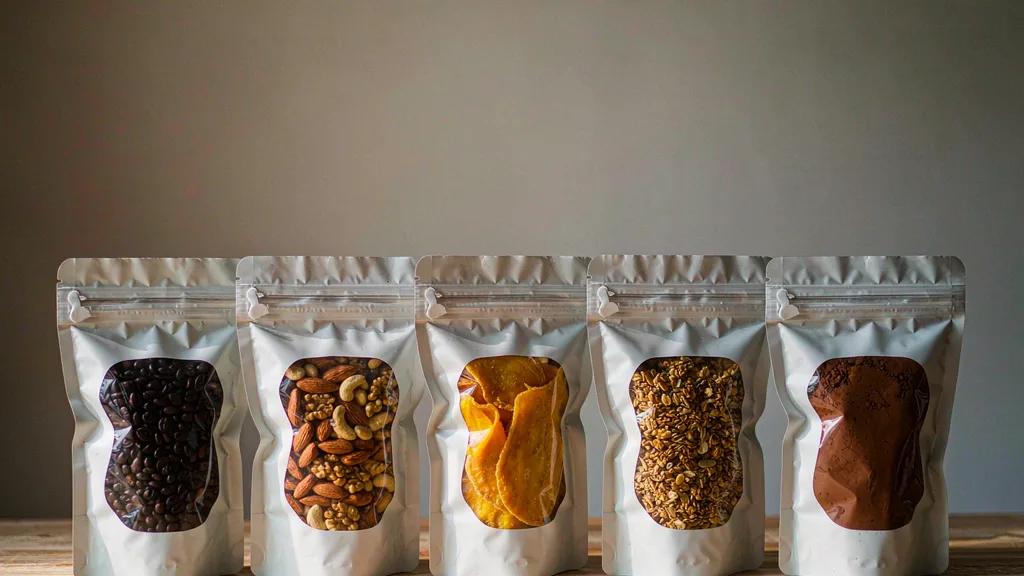
Recyclable mono-material packaging is the industry-recognized future direction. Unlike traditional PET/AL/PE laminates, all-PE or all-PP pouches enter existing recycling systems without separation. Several brands have already switched coffee and snack pouches from foil laminates to mono-material high-barrier solutions.
Strategy 4: Certifications first — building a compliance moat
As regulation tightens, relevant certifications become the “passport” to compliance:
- GB/T 20197-2006 degradable plastic certification (required for domestic sales)
- OK Compost / Seedling industrial composting certification (required for EU exports)
- BPI compostable certification (required for North American exports)
- FDA food-grade certification (for food contact materials)
Strategy 5: Expand exports — absorbing environmental costs through international markets
The EU, Japan, South Korea and other regions have stricter environmental policies than China, but correspondingly higher acceptance of and premium room for eco-packaging. Cross-border e-commerce brands using eco-packaging often achieve higher conversion and repurchase rates internationally.
Closing: the plastic ban is not the finish line but the starting point of industry upgrade
Looking back at the 2025-2026progress of China’s plastic restriction policy plastic ban progress, one thing is clear: policy is moving from “ban” to “replace” — from simple prohibition to systematic promotion of alternatives. For packaging companies and brands, proactively embracing the environmental transition beats passively reacting to policy — it is not just a compliance requirement but an inevitable choice for brand upgrading and market competition.
OMOPACK (omopack.cn) professionally provides all kinds of eco-packaging customization — biodegradable packaging, recyclable mono-material packaging and small-batch digital printing. For the latest eco-packaging solutions, welcome to visitOMOPACK contact page, or learn about our sister brand Huasu Packaging’s mass-production eco-packaging solutions.