
Dry lamination is the quiet workhorse of flexible packaging. It bonds two or more substrates with an adhesive that is coated, dried and then nipped under heat, producing a structure that can carry high-quality print on the outside and a reliable seal on the inside. Understanding how dry lamination behaves on the line matters more than memorising a list of recipe numbers, because most defects trace back to process windows rather than to the film itself.

The Four Steps That Make a Laminate
Every dry lamination line runs the same sequence: coating, drying, nipping and rewinding. Coating sets the adhesive weight, and that weight is governed by the gravure roller line count, the adhesive concentration and the working temperature of the mix. Drying removes the solvent through a staged temperature profile, and that profile is what determines residual solvent levels and final bond strength. Nipping then presses the two webs together with controlled heat and pressure, while rewinding tension decides how evenly the roll cures and how flat it converts later.
Because the steps are chained, a deviation in any one of them surfaces somewhere else. Weak drying looks fine at the winder and only shows up as low peel strength after curing. Excessive tension stretches the web, which later becomes misregistration during pouch making. Dry lamination therefore rewards operator experience as much as good equipment.
Matching the Adhesive to the Product
Solvent-based polyurethane adhesives offer strong initial tack, tolerate a wide range of substrates and are forgiving on older equipment, which makes them a safe choice for demanding structures. Their trade-offs are solvent handling and environmental cost. Solvent-free adhesives remove the drying step entirely, cutting energy use and emissions, and have become the default for mainstream food packaging, but they demand tighter coating precision and stricter curing discipline.
Three questions usually settle the choice: will the finished pack be retorted, will it hold high-fat or highly acidic contents, and what compliance requirements does the brand carry? Retort and high-fat applications generally need a more chemically resistant adhesive system plus a generous curing allowance.
Why Cure Time Cannot Be Compressed
Curing is the step that schedule pressure attacks first, and it is also the one that cannot be shortened safely. A freshly laminated web still has unreacted two-component adhesive, so peel strength is low. It needs time in a temperature-controlled curing room for the chemistry to complete. Insufficient temperature or duration leaves two problems behind: peel strength that fails specification, and residual solvent that keeps migrating into the pack, producing off-odours when the consumer opens it.
In other words, curing is a chemical process, not a waiting period. When a deadline is tight, the honest answer is to move the production slot, not to cut the cure. For retort applications it also pays to review the full barrier structure alongside the sterilisation conditions, as covered in our guide to retort pouch structures and 121°C sterilisation.
Reading Defects Back to Parameters
Most lamination defects follow predictable patterns. Localised bubbles usually mean insufficient adhesive weight or dusty substrate; widespread bubbling points back to the drying profile, where trapped solvent vaporises during cure and lifts the film. Delamination at the edges or across the seal area is typically a tension mismatch or an under-cured adhesive. Curling relates to the shrinkage difference between substrates, which is a structure design problem rather than a line setting.
Mapping each defect to its parameter makes troubleshooting far faster. It also argues for keeping a parameter log for every structure change: roller line count, adhesive weight, zone temperatures, line speed and cure duration. Those records turn a repeat order into a known quantity instead of a fresh experiment.
Designing Structure Around Process
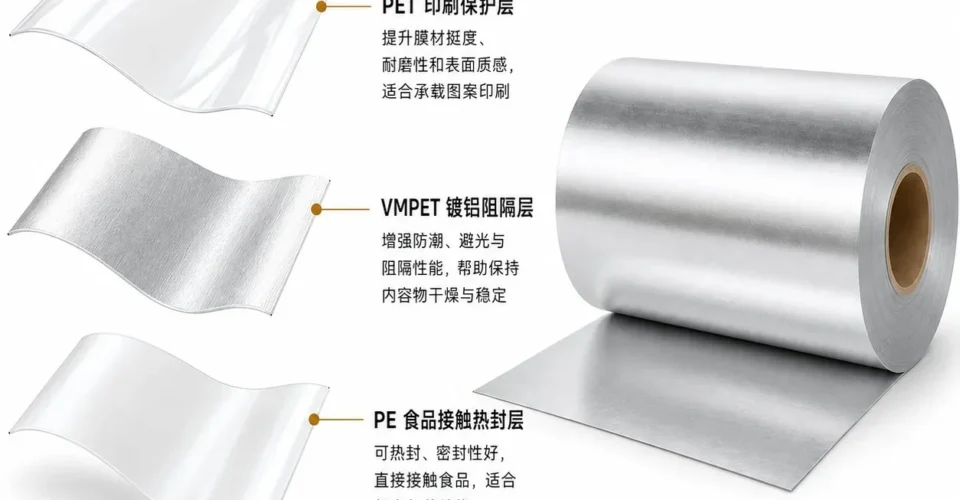
The laminate exists to serve the product. The outer layer carries print and mechanical protection, the middle layer provides the barrier, and the inner layer delivers seal performance. Dry lamination is what holds those roles together. Over-specifying adds lamination passes, cost and risk; under-specifying leaves the pack short on shelf life.
A practical sequence is to fix the pouch format first, then work back to the layer count. Mono-material and mono-PP structures are a good example of this thinking, since reducing the number of materials changes both the recycling story and the lamination sequence, as discussed in our note on mono-material PP packaging. For most ambient food products two or three layers remain sufficient, and extra barrier layers only earn their cost when shelf life targets are long or the contents are unusually sensitive.
Putting the Process Window in the Order
Two references are worth keeping alongside the specification: migration and residual-solvent limits for food-contact adhesives are assessed under the EFSA food contact materials framework, and barrier values for the finished laminate are quoted against methods such as ASTM F1249 for water vapour transmission.
If your product needs a multi-layer structure and the process window has to be re-established,
Dry lamination is a mature process, yet yield is usually decided by small numbers written in a work instruction: adhesive weight tolerance, drying temperature bands, and cure duration. Confirming those numbers at the sampling stage makes them repeatable at volume, provided peel strength and residual solvent are tested on a defined frequency. If your product needs a multi-layer structure and the process window has to be re-established, send us the structure, the contents and the sterilisation conditions and our engineers will help you scope it. Contact OMOpack for a structure review, or browse the main site at https://www.omopack.com to see the full range of flexible packaging formats.



