
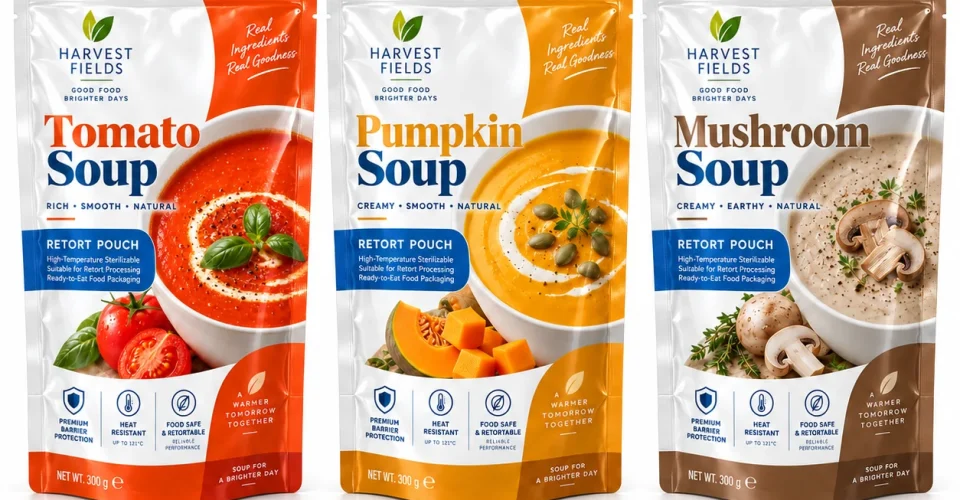
Brands under pressure to make packaging recyclable often start by swapping a laminated structure for a recyclable one, and then discover that performance does not survive the change: seals fail, the pouch distorts, shelf life drops. Mono-material PP packaging exists to resolve that tension. It builds the whole pouch from polypropylene family materials so the finished pack can enter a PP recycling stream, while keeping the heat resistance that polypropylene is known for. That makes it a stronger candidate than all-PE structures for retort, hot-fill and sauce applications.

Mono-material, however, does not mean simple. Keeping barrier, strength and seal integrity after a 121°C retort cycle requires decisions about film formulation, sealant choice, ink system and pouch-making parameters at the same time. What follows is how we frame those decisions in real projects.
Why high-temperature products need mono-material PP
All-PE recyclable structures work well for ambient, frozen and most dry foods, but PE softens at a lower temperature and tends to distort along the seal when sterilization goes above 100°C. PP has a noticeably higher melting point and heat resistance, so it can handle 121°C retort conditions and still qualify as a polypropylene stream at end of life. For sauces, ready meals, wet pet food and soups that require sterilization, all-PP is often one of the few structures that satisfies performance and recyclability at the same time.
If your product moves at ambient temperature, it is worth comparing an all-PE mono-material structure first. The cost and performance trade-offs are not the same.
How the layers are divided in an all-PP structure
A qualified all-PP retort pouch usually carries three functions, all delivered by the PP family. The outer layer handles printability and heat resistance, the middle layer carries barrier and mechanical strength, and the inner layer is the sealant that touches food. To keep the pouch recyclable without separation, the barrier layer is built from modified PP-based or PP-compatible materials rather than aluminum foil or PET.
The trade-off is lower barrier performance than a foil laminate. That gap is closed with a thicker barrier layer, coatings, or tighter filling and nitrogen-flush controls. Any all-PP proposal should therefore be validated with real shelf-life testing rather than a materials data sheet. For background on how temperature and time interact with seal and sterilization, see our breakdown of why retort pouches withstand 121°C.
The sealant layer decides whether the project works
The most underestimated part of an all-PP pouch is the sealant. Under retort conditions it must seal at a practical temperature, tolerate product contamination in the seal area, resist fats and oils, and avoid delaminating from its neighbor. When compatibility between the sealant and the adjacent layer is marginal, peel strength collapses after sterilization and shows up as channel leaks or layer separation.
In practice this means selecting a terpolymer PP sealant for better contamination tolerance, keeping printing ink out of the seal zone, and treating the amount of product left at the pouch mouth as a process specification rather than an operator variable. Sauce and paste products are the worst offenders, and simply raising sealing temperature usually makes it worse by thinning the film rather than closing the channel.
Inks and print coverage have to change too
Print for a recyclable pack is not only a visual decision. Ink and varnish chemistry, coverage and the presence of metallic pigments all affect whether a MRF treats the pouch as a recyclable or a contaminant. Heavy dark coverage across the full panel makes recovery harder; lighter, lower-coverage designs are friendlier. PP film also has a different surface energy than PE, so corona treatment and ink adhesion have to be re-qualified, otherwise scuffing and rub-off appear after packing.
On the shelf, an all-PP pouch usually feels softer and less rigid than a foil laminate. Designers should accept that or recover stiffness through structure, instead of asking the film supplier to fix it after the sample is made.
Will collectors actually take it?
A recyclable design only pays off where a polypropylene stream exists. Many markets still focus collection on rigid bottles, and flexible film acceptance is evolving. When scoping an all-PP project, check the recycling labelling requirements and household collection guidance in the target market alongside material compliance. Otherwise you can end up with a technically recyclable pouch that no one collects. Brands typically need to prepare the label, an online explanation and consumer education at the same time.
Cost and project rhythm
All-PP retort structures cost more per pouch than a standard foil laminate. The gap comes from modified barrier substrates, a narrower process window and higher trial scrap. The savings come from project discipline: standardizing pouch formats to reduce plate changes, freezing the structure and specs before trial runs, and keeping the ink count as low as the design allows.
A safe sequence is to confirm the thermal and shelf-life requirement, confirm the recycling conditions in the destination market, trial two candidate structures in small batches, and let real filling and storage tests choose the winner. Skipping a step usually costs more after mass production than it saves before it.
Design thresholds for polyolefin structures are published by CEFLEX, whose guidelines are the reference European converters and brands work to when a structure is graded.
If you are evaluating a recyclable retort format,
If you are evaluating a recyclable retort format, send us the product characteristics, sterilization conditions and target markets, and our engineers will return a side-by-side structure and cost comparison. Contact OMOpack to start the review, or browse more flexible packaging projects at OMOpack.com.



