Can recycled plastic packaging be used for food? This is one of the most frequently asked questions in the food industry today. As plastic regulations tighten around the world and brands face growing pressure to cut carbon footprints, more food companies are looking at recycled plastics. But the safety question never goes away. The answer is not a simple yes or no: the regulatory frameworks in the European Union, the United States and China differ enormously, and so do the compliance paths. This article maps the boundaries in each major market and helps both exporters and domestic brands see the road ahead clearly.
Can Recycled Plastic Packaging Be Used for Food: Three Markets, Three Answers
Whether recycled plastic packaging can touch food depends on the quality grade of the recycled material and the regulatory framework that applies. The European Union has the strictest rules. Under Commission Regulation (EU) 2022/1616, recycled plastics intended for food contact must pass an EU safety assessment and be listed on the register of authorised recycling processes. To date, only recycled PET has been approved, and it requires a closed-loop bottle-to-bottle collection system plus a functional barrier between the recycled layer and the food. In other words, the EU currently accepts only high-quality recycled PET for food contact, and other recycled materials have no legal route at all.
The US Food and Drug Administration uses a “No Objection Letter” (NOL) system. A company submits challenge test data proving that its recycling process removes contaminants to an acceptable level, and the FDA issues a letter of no objection after review. The FDA has issued NOLs for a number of recycled PET and recycled HDPE processes, but every plant and every process line must apply separately; the letters are not transferable. In China, the national standards for food-contact plastics, GB 4806.7 and GB 9685, have not yet opened a clear channel for recycled plastics in food contact. Domestic food packaging made with recycled resin still sits in a grey zone, and exporters need to be especially careful.
Core Risks of Using Recycled Plastic in Food Packaging
Three categories of risk explain why regulators are cautious. First, contaminant migration: post-consumer plastics can carry residues of pesticides, heavy metals, mineral oils and printing inks picked up during collection, sorting and washing. Under high temperature or fatty food conditions, these substances may migrate into the food. Second, polymer degradation: after multiple processing cycles, polymer chains break and performance drops, so barrier properties and mechanical strength are weaker than virgin resin. Third, uncontrolled sources: if non-food-grade waste plastic is mixed in, it can introduce substances banned by regulation.
To control these risks, the international approach is the “functional barrier” concept: place a brand-new, fully compliant barrier layer between the recycled layer and the food so that potential contaminants in the recycled material cannot migrate into the food. This concept is accepted by both EU and US regulators, and it is currently the only realistic route for recycled plastic to enter food packaging.
How Food Brands Can Use Recycled Plastic Packaging Compliantly
For food companies that want to try recycled plastic packaging, we recommend a three-step process. Step one: define the target market. If you export to the EU, only use recycled PET suppliers listed in the EU register and ask for complete compliance documentation. If you export to the US, verify that the supplier holds an FDA NOL and that the process parameters match the NOL. For domestic sales in China, we suggest postponing direct food-contact applications and first considering indirect contact structures where recycled resin forms the outer layer and virgin resin forms the inner layer.
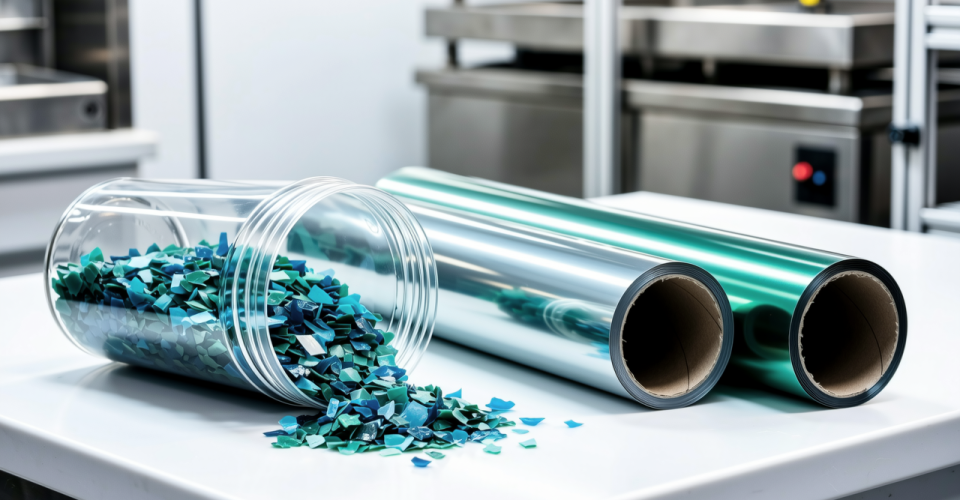
Step two: validate the supply chain. Ask recycled resin suppliers for batch test reports, with special attention to heavy metals, phthalates and overall migration. Step three: design a functional barrier structure. Put virgin material on the food-contact layer, recycled material on the outside, and isolate the two with aluminium foil or a high-barrier coating. This structure keeps the environmental value of recycled material while satisfying food safety requirements. For a deeper look at recycled resin grades and quality requirements, see our earlier guide on biodegradable packaging degradation time and our comparison of US versus EU packaging requirements.
Industry Trends and Outlook for Recycled Plastic Packaging
Despite the strict rules, the direction of travel is clear. The EU register of authorised recycling processes will gradually expand, and assessments of food-grade recycled PP and HDPE are already in progress. Research on national standards for food-contact recycled plastics has also started in China, and the industry generally expects dedicated regulations within the next few years. For food brands, building a recycled resin supply chain and a compliance management system now is a smart way to get ahead.
At the same time, be realistic: recycled plastic packaging still costs more than virgin packaging today, and supply is limited. When you promote “recycled material” on pack, make sure the claim matches the actual structure, or you may trigger advertising compliance risks. For exporters, understanding the broader regulatory picture is essential before committing to any material change.
Summary and Recommendations
So, can recycled plastic packaging be used for food? The answer is: yes, conditionally. The EU accepts only recycled PET on its authorised register, the US requires a plant-specific FDA NOL, and China has not yet opened a direct-contact channel. Put compliance first: use a “virgin contact layer + recycled outer layer + functional barrier” structure, and verify supplier qualifications strictly. OMOpack follows recycled material regulations closely and can help food brands evaluate compliant packaging options. Contact us for a one-on-one consultation: contact OMOpack.
Visit OMOpack.com for more packaging knowledge and industry insights.