
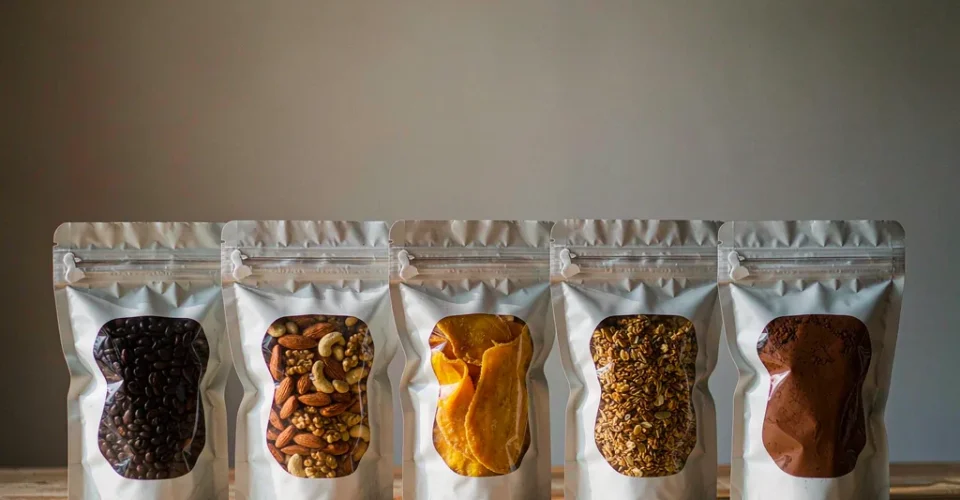
A pouch controls the oxygen, moisture and light that reach your food — but it cannot stop quality loss happening inside the pack. A defensible best-before date comes from three inputs: your product’s water activity, the barrier structure you specify, and a documented storage test. Small food brands can set one without a full laboratory.
What Does a Pouch Actually Control?
A flexible pouch is a barrier layer wrapped around your product. What it controls is the rate of transfer, not the state of the food. Three numbers matter most:
| Property | What it measures | Typical target for sensitive dry foods |
|---|---|---|
| OTR (oxygen transmission rate) | Oxygen entering per day | Below 1 cm³/m²/day; below 0.1 for foil laminates |
| MVTR (moisture vapor transmission rate) | Water vapor entering or leaving per day | Below 1 g/m²/day; below 0.1 for foil laminates |
| Light transmission | UV and visible light reaching the product | Near zero for foil; 5–15% for metallized film |
These numbers come from standard tests such as ASTM D3985 for oxygen and ASTM F1249 for water vapor, and a converter should quote them per structure, not as a marketing adjective. When you ask for a quote on custom pouches, the useful question is not “is it high barrier?” but “what are the OTR and MVTR of this exact laminate at 23 °C and 50% RH?” — and if the film will touch food, what its food contact migration testing file shows.
The second thing a pouch controls is reclaiming headspace. Nitrogen flushing and oxygen absorbers change what is inside the pack at the moment of sealing; the pouch only decides how fast the outside world gets back in. If you are comparing whole bean coffee pouches against snack packaging, the flush and the film are two halves of the same specification, and neither substitutes for the other.
Start With Water Activity, Not With the Film
Water activity (aw) — the free water available for reactions, measured on a 0 to 1 scale — decides whether your dominant failure mode is moisture gain, oxygen attack, or both. Most spoilage and safety concerns track water activity far more closely than total moisture content.
| Product | Typical water activity | Dominant failure mode |
|---|---|---|
| Roasted coffee beans | 0.20–0.30 | Oxygen (aroma loss, oil oxidation) |
| Crackers and biscuits | 0.20–0.35 | Moisture gain (stale, soft texture) |
| Roasted nuts | 0.30–0.45 | Oxygen (rancidity) plus moisture |
| Soft dried fruit | 0.55–0.65 | Moisture balance; too dry hardens, too wet ferments |
| Jerky and dried meat | Must stay at or below 0.85 | Moisture and oxygen together |
The jerky figure is not a suggestion. USDA’s Food Safety and Inspection Service requires dried meat products to reach a water activity of 0.85 or lower precisely because pathogens stop growing below that line. This is also why the FDA and EU regulators treat shelf-stable low-moisture foods differently from chilled ones, and why a brand cannot simply copy a competitor’s date.
If your product is oxygen-limited (coffee, nuts, jerky), invest in oxygen barrier and oxygen scavengers — and where oxygen is the enemy, pair the film with a gas flush; a food factory’s specification for MAP packaging film shows how the two are set together. If it is moisture-limited (crackers, crisps, powders), invest in moisture barrier and check your seal integrity, because a perfect film with a leaking seal still fails the shelf life test. Our dried fruit packaging guide walks through a product where both matter at once.
How to Test Shelf Life Without a Full Lab
Regulators in the EU, under Regulation (EU) 1169/2011, require a durability indication — “best before” or “use by” — but they do not prescribe a test method. The burden of a reasonable method falls on the brand. A practical protocol for a small brand looks like this:
- Fill real production pouches, not lab pouches, because the sealing step is part of the system.
- Store at two conditions: ambient 23 °C / 50% RH for the real-time arm, and 35 °C for the accelerated arm.
- Pull samples at fixed intervals — for a 12-month claim, pull at 0, 1, 3, 6, 9 and 12 months.
- Measure what your failure mode is: water activity and moisture gain for moisture-driven products; headspace oxygen and peroxide value or sensory aroma for oxygen-driven ones.
- Record everything, because your best-before date is only as defensible as the file behind it.
For the accelerated arm, the common screening rule is Q10 = 2: every 10 °C rise roughly doubles the rate of most degradation reactions. Twelve weeks at 35 °C therefore screens roughly six to eight months of ambient storage. It is a screening tool, not proof — sensory quality, in particular, does not accelerate as cleanly as chemistry does.
A third arm that costs almost nothing is the worst-case retail simulation: one case in a delivery van in summer, one on a brightly lit shelf. Many date failures come from distribution, not from the pouch at all.
Where Shelf Life Claims Actually Break
In practice, the pouch film rarely fails first. The usual suspects, in order of frequency:
- Seal contamination and pinholes. Product dust or oil in the seal area creates channels; sharp edges (jerky pieces, nuts) puncture film from inside. This is why seal quality and handling matter more than an extra barrier layer.
- Zipper and closure leakage. A press-to-close zipper is a convenience feature with its own leak path. Products consumed over weeks — pet treats, snacks — lose shelf life through the zipper every time they are opened, which is why packaging that protects after opening needs a genuinely different design than packaging that protects until opening.
- Distribution abuse. Vibration, drops and compression open micro-channels at folds and seals.
- Wrong structure for the climate. A laminate validated for a temperate market may lose half its effective margin in a hot, humid export destination.
If a product line keeps failing before its date, check these four before asking for a “better” film. Our stand-up pouch sizing guide covers another hidden variable: over-sized pouches hold more headspace oxygen, which quietly shortens oxygen-driven shelf life.
Best-Before vs Use-By: Different Questions
A best-before date is a quality guarantee: the food should taste and perform as intended up to that date if stored properly. A use-by date is a safety guarantee, reserved for highly perishable products. Flexible pouches of low-moisture foods almost always carry a best-before date, and over-claiming one is a commercial risk, not primarily a legal one: returns, reviews and retailer delistings arrive before regulators do.
FAQ
How long can a stand-up pouch keep food fresh?
There is no single answer: roasted coffee in a foil laminate with nitrogen flush commonly carries 9–12 months, nuts 6–9 months, and baked snacks 4–6 months, but the date belongs to your product, your fill line and your climate. The pouch sets the ceiling; the product and process decide where you land under it.
Does a higher barrier always mean a longer shelf life?
No. Once the barrier exceeds what the product can consume, additional layers add cost without adding days, and may hurt recyclability. Compare the product’s water activity and oxygen sensitivity against the laminate’s OTR and MVTR, and stop upgrading when the measured headspace and moisture stay flat through the storage test.
What water activity is safe for room-temperature storage?
Foods with a water activity at or below 0.85 are generally treated as low-moisture, shelf-stable products because most pathogenic bacteria cannot grow below that level. Yeasts and molds can still grow at 0.70 and above, so dried fruit and similar products need both moisture control and clean filling conditions.
How do I validate a 12-month best-before date?
Run a real-time study at ambient storage for 12 months, supported by an accelerated arm at 35 °C as a screening check, and document the measurements at each pull. Keep the file with batch numbers, test methods and sensory notes so the claim can be defended to a retailer or inspector later.
Do zippers and degassing valves shorten shelf life?
They add potential leak paths, but a well-made zipper or valve from a competent converter does not meaningfully reduce unopened-pack shelf life. The real loss happens after opening, so build resealability into products consumed over time and treat it as part of the shelf life design rather than an accessory.
Who is responsible for the best-before date, the brand or the pouch maker?
The brand is. A pouch maker certifies the material properties of the laminate and the quality of the pouch construction, but the date applies to a specific product, fill process and market. Treat the converter’s OTR, MVTR and seal data as inputs to your own validation, never as a substitute for it.



