
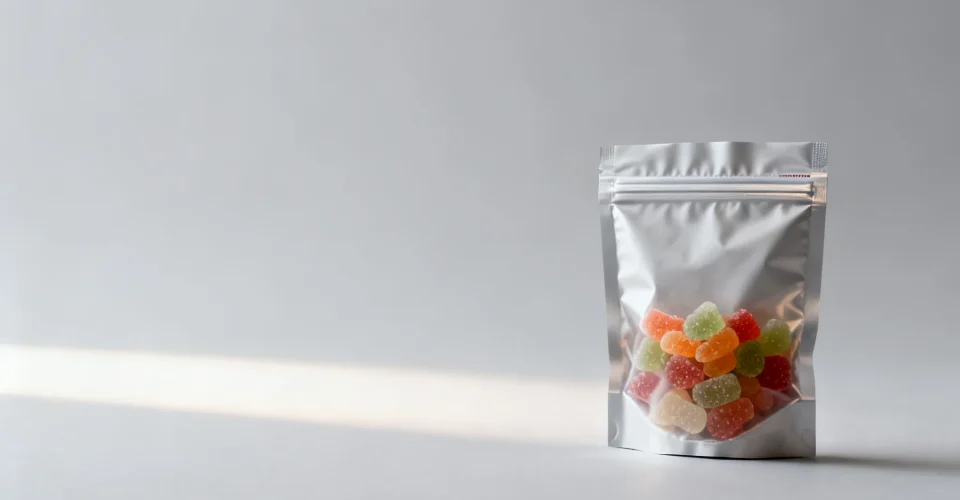
Gummy packaging complaints rarely arrive as one problem. Moisture gain, aroma loss and a closure that stops sealing usually appear together, and the first useful step is deciding which of the three is the original defect and which are consequences. In most cases the pack is not the starting point: the product’s own moisture, the temperature at filling, and how the closure area is treated on the line decide the outcome before the film choice matters. This article sets out a diagnostic order for buyers and quality teams facing that mixture of symptoms. The scope covers premade pouches and rollstock formats, filled at warm or ambient conditions.
What goes wrong when gummies pick up or lose moisture?
Gummies are formulated to hold a defined amount of water, and they exchange it with the headspace until the two reach balance. If the pack lets moisture leave, the pieces firm up, the surface loses its gloss and the chew becomes shorter. If moisture enters, pieces turn tacky, stick to the film and to each other, and the pack can form a solid block. Both directions are possible for the same product when the storage environment is drier than the gummy in one season and more humid in another.
Because both directions are possible, saying that the pack needs a barrier is not a diagnosis. The first question is which direction has actually been observed, and where in the chain it appeared: at the end of the packing line, after warehouse storage, or after the consumer opened the bag once.
Where does the failure usually start: seal, headspace or film?
Three candidates cover most gummy complaints, and they are cheap to separate. Seal contamination comes first: starch, sugar or anti-sticking agents from the gummy surface sit in the seal area and stop the layers bonding across their full width. Headspace is second: a pack filled with warm product carries moisture and volatiles that later condense on the film. Film selection is the last, and it is the one most often changed first.
Before changing anything, inspect a failed pack. Open the seal and look for a channel, a hard particle, or a dull band where the layers never fused. Then check the inside of the film for condensation or a tacky residue. Only move on to film structure when both checks come back clean.
A troubleshooting order for moisture, aroma and reseal complaints
- Confirm which symptom is primary: firming, tackiness, flavour change, or a closure that will not hold.
- Establish when it appeared: on the line, in the warehouse, in transit, or after the first opening.
- Inspect the seal area of failed packs before touching any specification.
- Record filling temperature and the time between depositing the gummy and closing the bag.
- Check headspace conditions on freshly packed product instead of assuming them.
- Only then compare candidate film structures, keeping every other variable unchanged.

Concept packaging visual generated for editorial use. Not a customer project, not a tested structure.
Why are aroma loss and moisture gain different problems?
Moisture moves through a film as water vapour. Aroma is a mixture of volatile organic molecules with different polarities and different affinities for the sealant layer. A structure that performs well against water vapour may not hold a fruit ester, and the reverse happens as well. That is why a gummy with added flavour can smell correct at packing and muted a month later while the texture is unchanged.
Oxygen is a third pathway and behaves differently again, which is why package transmission results are always reported with their test conditions. Oxygen transmission rate under ASTM D3985 is measured at a stated temperature and relative humidity for exactly this reason. Ask for those conditions whenever a supplier gives you a number to compare.
Can the packing line cause the complaint?
It can, and often does. Gummies are deposited warm, and a bag sealed while the product is still releasing moisture traps that moisture against the film. Depositing into a pouch that already carries starch dust pushes that dust into the seal, and a forming collar running hot carries sticky residue into every new bag. Speed matters too: shortening dwell time to protect output reduces the chance of a complete seal across the full width.
The line also sets the closure. A resealable feature needs a clean, flat strip to work with, and on a dusty line that strip is the first area to suffer. When the closure rather than the film is the weak point, reviewing zipper, easy-tear and spout pouch options against the actual fill behaviour is more productive than adding barrier layers.
Conditions where a simpler structure is the better choice
A short-shelf-life, fast-turning gummy SKU does not always need the heaviest laminate available. Where the closure is the real problem, a wider seal and better dust control on a simpler structure will outperform a high-barrier film with a contaminated seal. Where the SKU sits inside a mono-material commitment, keeping the structure simple also keeps the pack inside that commitment. That trade is worth testing rather than assuming, even when a heavier structure looks safer on a data sheet.
Pack format should follow the way the product is bought. A candy pouch with a three-side seal and a window serves a single-portion impulse purchase, while a larger resealable stand-up bag carries a different closure duty and a different headspace volume.
Conclusion
Separate the three symptoms before changing the film, and treat filling temperature and seal-area contamination as the first suspects rather than the last. Where a gummy range spans several formats, the candy and snack packaging range shows how the formats compare, but the specification should still be written against one product, one fill temperature and one storage climate at a time.
Frequently Asked Questions
Why do gummy pouches turn sticky a few weeks after packing?
Moisture entering the pack is the usual cause, and the source is often the headspace rather than the store. Gummies sealed warm release water vapour that condenses on the film and then reabsorbs into the pieces, so the surface becomes tacky even though the bag was closed properly. Check the filling temperature and the delay before sealing first; if both are controlled and the tackiness continues, then compare film structures with everything else held constant.
Is a resealable closure worth adding to a gummy pack?
It is worth adding when the pack is opened more than once and the product is sensitive to air exposure, which covers most share-size bags. It is not worth adding if the fill system leaves starch and sugar on the strip, because a contaminated closure fails on the second or third opening and generates more complaints than a simple tear notch. Decide on the basis of portion size and how the pack is used, then confirm the strip stays clean in production.
Can a gummy bag smell wrong while the texture stays fine?
Yes. Moisture and aroma move through a film by different routes, so a structure can hold water vapour while allowing flavour volatiles to leave. The effect shows up as a muted or changed flavour with no visible change in texture. If aroma is a defined part of the product promise, ask for volatile retention to be assessed in the storage trial rather than judging the pack on moisture results alone.
What should be checked first when seals fail on a gummy line?
Open the failed seal before changing any setting. A dull band, a hard particle or a visible channel points to contamination or incomplete fusion, and that is a fill and cleaning issue rather than a film issue. Confirm the cause on a sample of packs from the middle of the run, since the start of a run is usually clean and can hide a problem that develops after an hour of production.



