
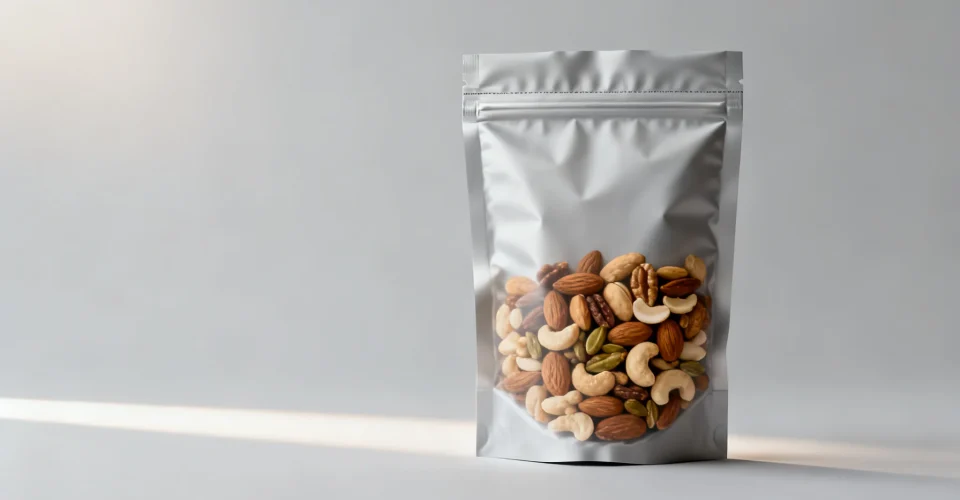
Do all nut products need a high-barrier pouch?
No. Most nut packaging pouches are over-specified before anyone checks whether the product actually needs the heaviest laminate available. Three variables decide the film: how much oil the nuts release, how long the pack has to hold up on the shelf, and how the pack is filled. Get those three right and a mid-range structure usually performs as well as an expensive one. Get them wrong and no amount of barrier film fixes a seal that was contaminated during filling.
Key Takeaways
- Headspace oxygen and oil contact at the seal are usually bigger risks for nuts than the oxygen transmission rate of the film itself.
- Reclosing features should be chosen from how the pack is used, not from what looks premium on a shelf.
- Nitrogen flushing changes the specification only when the filling line can hold a consistent gas atmosphere.
- Every structural change needs a sample run on the actual filling line before it is written into the specification.
When is a mid-range laminate enough?
A laminated structure with a metallised or foil-containing layer earns its cost when the product is high in unsaturated fat, is sold in a clear or brightly lit shelf position, or is expected to sit in distribution for many months. If the nuts are roasted in oil, salted, or packed as small single servings that are opened quickly, the exposure per pack is shorter and the shelf-life requirement is usually set by the retailer rather than by the oil content alone.
The boundary is not a single number. It depends on the roast level, the salt and oil addition, the headspace volume, and the temperature the pack sees in transit. Two products that look identical on paper can need different films once those four inputs are measured.
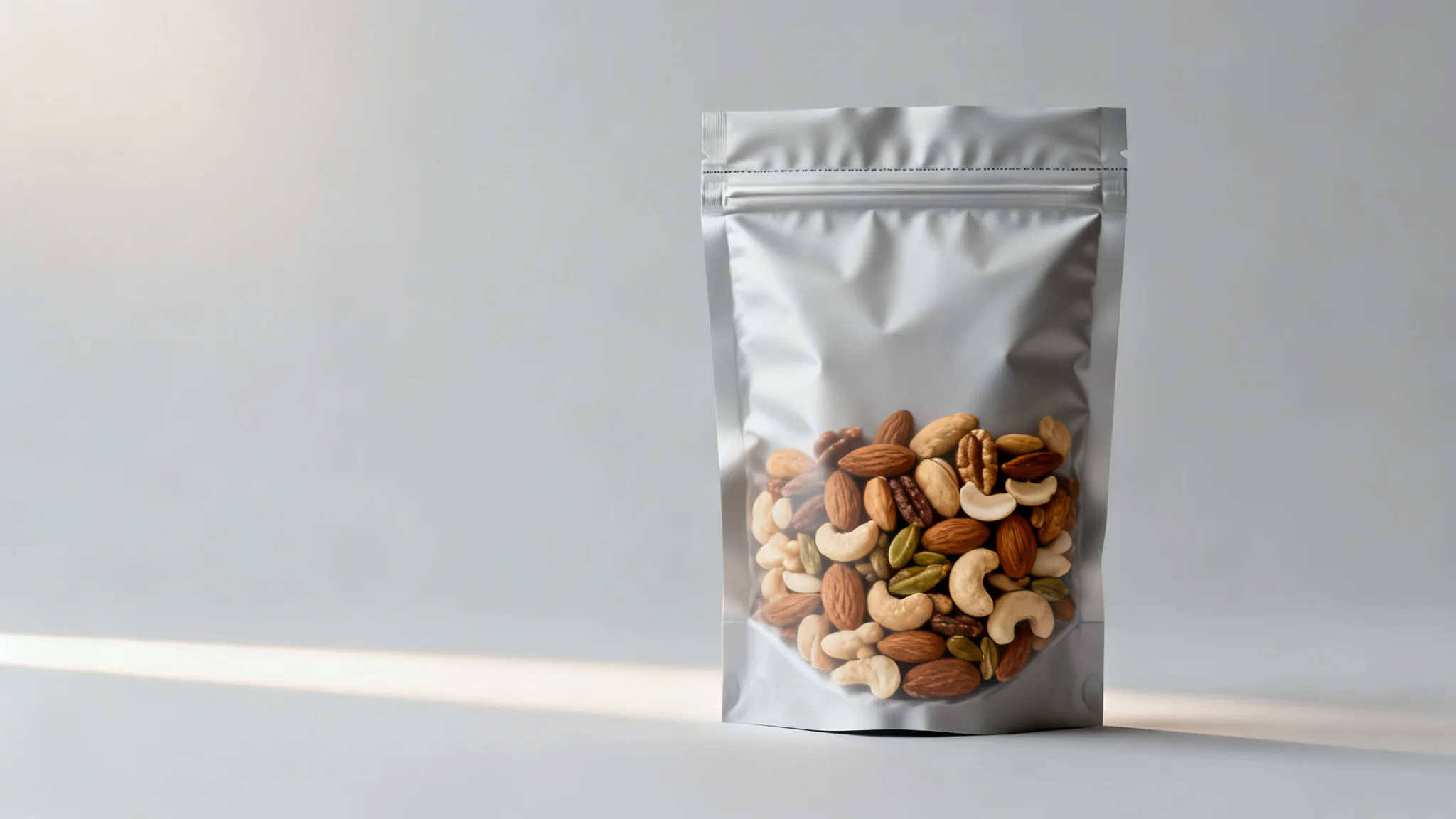
Concept packaging visual generated for editorial use. Not a customer project, not a tested structure.
How should you set the specification, step by step?
The sequence below keeps the decision anchored to the product rather than to a supplier’s stock list.
- Describe the product first. Roast level, oil or salt additions, average piece size, and whether shells or fragments are present. Fragments press against the film like small knives.
- Fix the shelf-life target. Record the months, storage temperature and light exposure the pack will face.
- Choose the format before the film. A stand-up pouch, a flat-bottom pouch and a quad-seal pouch load differently on the filling line and carry different headspace volumes.
- Select a candidate structure. Ask the supplier which layer carries the barrier and which carries the seal.
- Run a sample and test it. Fill, seal and store real packs; check seal strength, leaks and repeated opening.
- Write the specification with tolerances. Film thickness, seal width and reclosure type each need a range, not an ideal value.
Pouch formats for nuts: stand-up, flat-bottom and quad-seal
Format choice drives the filling line more than it drives the barrier. A stand-up pouch is the default for retail packs in the 100 g to 500 g range because it stands on the shelf and presents a large print area. A flat-bottom pouch carries more weight and stacks predictably. A quad-seal pouch gives a rectangular footprint and a firm base for pallet use.
| Format | Typical use | What to confirm on the line |
|---|---|---|
| Stand-up pouch | Retail packs, 100–500 g | Fill opening width vs. filler nozzle; base gusset forming |
| Flat-bottom pouch | Larger packs, e-commerce shipping | Corner seal integrity; drop performance under load |
| Quad-seal pouch | Rectangular, stackable packs | Side-seal dwell time; print registration across four panels |
Data nature: general format characteristics from common practice; confirm on your own line. No performance values are implied.
The reclosure decision is separate from the format. A press-to-close zipper earns its place where a pack is reopened over weeks; where it is emptied in one sitting, a zipper adds cost without adding protection. The comparison of zipper, easy-tear and spout pouches covers how the three trade off.
What should you test before approving a sample?
Approval should rest on physical evidence from real packs, not on a film data sheet. A film data sheet describes the film, not the pouch, and it says nothing about a seal that ran with nut dust in it.
- Seal strength. Pull the seal across its width and record where it fails; delamination and clean peel behave differently.
- Leak tightness. Submerge representative packs; a steady stream of bubbles at the seal points to a channel, not a material problem.
- Repeated reclosure. Open and close the pack as often as a household would, then check it still holds product.
- Headspace condition. If flushing is used, confirm the line holds the target atmosphere pack after pack, not just on the first.
Where a flash point for the specification matters, two standard methods are worth naming in the test plan: ASTM F1249 for water vapour transmission and ASTM D3985 for oxygen transmission. Both describe steady-state transmission through a film at stated conditions, so the result is only comparable when the temperature, humidity and area are recorded alongside it.
Which mistakes raise cost without adding protection?
The most common one is specifying a heavier barrier before checking the seal. If nut dust sits in the seal area, the pack fails there regardless of the film. The fix is usually how the product is presented to the filler, not the laminate.
A second mistake is treating light protection as an afterthought. Oil oxidation is driven by both oxygen and light, and a clear pack on a bright shelf behaves differently from the same film behind a carton. The nitrogen flushing guide for nut packaging bags covers how atmosphere and light interact with headspace design.
A third mistake is choosing the format for shelf appearance, then finding the filling line cannot open and hold the pouch at speed. Format and film should be chosen together, with line speed in view.
For packers who also handle dried fruit, candy and grain, the same format logic applies across the category; the snack and grain packaging category collects the formats used across that group. Where custom-printed film is part of the plan, the custom-printed snack and tea film range shows the roll film options that sit behind these pouch formats.
Conclusion
For most nut products, the specification should be built from three answers: how much oil the product releases, how long the pack must last, and how the filling line presents the product to the seal. A mid-range laminate with a controlled headspace and a clean seal outperforms an expensive laminate with a contaminated seal in most real distribution chains. Treat every structure as a candidate and confirm it on your own line. Where ASTM F1249 and ASTM D3985 are used to compare films, quote the results with the test conditions. Background on food contact materials is set out by EFSA’s food contact materials topic page.
Frequently Asked Questions
Is nitrogen flushing always necessary for packaged nuts?
No, but for nut packaging pouches it is worth considering whenever the shelf-life target is long and the product is high in unsaturated fat. Flushing replaces the oxygen in the headspace, which is where most of the early oxidation happens. The limit is the filling line: if the line cannot hold a consistent gas atmosphere from pack to pack, the flushing is unreliable and the specification should not depend on it. Confirm by measuring headspace oxygen on several packs across a full run, not on the first pack alone.
Should a nut pouch use a zipper or a plain easy-tear opening?
Choose a zipper when the pack will be reopened many times after purchase, and a plain easy-tear opening when it is emptied in one sitting. A press-to-close zipper earns its cost when a household opens and closes the pack over days or weeks, because it keeps air exchange down between servings. For single-serve packs, a plain easy-tear opening is simpler and cheaper. Whichever is chosen, the zipper must be placed clear of the seal area so nut dust cannot sit in the track.
How do you compare two candidate films for a nut pouch?
Compare them on three measured points rather than on a single barrier figure. First, the seal strength and failure mode on real packs filled with the real product. Second, the leak rate from a submersion test on finished pouches. Third, the headspace condition if flushing is used. Only then compare the transmission figures, and compare them at the same temperature and humidity. The transmission methods are described in ASTM F1249 and ASTM D3985.
Can a stand-up pouch carry a large nut pack without a flat bottom?
Often it cannot, once the pack passes roughly a kilogram. A stand-up pouch keeps its shape through the base gusset, and that base carries the full weight. Larger packs usually move to a flat-bottom or quad-seal format, which spreads weight across a wider base. The threshold is set by a drop test on the actual pack, since handling and pallet height both change the load.



