
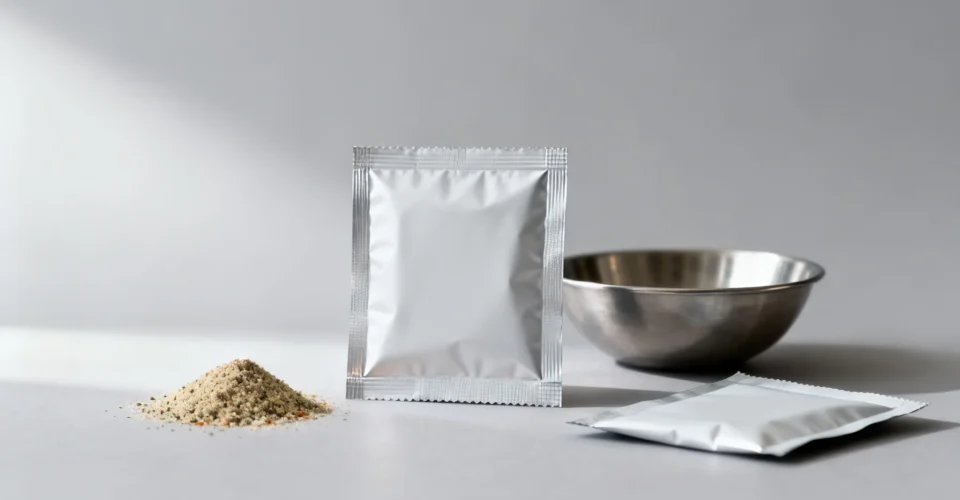
Seasoning powder packaging rarely fails because the film is too thin. It fails where powder sits in the seal. A fine, hygroscopic powder such as a bouillon blend or a spiced seasoning picks up moisture from the air in the filling room, cakes onto the inner seal surfaces, and leaves a channel that looks sealed and leaks. Checking the seal area, the powder condition and the filling room humidity before specifying a heavier structure will solve more complaints than a barrier upgrade.
Why Moisture Enters at the Seal Rather Than the Film
Powder residue trapped in the seal is the difference between a barrier that works and one that does not. Where the two inner layers meet cleanly, the seal forms a continuous bond. Where a powder grain sits between them, the bond forms around the grain and leaves a channel narrower than the grain itself.
Because the channel is small, it does not fail immediately. Moisture enters slowly, the powder at the opening cakes, and the customer finds a hardened lump rather than a wet pack. This is why leak complaints in seasoning lines arrive weeks after production and appear scattered rather than as a full batch.
How Powder Residue Builds Up on a Form-Fill-Seal Line
Three points on the machine usually account for most of it. The fill chute sits too close to the jaw, so powder falls into the sealing zone rather than into the pouch body. Static holds fine particles on the film surface after the fill tube withdraws. And dust from the auger or the dosing screw builds on the jaw faces over a shift.
Each has a different fix. Increasing the gap between the fill point and the jaw costs a little film but removes a large share of contamination. An ionising bar or a controlled air purge near the tube reduces static hold. Scheduled jaw cleaning at a fixed interval stops the slow accumulation that creeps past visual inspection.
Caking and Clumping: What the Pack Has to Protect
Seasoning blends are usually blends of ingredients with different moisture sensitivity. Salt and hydrolysed protein take up moisture readily, starches swell, and some spices carry volatile oils that oxidise. A pack has to limit moisture gain, limit oxygen exposure for the oil fraction, and keep light away from colour-sensitive spices.
The three risks do not scale together. A blend with a high salt content is dominated by moisture control, while a spice-heavy blend with a low salt content is more exposed to aroma loss and oxidation. Structure choices follow whichever risk is largest, rather than a general assumption that more barrier is safer. Caking and oxidation in condiment and spice packs covers the mechanism in more detail.
Concept packaging visual generated for editorial use. Not a customer project, not a tested structure.
Which Barrier Level Does Seasoning Powder Actually Need?
Start with the storage condition and the shelf life, then work backwards. Powder sold through ambient retail with a long shelf life carries a different requirement from a sachet used within a food service operation, and a bulk catering pack behaves differently again.
The boundaries are also set by the format. A rigid canister or a thick foil pouch holds its seal geometry under stacking, while a thin three-side seal sachet deforms and can flex the seal area during transport. Where the pack is small and handled individually, the mechanical durability of the seal often matters more than the fourth decimal of barrier performance. Three-side seal pouches are common in this segment for that reason.
Seal Window and Contamination Control: Settings to Check
Record the seal window rather than a single set point, and check it with powder present.
- Seal temperature range over which the bond is continuous, measured at the lowest temperature that still gives a clean peel.
- Dwell time and pressure, confirmed at the highest realistic line speed rather than at bench speed.
- Jaw condition, including any build-up on the faces, checked at a fixed interval through the shift.
- Position of the fill point relative to the jaw, and whether powder is visible on the film above the fill line.
- Powder condition at filling, including lumps from the hopper and any moisture absorbed during the shift.
Together these settings define where the powder-moisture interaction is managed. Seasoning packaging solutions in production usually combine a wider top seal with a dust-management step rather than relying on the film alone.
What to Measure Before Scaling Up
A trial should produce evidence on leak rate and moisture gain, not on seal appearance. Seal strength measured by a defined peel method is a useful indicator of process consistency, and water vapour transmission through the finished pack is measured under defined conditions; ASTM F1249 sets out the standard method and the test conditions that must be reported with the result.
Moisture gain in the product is the outcome that customers notice, so a storage trial at the humidity you actually expect is worth running alongside the seal tests. Where the pack is also part of a recyclability review, the material choice intersects with regulatory direction on packaging waste, which the European Commission summarises on its packaging and packaging waste page. Replacing a multi-material laminate is a design decision that should be tested against seal performance on your own line before it is adopted.
Conclusion
Moisture problems in seasoning powder packaging usually start in the seal, not in the film. Confirm the fill point distance, the static control and the jaw cleaning interval before considering a heavier structure, then measure the seal window with powder present and at production speed. Barrier choice comes afterwards and should answer the dominant risk in the blend, whether that is moisture, oxygen or aroma loss. Finish with a storage trial under realistic humidity rather than a visual seal check.
Frequently Asked Questions
Does seasoning powder packaging need a foil layer to stop caking?
Not always. In seasoning powder packaging, caking follows moisture gain, and moisture gain is driven more often by a leaking seal or a humid filling room than by the film’s barrier level. A foil layer reduces transmission through the film, which is useful over a long shelf life, but it will not compensate for a channel in the seal. Fix the seal and the room condition first, then decide whether the film needs upgrading based on a measured moisture gain trial.
How do I tell whether a leak is a seal fault or a pinhole?
Seal faults run along the seal line and are usually straight and narrow, while pinholes appear on the pouch body or at a fold. Open a suspect pack, look at the inside of the seal for a powder trail, then flex the pack gently over a water bath and watch for a bubble stream to locate the point. Tracking where the failures occur across a batch tells you more than testing a single pack.
Is powder residue in the seal visible during production?
Sometimes, but not reliably. Fine powder sitting on the film above the fill line is a useful warning, while a single grain inside the seal is invisible at line speed. Visual inspection catches gross contamination and misses the rest, which is why the fill point distance and the cleaning interval matter more than a visual check. Compression or dye testing on a sample basis finds what inspection cannot. Custom three-side seal seasoning pouches are usually specified with a wider seal for this reason.
Can a stronger seal temperature solve powder contamination?
Only within limits. Raising the temperature can force a bond through a thin powder layer, but it also narrows the process window and risks burning the film, which weakens the seal elsewhere. Powder has a melting point far above the film, so the grain stays as a hard inclusion however hot the jaw runs. Reduce contamination at the source and use temperature to widen the operating window rather than to force a bond.



