
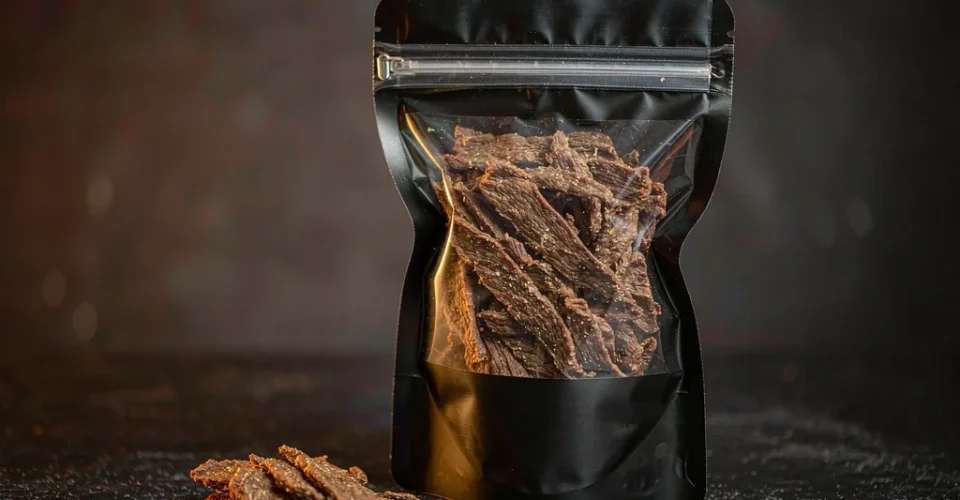
Jerky packaging fails for three predictable reasons: fat in the meat oxidizes, salt in the marinade pulls moisture back into the product, and dried meat strips are sharp enough to puncture a thin film. A jerky pouch therefore needs a high oxygen barrier, a proven moisture barrier, and a puncture-resistant outer layer all at once. Here is how those requirements translate into a structure a small brand can actually order.
What Makes Jerky Different From Other Snack Packaging?
Most snacks stress one property of a pouch. Jerky stresses three at the same time:
- Fat content. Beef jerky commonly carries 3–15% fat by weight, and rendered fat migrates to the inner surface of the pouch, attacking seals and inks.
- Salt. Marinades push salt content above 4% in most commercial recipes, which raises the water activity that drives both microbial limits and moisture re-absorption.
- Physical sharpness. Dried strips are rigid and have angular cut edges; a 60-micron film can be pierced in transit without any external impact.
The defining number is water activity (aw). USDA FSIS compliance guidance for jerky requires a moisture-to-protein ratio of 2.03:1 or lower, which in practice puts finished jerky at aw values of roughly 0.70–0.85 — shelf-stable, but close enough to the 0.85 boundary that any moisture pickup shortens quality life.
How Much Barrier Does Jerky Actually Need?
Because oxidation, not microbial spoilage, is usually what ends shelf life, oxygen ingress is the first thing to specify. A common industry target is keeping in-pack oxygen low and limiting transmission through the film over the product’s best-before window.
| Structure | Typical OTR (23°C) | Typical WVTR | Best fit |
|---|---|---|---|
| PET 12 / PE 60 | High | Moderate | Budget, short-life (3–4 months) |
| PET 12 / AL 7 / PE 60 | <0.5 cc/m²·day | <0.5 g/m²·day | Long shelf life, premium, dark environments |
| PET 12 / VMPET 12 / PE 60 | ~0.5–2 | ~0.5–1 | Mid-premium, window-free barrier |
| PET 12 / EVOH-based PE 60 | ~1–3 | ~1–3 | Mono-material recyclable routes |
Opaque foils and metallized films also block light, which matters because light accelerates the same oxidation chain that oxygen starts. If the product sits under retail lighting for weeks, a foil or metallized barrier typically outperforms a clear high-barrier film on flavor retention.
Why Does Fat Oxidation Decide the Best-Before Date?
Lipid oxidation in jerky is a chain reaction: oxygen reacts with unsaturated fats, producing off-flavors described as rancid, cardboard-like or paint-like. Three practical controls follow from that chemistry:
- Minimize headspace oxygen at filling. Nitrogen flushing or vacuum sealing reduces in-pack oxygen; residual oxygen above roughly 2–3% noticeably accelerates rancidity in fatty snacks.
- Choose a structure with a real oxygen barrier. A foil layer effectively stops transmission; EVOH or metallized PET reduces it to a fraction of plain PET/PE.
- Consider oxygen scavengers for extended lines. An active sachet or scavenging film layer can extend a 6-month claim toward 9–12 months when the barrier alone is marginal.
What Do Salt and Moisture Do During Distribution?
Finished jerky is hygroscopic. If the film’s moisture barrier is weak, the product gains water over time: texture softens, salt migrates to the surface, and water activity climbs back toward the 0.85 microbial threshold. A WVTR below about 1 g/m²·day at 38°C/90% RH keeps a standard 100 g pouch effectively stable for 9–12 months in most climates.
The second moisture problem is inside the seal area. Fat and brine residue on the inner surface during filling contaminates the sealing zone, so the seal window of the inner PE layer must tolerate contamination — a heat-seal PE blend formulated for products with grease or powder residue seals reliably where a generic film would channel and leak.
How Should Seals, Zippers and Tear Notches Be Specified?
- Seal strength ≥ 20 N/15 mm on both long seams keeps the pouch closed through handling, in line with common seal-integrity test practice.
- A press-to-close plastic zipper rated for repeated use lets consumers reseal after opening — important because jerky is eaten over multiple sittings. The zipper sits below the top seal, with no slider and no metal parts.
- Tear notches at both ends of the top seal give a clean first opening even with oily fingers.
- Wide bottom gusset carries the product weight; jerky is dense, and a 100 g pouch filled with meat weighs far more than a 100 g pouch of puffed snacks.
How Do Sharp Edges Puncture the Pouch — and What Stops It?
Dried strips have hard, angular edges. During truck vibration they work like small blades against the film. Two countermeasures are standard:
- Add an outer PET layer of at least 12 microns, which raises puncture resistance substantially versus all-PE structures.
- Consider a PA (nylon) tie layer when the recipe leaves strips extra rigid, such as biltong-style products dried to lower moisture.
A simple drop-and-vibration check before releasing a new structure catches most puncture failures at the sample stage rather than in customer returns.
What Should Go Into a Jerky Pouch Specification?
A one-page spec that prevents most quality disputes includes:
- Structure and layer thicknesses (e.g., PET12 / VMPET12 / PE60)
- OTR and WVTR targets with the test conditions stated
- Seal strength and burst requirements
- Zipper type and closure cycle rating
- Puncture resistance method and minimum value
- Light barrier requirement (opaque vs clear window decision)
- Food-contact compliance of every layer, not just the sealant
Getting these five or six lines agreed before tooling saves a full sampling round later.
FAQ: Jerky Packaging Questions
What is the best bag structure for beef jerky?
For most shelf-life targets, a PET 12 / VMPET 12 / PE 60 or PET 12 / AL 7 / PE 60 laminate is the practical choice: the metallized or foil layer supplies the oxygen and light barrier that jerky’s fat content demands, while the PE sealant handles oily seal areas.
How long does jerky last in a pouch?
With a high-barrier laminate and low residual oxygen, 9–12 months of best-before life is realistic; a plain PET/PE pouch without a barrier layer typically degrades flavor in 3–4 months under retail lighting.
Do jerky pouches need nitrogen flushing?
It is strongly recommended. Reducing residual oxygen to 2–3% or below slows fat oxidation directly; a barrier film without a flush leaves most of the oxygen inside the pouch where the film cannot reach it.
Why does jerky puncture its own packaging?
Dried strips are rigid with sharp cut edges, and transport vibration presses those edges into the film repeatedly. An outer PET layer plus adequate thickness prevents the slow puncture that thin films cannot resist.
Can jerky packaging be recyclable?
Mono-material PE-based structures with an EVOH barrier core are the current workable route, trading some top-end barrier for recyclability. Brands with 12-month shelf-life claims should verify aw and flavor panels on a recyclable structure before switching.
Does jerky packaging need to block light?
If the product sits under retail lighting, yes. Light accelerates the same oxidation chain as oxygen, and opaque foil or metallized barriers measurably extend flavor life compared with fully clear structures.
Learn how the same barrier logic applies to other oily products in our guide to nut packaging pouches, and see how reseal closures behave for fatty products in the dog treat packaging guide. For the factory side of seal settings on oily products, the heat seal parameter troubleshooting guide on PURESTPACK covers dwell, temperature and pressure combinations, and the MAP packaging film specification guide explains gas-flush film selection in detail.



