
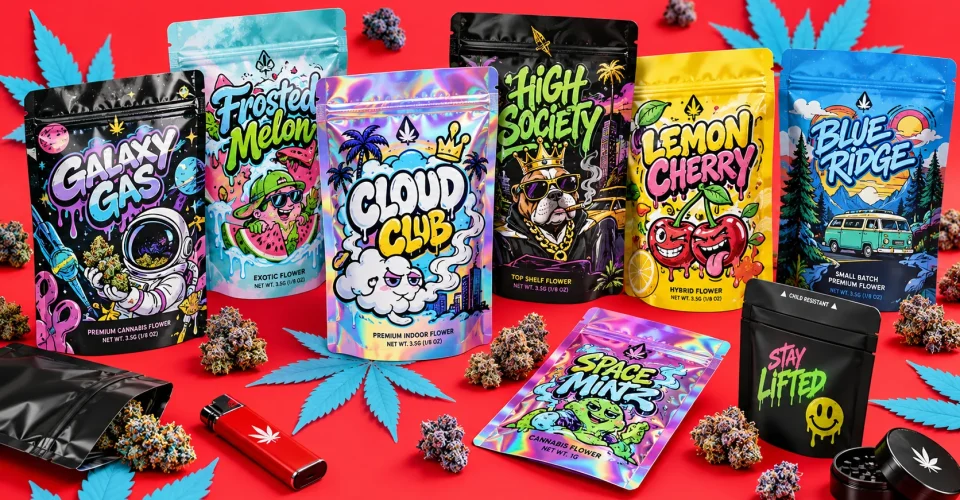
Preserving terpene profiles, extending shelf life, and preventing aroma leakage are essential requirements for commercial cannabis operations. When handling aromatic flower, pre-rolls, or infused edibles, product quality depends heavily on packaging that seals volatile compounds inside and protects contents against oxygen and moisture ingress. Barrier performance is quantified with standard methods — ASTM F1249 for water vapour transmission and ASTM D3985 for oxygen transmission — and a supplier claim is only comparable when it names the method and the unit.
Choosing reliable smell proof weed bags goes beyond selecting an attractive retail pouch. It involves understanding barrier films, seal integrity, closure mechanisms, and operational handling.
This technical sourcing guide breaks down the core material laminates, barrier properties, zipper structures, and sizing considerations needed to select reliable weed packaging.
1. What Determines Odor Barrier Performance?
Cannabis aroma is driven by volatile organic compounds (VOCs), primarily monoterpenes and sesquiterpenes such as myrcene, beta-caryophyllene, pinene, and limonene. Because terpenes have low molecular weights, they can migrate through standard non-barrier plastics.
Odor retention in commercial flexible packaging relies on two core factors:
-
Substrate Gas Permeation: Monofilm plastics like basic polyethylene (PE) or polypropylene (PP) possess relatively porous molecular matrices. Terpenes can dissolve into the inner contact layer and gradually permeate to the outside. High-barrier laminates with low Oxygen Transmission Rate (OTR) values are generally preferred for odor-sensitive cannabis products, but the required specification depends on the product format, total laminate structure, seal integrity, and storage conditions.
-
Seal and Closure Integrity: Volatile compounds escape through micro-channels at heat-seal junctions or around zipper crush points long before passing through a dense barrier film. True smell control requires both an impermeable laminate and an airtight closure.
2. Barrier Material Comparison: Foil vs. VMPET vs. EVOH
Most commercial weed packs rely on multi-layer flexible packaging laminations where each substrate performs a defined engineering function: an outer print web, a core barrier layer, and an inner virgin heat-sealable film.
| Barrier Structure | Core Barrier Mechanism | Moisture Vapor Barrier (MVTR) | Odor & Gas Barrier (OTR) | Typical Use Case |
| PET / AL / PE | Pure Aluminum Foil | Very low / near-zero under controlled test conditions | Very low / near-zero under controlled test conditions | Long-term cured flower, bulk wholesale storage, maximum barrier |
| PET / VMPET / PE | Metallized Polyester | High barrier | High barrier | Commercial dispensary retail, standard 3.5g (1/8 oz) weed packs |
| Kraft / VMPET / PE | Metallized Core + Paper | High barrier | High barrier | Natural/craft visual aesthetics with full internal barrier |
| Mylar / EVOH / PE | Ethylene Vinyl Alcohol | Medium-High barrier | High barrier (performance depends on ambient humidity) | Pouches requiring transparent inspection windows |
Notes on Material Selection & Thickness:
-
Foil vs. Metallized Film: Aluminum foil provides the highest barrier performance but can be susceptible to pinholing if subjected to repetitive flex-cracking. Metallized films (VMPET) offer high barrier characteristics with increased puncture flexibility for standard retail distribution.
-
Laminate Caliper: For retail distribution, total pouch thickness typically ranges between 4.0 mil to 5.5 mil (approx. 100 μm to 140 μm). Very thin structures (under 3.0–3.5 mil) carry a higher risk of crease leakage or punctures from rigid stems.
3. Closures, Child-Resistant Standards & Seal Geometry
The opening system is the most critical mechanical variable in smell-proof pouch performance.
-
Airtight Zipper Mechanisms: Single-track press zippers may exhibit micro-venting under physical pressure or handling. Multi-track or labyrinth-style zippers provide multiple sealing points to mitigate vapor escape after the initial seal is opened.
-
Child-Resistant (CR) Package Protocols: Child-resistant packaging requirements vary significantly by jurisdiction and product classification. In the U.S., applicable commercial packages may be evaluated under 16 CFR Part 1700 testing protocols, while ASTM D3475 provides an index and classification system for child-resistant package types. Common closure approaches include push-and-slide locks, pinch-and-pull tabs, and dual-action internal flaps.
-
Heat Seal Area: Above the resealable zipper, a sufficient heat seal area should be reserved above the tear notch according to the pouch design, equipment tolerances, and downstream filling process. A clean, uniform heat seal ensures a hermetic, tamper-evident barrier during transit and warehousing.
4. Dispensary Pouch Sizing Matrix
Selecting pouch dimensions that closely match target fill weights minimizes residual headspace air, which helps reduce flower oxidation over time:
-
1g (Single Serve / Concentrates):
3.0" x 4.5"(Flat 2-side or 3-side seal pouch) -
3.5g / 1/8 oz (Industry Standard):
3.62" x 5.0" x 1.5"or4.0" x 5.0" x 2.0"(Stand-Up Pouch with bottom gusset) -
7g / 1/4 oz (Quarter):
4.0" x 6.5" x 2.0"(Stand-Up Pouch) -
14g / 1/2 oz (Half Ounce):
5.0" x 8.0" x 2.5"(Stand-Up Pouch) -
28g / 1 oz (Full Ounce):
6.0" x 9.0" x 3.0"(High-capacity bottom-gusset pouch)
Looking for scalable barrier packaging tailored to your brand lineup?
Explore our custom weed bags to review high-barrier laminate options and child-resistant closure options available according to your project requirements.
5. Frequently Asked Questions (FAQ)
What is the difference between standard Mylar and smell-proof packaging?
“Mylar” is a trade name commonly used to describe BoPET (biaxially-oriented polyethylene terephthalate) film. On its own, clear PET film provides moderate tensile strength but limited barrier against volatile terpenes. Commercial smell-proof bags require a laminated structure combining PET with aluminum foil, metallized film (VMPET), or barrier resins to effectively retain odor.
Can clear window pouches provide an adequate odor barrier?
Yes, provided the clear panel incorporates a dedicated high-barrier polymer such as EVOH (Ethylene Vinyl Alcohol) or specialized barrier coatings. Standard unlaminated poly windows will allow gradual terpene permeation over time.
Do smell-proof bags eliminate the need for humidity control?
Barrier pouches prevent moisture exchange with the external environment, keeping the internal atmosphere stable. However, they do not generate or regulate relative humidity. For long-term shelf storage, pairing high-barrier packaging with an internal 2-way humidity control pack helps maintain ideal water activity (0.55–0.65 $a_w$) inside the pouch.



