Overview of the EU packaging regulatory system
The EU is one of the regions with the most complete food packaging regulations in the world. For Chinese companies planning to export to the EU, understanding its packaging requirements is the basic precondition for market entry. The EU manages food contact materials around EU 10/2011, a comprehensive system covering plastic food contact materials. Beyond the materials themselves, exporting to the EU also requires attention to CE mark compliance, Declaration of Compliance (DoC) preparation, and the REACH regulation and Packaging and Packaging Waste Directive. This article systematically lays out EU export packaging compliance points across these dimensions, helping companies prepare thoroughly before exporting.
The CE Mark: Your Passport to the EU Market
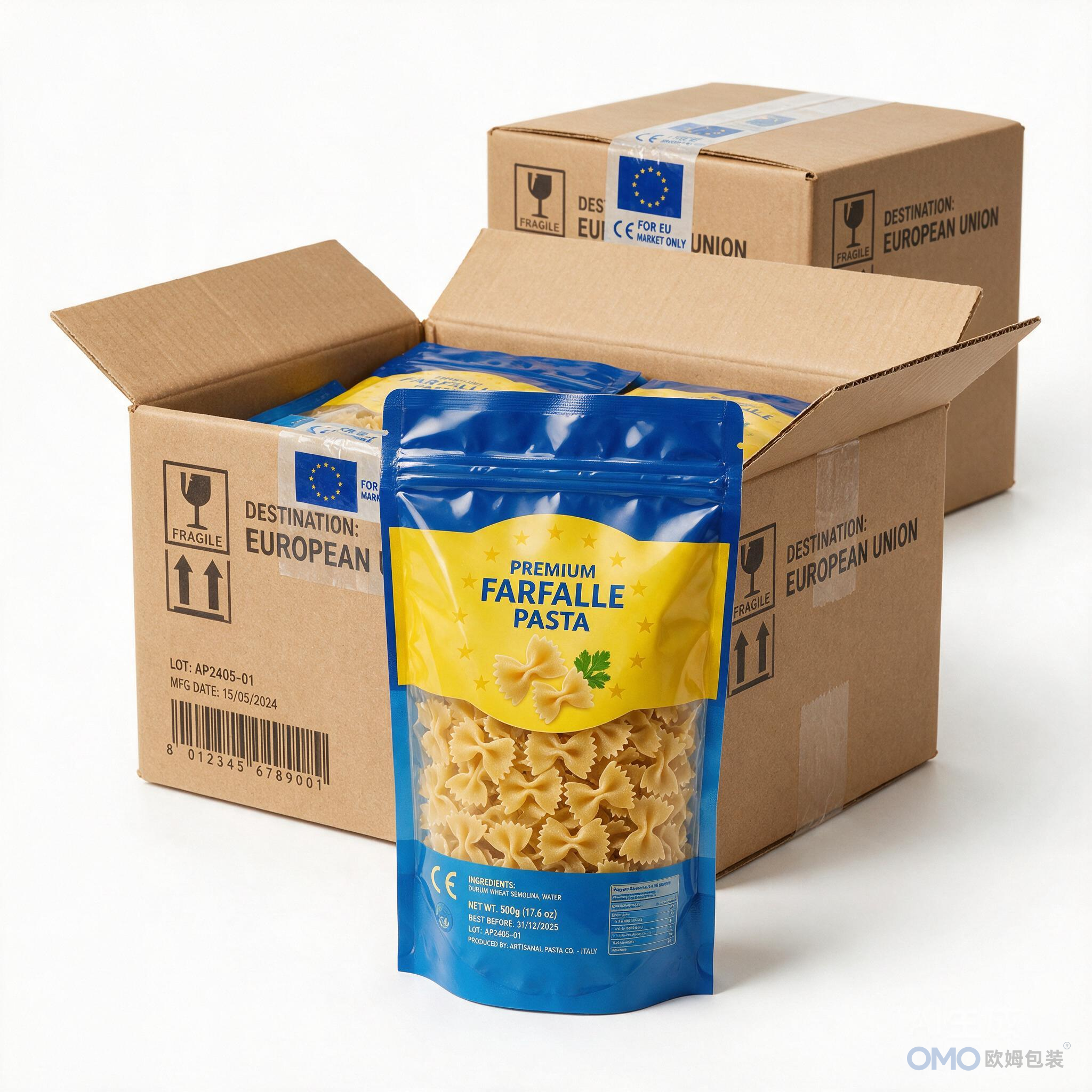
The CE mark is a mandatory safety certification mark for products in the EU market, covering a very wide scope. For food packaging products, the CE mark indicates compliance with the EU’s basic health, safety and environmental requirements. Note carefully: the CE mark is not a quality mark — it shows the product meets the minimum requirements of the relevant EU directives. Food packaging materials exported to the EU must meet EU 10/2011 and pass migration testing in accredited laboratories before the CE mark can be affixed. Companies must prepare complete technical files — product descriptions, design drawings, test reports and Declarations of Compliance — kept for at least 10 years for regulatory inspection.
Affixing the CE mark involves several key steps. First, confirm which EU directives and regulations apply — mainly EU 10/2011 for food packaging materials. Second, run product testing to ensure every component is on the EU 10/2011 positive list and migration values meet the limits. Third, compile the technical file with all test reports and design materials. Finally, sign the Declaration of Compliance and affix the CE mark. The whole process requires professional technical knowledge and regulatory understanding — consult a compliance advisor before your first export.
EU 10/2011 explained in detail
EU 10/2011 is the specific regulation for plastic food contact materials and a core part of the EU’s food contact material system. It establishes a positive list (Union List) of monomers, other starting substances and additives permitted in food contact plastics. In principle, substances not on the positive list cannot be used unless specifically exempted. The regulation sets clear limits for both overall and specific migration: overall migration must not exceed 10 mg/dm², while specific migration limits vary by each substance’s toxicological data. For more regulation comparisons, visitGlobal Packaging Regulations Comparison Guide。
Beyond substance compliance, EU 10/2011 also sets specific requirements for Declarations of Compliance and labeling. The DoC must include manufacturer information, material description, applicable regulatory articles, test result summaries and other key information. In addition, the EU requires companies to build complete traceability systems, with records for every step from raw material purchase to finished goods dispatch. For laminated materials, each layer must separately meet EU 10/2011 — or use the functional barrier concept to simplify compliance.
Preparing the Declaration of Compliance (DoC)
The Declaration of Compliance (DoC) is an indispensable compliance document for the EU market. Under Article 15 of EU 10/2011, manufacturers of food contact plastic materials must provide written Declarations of Compliance to customers. The DoC must include: the declaring manufacturer’s name and address, description of the material or product, applicable regulatory articles (including EU 10/2011 and its amendments), a summary of compliance test results, and restrictions on conditions of use (temperature range, contact time, food type, etc.). For the complete FDA registration process, refer toFDA Food-Contact Material Registration Guide。
Preparing the DoC must be based on sufficient test data. Recommended test conditions should simulate the harshest real-world use — highest use temperature, longest contact time and most aggressive food simulants. Test reports should come from accredited independent laboratories, typically meeting ISO 17025. Beyond initial type testing, companies should build routine quality control systems and run periodic verification tests to ensure continued compliance. We recommend a complete compliance document management process, safely retaining all technical files for at least 10 years.
The REACH regulation and the Packaging and Packaging Waste Directive
Besides food contact material rules, packaging exported to the EU must also meet the REACH regulation and the Packaging and Packaging Waste Directive. REACH governs the registration, evaluation, authorization and restriction of chemicals — every chemical in packaging materials must comply with REACH limits. In particular, substances on the SVHC (Substances of Very High Concern) list must be communicated down the supply chain when present above 0.1%. Directive 94/62/EC on packaging and packaging waste sets strict heavy metal limits: the total of lead, cadmium, mercury and hexavalent chromium must not exceed 100 ppm.
In addition, the EU is advancing a major revision — the Packaging and Packaging Waste Regulation (PPWR). The new regulation will require all packaging to be recyclable or reusable by 2030, with stricter recycled content requirements. For exporters to the EU, this is an important policy signal: the future trend is tighter environmental requirements. Companies should start integrating sustainable packaging into product planning now — gradually raising recycled content and optimizing designs for recyclability.
Still have questions about EU export packaging compliance? Welcome toContact Us, get professional EU market compliance advice and material recommendations.