
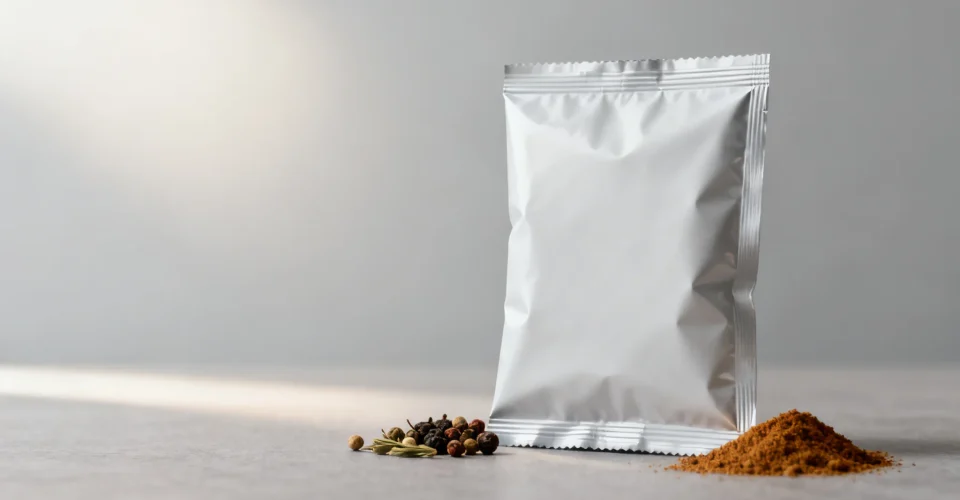
Spice packaging fails in two ways that look alike on a shelf: the product loses the volatile oils that carry its aroma, or it takes on odours and residues from elsewhere in the plant. Both get blamed on the film, and both are usually created by the combination of grind size, pouch structure and the conditions between the filling line and the customer’s kitchen. Define what the aroma has to survive, choose the barrier as a set of separate properties, then settle the seal and the line hygiene. Over-specifying one while under-specifying another is the usual reason a spice pouch performs worse than its data sheet suggests.
Key Takeaways
- Grind size is the first variable. Milling ruptures plant cells and exposes far more surface area, so a fine grind gives up its volatiles faster than a whole or cracked spice held in the same film.
- Barrier is three separate questions — moisture, oxygen and aroma — plus light. A structure can be strong on one and ordinary on the others.
- Cross-contamination is mainly a line and storage problem: shared hoppers, shared bins, dusty sealing zones. A better film cannot correct it.
- On a dusty grind running through a form-fill-seal machine, seal cleanliness affects aroma retention more than an extra micron of film.
What actually causes aroma loss in spice packaging?
Whole spice keeps its volatile oils inside intact cell structures. Grinding ruptures those cells, and the oils become free to migrate to the particle surface and then into the pouch headspace. The finer the grind, the shorter the path from the centre of a particle to the air around it, and the larger the total exposed area for the same weight. A milled spice and a whole spice with comparable oil content therefore behave differently in the same pouch.
From the headspace, volatiles leave by three routes. They permeate through the film by solution and diffusion, which depends on the polymer and on temperature. They escape through seal defects: a fold, an incomplete seal, or a channel created by a particle caught in the sealing area. They are also removed physically every time the pouch is opened, which is why reclosability changes what happens after the first use rather than during distribution.
The order matters for specification. If loss is happening at the seal, a heavier barrier film will not recover it. If it is happening through the film, better line hygiene will not recover it either. Diagnostic work that changes only one of the two is a common reason a spice project loops through samples without improving.
Which structures hold aroma, and where do they fail?
Most retail spice packaging sits inside three broad structural families. The comparison below stays qualitative on purpose. Exact transmission values depend on the polymer grade, coating, adhesive and thickness of the lamination in front of you, and those figures belong in a supplier test report for the offered structure rather than in a general article.
| Structure family | Normally chosen for | Where it tends to fall short |
|---|---|---|
| Clear PP- or PE-based laminates | Product visibility, lower material cost, mono-material recyclability work | Lower moisture and aroma barrier than metallized or foil options; light passes through |
| Metallized PET laminates | Light blocking plus improved moisture barrier at moderate weight | The metallized layer can scratch or crack at folds and creases, creating local weak points |
| Aluminium foil laminates | Highest combination of moisture, oxygen and light barrier in a flexible pouch | Foil creases can crack; metal detection and microwave reheating become constraints; usually the heaviest option |
Table scope: retail and food-service spice pouches. Data nature: supplier literature and general industry practice, qualitative, no measured values. Conditions: ambient distribution unless stated.
Two practical points follow. A structure is not chosen by family alone, because the sealant layer decides how the pouch behaves on a dusty, oily product. And the pouch format interacts with the structure: a flat-bottom or quad-seal pouch puts more film under more folds than a simple three-side-seal pouch, and each fold is a place where a brittle barrier layer can be damaged. Our guide to how moisture, oxygen and light barrier compare across structures sets out the trade-offs in more detail.
Concept packaging visual generated for editorial use. Not a customer project, not a tested structure.
Does cross-contamination come from the film or the filling line?
Most cross-contamination in spice packing is a process problem. The usual sources are changeover residue in hoppers, screw feeders and vibratory trays; dust that settles on sealing jaws and in the sealing area; bins and tote bags that previously held a stronger-smelling material; and storage that leaves a mild spice beside a pungent one for weeks. Aroma compounds are small molecules, and a film that is an effective barrier for a sealed pouch need not be an effective barrier for a film roll stored in the same room as a strong odour source.
Film contributes mainly through adsorption. Sealant layers can take up odour compounds at the surface, particularly after a long run with a pungent product, and release them slowly into a later batch. That is why a changeover procedure that cleans the machine but leaves the same film roll in place sometimes still produces an off-note.
A short diagnostic sequence helps separate the two. Pack a neutral reference product on the suspect line, hold it at ambient for several days, and evaluate the headspace before opening. If the reference is clean, the film is unlikely to be the source. If it is contaminated, the line, the storage room and the film handling sequence all become candidates, and the material specification is the last item to change.
Steps to specify a spice pouch without over-specifying
- Write the aroma target in the customer’s terms: what the spice should smell like when the pouch is opened, and after how long in distribution. This becomes the acceptance criterion.
- Fix grind and particle size distribution with the product team, not with the packaging supplier. Grind is a product decision that sets the barrier requirement.
- Treat barrier as three properties. Moisture, oxygen and aroma each need a decision, and the one that matters most drives the structure. Light exposure adds a fourth where the pouch is displayed.
- Size the pouch around fill weight tolerance and stack height rather than a preferred look. Dusty product settles, and an oversized headspace leaves more air for volatiles.
- Define the seal window on the actual product. Sealing through a dusty, oily layer is the most common mechanical cause of aroma loss, and the usable window is narrower than the one published for clean film.
The same order applies when the product is a blend rather than a single spice, which is the case for most seasoning packaging solutions supplied as complete programmes: salt, acid and oil content join grind as specification drivers.
What to check on samples before you commit
Sample evaluation for spice has to include the product as well as the film. Seal strength and seal appearance should be checked on pouches filled with the real grind on the real machine. Creases should be inspected after a drop and a compression test that reflects the distribution route, because crease cracking is the failure mode a flat sample never shows. Reclose features, where used, should be cycled with the actual particle size present, since dust in a zipper track and a clean track behave differently.
An aroma comparison is worth building into the sample schedule. Hold filled pouches at ambient and evaluate the headspace of the sealed pouch before opening it, at more than one point in time, against a retained reference from the same batch. The comparison is between your own samples, so no external benchmark or shelf-life claim is implied. Pre-made three-side-seal seasoning pouches suit this stage because they can be filled on a short run.
Which test methods and references actually apply?
Where barrier performance has to be compared between suppliers, the usual test families are water vapour transmission rate, oxygen transmission rate and seal strength. ASTM F1249 covers water vapour transmission through plastic film, and ASTM F88/F88M covers seal strength measurement. Both are voluntary standards: they apply when a buyer writes them into a specification, and the test conditions and sample preparation matter as much as the method number.
On the food contact side, EFSA’s food contact materials framework describes how the European assessment is structured, and the obligations that follow for a food business depend on the market being supplied. A lamination compliant for one market is not automatically compliant for another, and the declaration of compliance should come from the converter for the exact structure.
Conclusion
Aroma loss and cross-contamination are controlled in a fixed order before any film decision: grind first, then barrier as three separate properties, then the seal and the handling conditions around the line. For a whole spice in fast turnover, a metallized structure with a verified seal window and a disciplined changeover routine is typically sufficient. For a fine blend facing months of ambient storage and display, the case for a foil laminate and a tighter sealing specification is stronger. Both decisions follow the aroma target and the distribution route, and both should be confirmed on pouches filled with the real product rather than on flat film samples.
Frequently Asked Questions
Does ground spice always need a foil laminate?
No. Foil is justified when the pouch has to hold volatiles through a long ambient shelf life or when light exposure is part of the display, and it is often unnecessary for product that moves quickly. A metallized structure with a well-controlled seal will hold a moderate aroma target over shorter distribution. In spice packaging, the deciding factors are the aroma target, the expected time on shelf, how the pouch is displayed, and whether metal detection is used in the plant. Confirm the choice by comparing filled pouches from your own production rather than by comparing data sheets.
Can one pouch structure cover both whole and ground spice?
It can, but only if the specification is written around the finer grind. Whole spice has far less exposed surface, so a structure that suits ground product will over-deliver on whole product, and the reverse does not hold. Running one film across both formats is a legitimate simplification when the product mix is stable, provided the seal window is set to handle the dustiest item and the aroma target is set for the longest shelf life in the range. Where both formats run on one line, changeover cleaning becomes part of the aroma specification.
Why does a spice pouch smell off even when the seal is intact?
The likely causes are adsorption and migration rather than leakage. Sealant layers can take up odour compounds during a long run of a pungent product and release them into a later batch, and a film roll stored near a strong odour source can carry that odour into the pouch. Solvent residues left from lamination are a further possibility. Check the sequence before changing material: pack a neutral reference product on the line, hold it at ambient, and evaluate the headspace before opening. If the reference is clean, look at storage and changeover practice first.
How do I compare two film quotes for an aroma-sensitive spice?
Ask for identical information from both suppliers so the comparison is like for like: full structure with layer order, nominal thickness of each layer, sealant type, and transmission data with the test method and conditions stated. Then run both structures on the same product and the same machine and compare headspace aroma on retained samples over the same period. A quote that gives only a total micron figure or a barrier adjective cannot be set against one that gives a structure. Where a supplier cannot state the method behind a barrier figure, treat that figure as unverified.



