
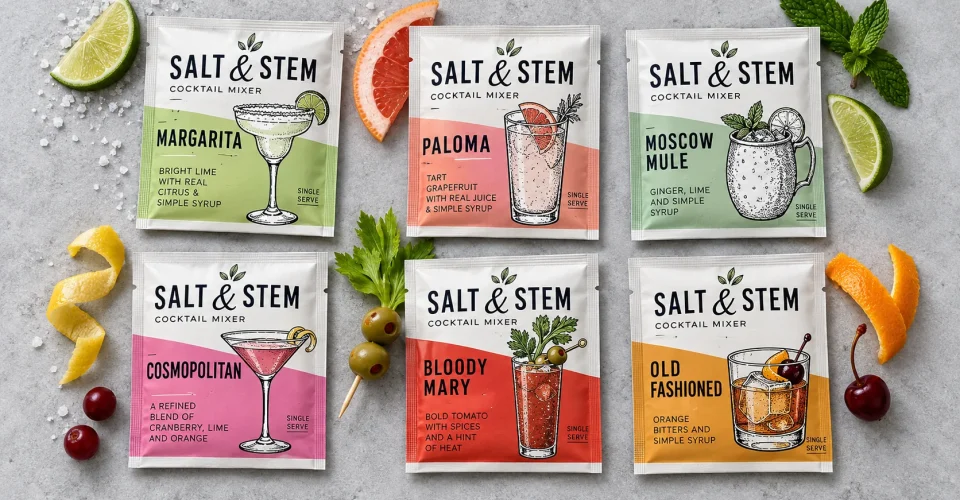
A single-serve drink mix sachet looks simple until it reaches a fast packing line. Fine powder drifts into the seal. Citric acid and sugar collect on machine parts. A tear notch that works on an empty sample can split badly once the sachet is full. And a film that feels suitably “high barrier” may still be wrong for the product’s humidity exposure or the sealer’s operating window.
The way through those problems is to treat the sachet as part of the dosing and sealing process—not as artwork wrapped around a serving. For cocktail mixers, electrolyte powders, instant tea and flavored drink bases, the first useful facts are the powder’s flow, particle size, tendency to absorb moisture, oil or flavor content, dose weight and the machine that will form and close the pack.
Powder behavior shows up at the seal
Drink-mix powders rarely fall as one clean, compact plug. Very fine fractions can remain airborne after dosing, especially at production speed. Granules may bounce. Static can hold particles against the inner web. When that material reaches the cross-seal, the package may look closed while containing a weak channel.
Before changing the laminate, watch the filler. Check the drop height, timing between dose and jaw closure, extraction, forming-tube condition and the headspace above the product. A slower bench sample does not reproduce a line running at normal speed. Trials should include the powder from routine production, including the fines that often settle in the bottom of a batch.
Moisture protection starts with the product, not a material name
Sugar, salts, acids and some flavor systems readily take up moisture. The result may be caking, slow dissolution or a flavor change long before there is any obvious package damage. The required water-vapor barrier depends on the actual formulation, sachet area, target shelf life and the climate through which it travels.
Ask for transmission data with the test temperature and humidity attached. Then check the converted sachet, because folds and seals are part of the package. Where the product is especially moisture-sensitive, run storage work in the warm, humid conditions expected in distribution rather than relying only on room-temperature samples.
Three-side seal sachet or rollstock?
Premade three-side-seal pouches can suit trial quantities, manual filling and products that need a wider filling opening. Rollstock usually makes more sense on form-fill-seal equipment, but only when web width, repeat length, friction, stiffness, curl and registration match the machine.
For a rollstock project, send the converter the machine model, unwind direction, eye-mark requirements, maximum roll diameter, core size and intended running speed. OMOPACK’s custom rollstock overview is a useful checklist, but an on-line trial remains the deciding step.
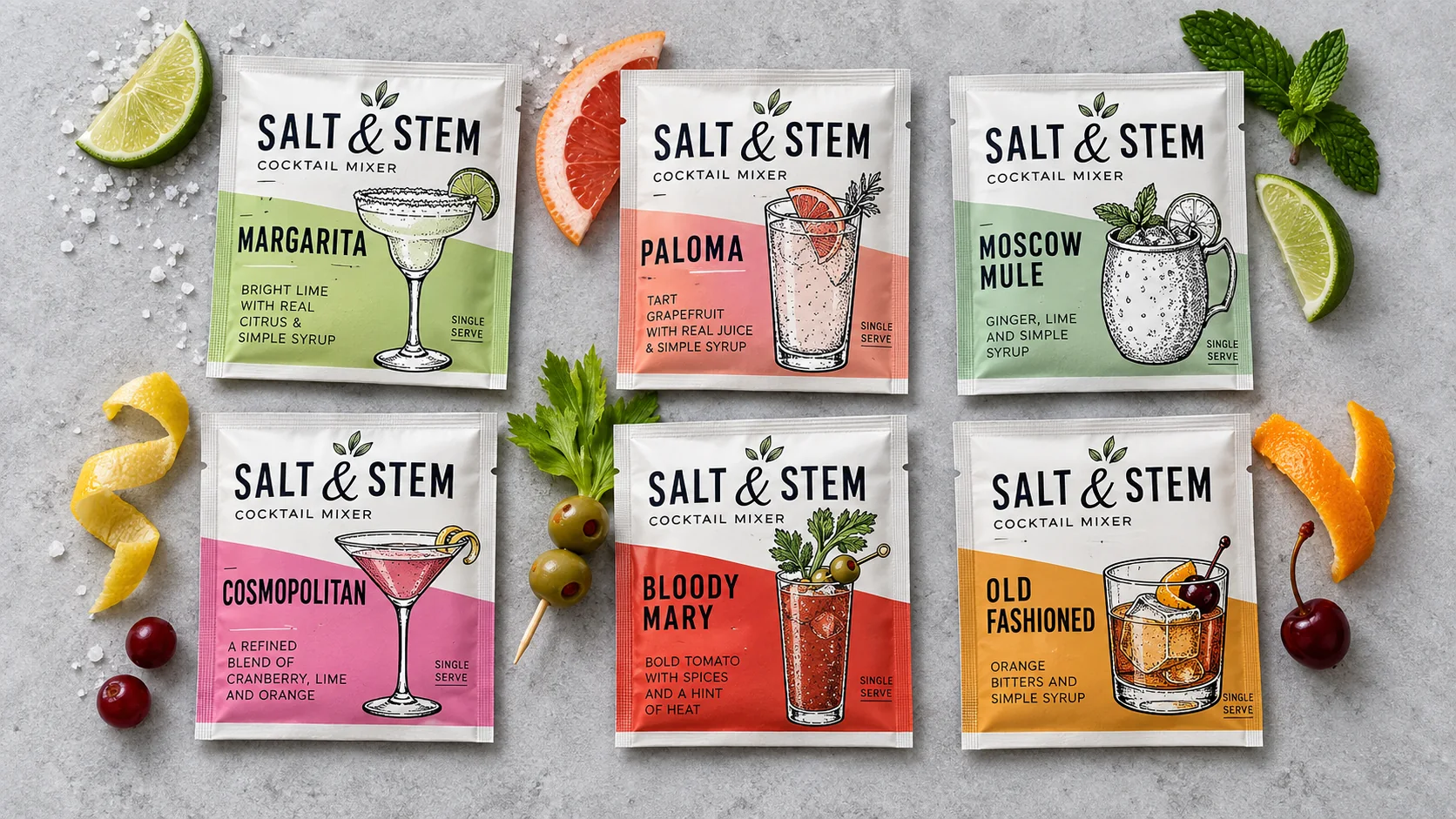
Concept image showing single-serve drink-mix sachets; final materials and seal settings require line and product validation.
Opening should be tested with real hands and a full sachet
A tear notch must start reliably without weakening the side seal. The tear path also has to clear the product and produce an opening suitable for pouring into a bottle or glass. If the opening is too narrow, powder bridges or spills; if it is too wide, the dose can leave the pack all at once.
Test left- and right-handed opening, dry and slightly damp fingers, and users who do not know where the tear is supposed to travel. Check whether the lot code remains readable after opening. These small trials catch problems that a flat artwork approval cannot.
Seal strength is useful only when the method is recorded
Seal temperature, pressure, dwell time and contamination tolerance need an operating range, not one “best” setting. ASTM describes F88/F88M for seal-strength testing and F1921 for hot tack. The applicable method, specimen preparation and acceptance range should be agreed before commercial production.
For flavored powders, confirm that the sealant and other food-contact layers are appropriate for the formulation and target market. Regulatory documentation belongs with the final structure, inks and adhesives—not with a generic film family.
What to put in the first sampling brief
- Full product type, dose weight, particle range and known moisture sensitivity
- Machine model, sealing-jaw style, target speed and roll constraints
- Target shelf life, distribution climate and carton configuration
- Required tear direction, opening width and coding area
- Barrier, seal, leak and line-trial methods to be used for approval
Questions that usually arise
Does every drink powder need foil?
No. Foil, metallized and transparent barrier structures offer different combinations of barrier, flex resistance, appearance and machinability. The formulation and shelf-life work should decide.
Can one rollstock structure cover several flavors?
Often, but the most demanding formula should be identified. A flavor containing oil or a more hygroscopic acid-sugar blend may set the barrier requirement for the range.
Why do seals fail only at full production speed?
Higher speed changes powder settling time, hot-tack demand and the time available for the jaws to form a seal. That is why normal-speed trials matter.
The best sachet sample is not simply the neatest one on the desk. It is the one that doses cleanly, seals across a workable range, opens without fuss and keeps the actual powder within its agreed limits through distribution.



