Laundry pod packaging fails in the field for two reasons far more often than any other: moisture reaches the water-soluble film, or the container cannot be closed safely away from children. Everything else — print, shelf presence, dispensing features — sits behind those two constraints. This guide works through how moisture ingress ruins pods, which barrier options fit rigid containers and flexible pouches, what child-resistant requirements change in the structure, and how to verify a format before scaling.
Why Does Moisture Decide Everything for Laundry Pod Packaging?
Laundry pods are built on polyvinyl alcohol (PVA) film, engineered to dissolve in the wash. The same property that makes the film useful makes it the packaging’s weak point: the film absorbs water vapor from the surrounding air, and once it picks up enough moisture it turns tacky, pods begin to fuse, and dissolved contents can leak into the pack. Humidity during storage, transport and even on the consumer’s shelf works against the product continuously, so the packaging’s job is to keep the internal environment dry for the entire shelf life. Moisture vapor transmission through the barrier is measured with methods such as ASTM F1249, and the target is set by the film’s sensitivity and the claimed shelf life rather than by a universal number. Any discussion of a laundry pod packaging format should therefore start with a humidity budget, not with a container shape.
Which Barrier Options Fit Rigid Containers and Pouches?
Rigid tubs dominate the retail shelf for pods, and their barrier comes from the material and the closure. Container candidates include high-barrier rigid plastics, and in some formats co-extruded structures with a barrier core; the closure system matters as much as the tub, because a wide threaded opening is a large potential ingress path. Flexible stand-up pouches are the common refill and e-commerce format, and their barrier is built into the lamination, with foil or metallized layers as the high-barrier candidates and transparent EVOH-based structures as the visibility-oriented option. Seals on pouches deserve particular attention: a wide, flat seal made on a well-maintained jaw usually outperforms a narrow one, and every seal is a potential channel if powder or liquid contaminates the sealing area during filling.
| Item | Rigid tub | Flexible pouch |
|---|---|---|
| Barrier source | Container material plus closure | Lamination structure |
| Ingress paths | Threaded closure, gasket | Seals, pinholes, zippers |
| Typical role | Retail shelf, count packs | Refill, e-commerce, multi-packs |
| Key check | Closure repeatability | Seal integrity after filling |
What Do Child-Resistant Requirements Change?
Laundry pods are an ingestion risk category in most markets, and regulators have responded with child-resistant packaging expectations — the EU detergent regulation regime and national rules in other regions have pushed flexible-film child-resistant closures for pods in recent years. For the structure, this usually means a certified child-resistant closure on rigid tubs, or flow-wrap and pouch formats engineered with specific tear and opening features that pass a recognized child-resistance protocol. The engineering consequences are real: closure systems add cost and assembly steps, and flexible formats may need a secondary barrier or a modified seal layout to carry the required closure features. Confirm the destination market’s exact requirement in writing before tooling, because expectations differ between regions and change over time.
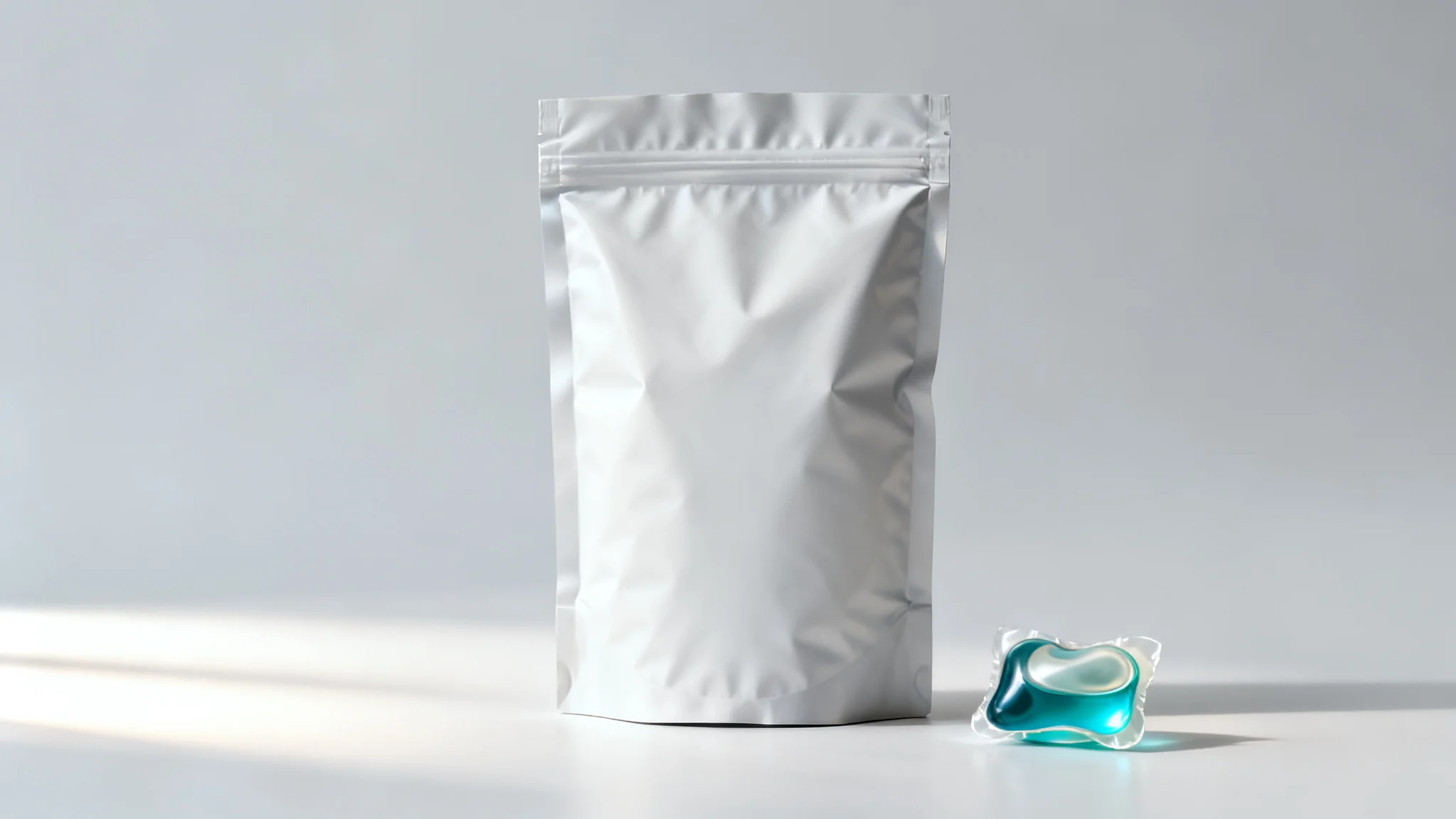
Concept packaging visual generated for editorial use. Not a customer project, not a tested structure.
A Step-by-Step Verification Sequence Before Scaling
Verification runs the format through the conditions that will actually surround it. A practical sequence starts with stability storage at controlled humidity and temperature against the claimed shelf life, followed by transport simulation covering stacking, vibration and drop, and then a leak and seal review after the transport cycle rather than before it. Water vapor transmission data for the chosen structure, measured per ASTM F1249 or an equivalent method, should be compared against the stability result, not treated as a standalone pass. For pod-specific risk, check the pod-to-pod and pod-to-film surfaces after storage: tackiness and fusion are the earliest visible signals that the humidity budget is not being met. Gross leak practices such as ASTM F2096 give the seal and leak review a documented backbone.
Where Does This Guidance Apply — and Where Not?
This applies to single-chamber laundry pods in water-soluble film, sold in rigid tubs, stand-up pouches or flow wraps, across retail and e-commerce channels. It applies with extra force to e-commerce, because parcel transit combines vibration, stacking and uncontrolled humidity in one journey. It does not by itself cover multi-chamber pods with separate actives, where chemical compatibility between chambers adds a design layer, nor fabric-care products that use conventional non-soluble films. Home-care liquid products in spouted pouches follow a different logic centered on dispensing; our home and personal care packaging page covers that side. For the pouch option specifically, our laundry pod pouch shows a current implementation, and the broader liquid-packaging context sits in our liquid packaging bags guide.
Key Takeaways
- Moisture ingress is the primary failure mode; set a humidity budget before choosing a format.
- Rigid tubs carry barrier in the container plus closure, pouches carry it in the lamination.
- Child-resistant expectations are structural, so confirm the market rule before tooling.
- Verify with stability storage plus transport simulation, and inspect seals after the cycle.
Conclusion
Treat a laundry pod package as a moisture control system with a safety closure attached. Define the shelf life and the humidity conditions it must survive, pick the barrier accordingly, and only then argue about tubs versus pouches. Where the market’s child-resistant rule is unclear, get the written requirement first, because retrofitting a closure onto a finished structure is expensive. Formats that pass stability storage and transport simulation with dry, non-fused pods at the end are the ones worth scaling.
Frequently Asked Questions
Can standard moisture-barrier film protect laundry pods well enough?
Only against the humidity profile it was chosen for. A barrier that keeps conventional detergent powder stable can still let enough vapor through to tackify a PVA film over a long shelf life, because the soluble film’s sensitivity is far higher. For any laundry pod packaging format, the working method is to match measured water vapor transmission against the product’s own stability data at controlled humidity. If pods stay dry and separate through the full storage test, the barrier is adequate for that shelf life and market.
Do child-resistant requirements apply to refill pouches as well as tubs?
In many markets they do, and the expectation keeps expanding across pod formats. The exact rule depends on the destination market’s detergent and child-protection regulations, so confirm it in writing with the customer’s regulatory contact before locking a structure. Refill pouches usually meet the requirement through engineered film or closure features rather than a rigid cap, which affects both the lamination and the filling process. Budget for certification testing of the final format, not just the component.
Why did pods fuse together inside an apparently intact pouch?
Fusion means moisture reached the PVA film, even though the seal looked sound. The vapor usually enters gradually through the barrier or slowly through a micro-channel at a seal, so the pouch shows no visible defect. Check the storage humidity record first, then review transmission data for the lamination, then examine seals under magnification for channels. Recurring fusion across batches points to the barrier; single-batch fusion points to a sealing or handling event.
What should a supplier be given before quoting laundry pod packaging?
At minimum: pod count and dimensions, water-soluble film type, target shelf life, sales channel, distribution route, and the destination market’s child-resistant requirement. These inputs decide if the quote should cover a rigid tub, a pouch or both, and which barrier class enters the sampling round. Leaving the child-resistant requirement undefined is the most common reason a quoted format has to be re-engineered after regulatory review.