Key Takeaways
- A dish soap refill pouch is limited by two joints, not by the film as a whole: the sealant layer that touches the surfactant, and the spout weld that carries every squeeze.
- Surfactant attack rarely shows up as a hole. It shows up as a seal that keeps creeping, a print that lifts at the edge, or a cap that no longer seats after the fifth refill.
- Sealant choice is a compatibility question, not a price question. Two structures that look identical on a spec sheet can behave differently after eight weeks of contact.
A dish soap refill pouch is a contact problem before it is a printing problem. The surfactant that makes the product work also lowers surface tension enough to wet the inside of a seal, and it keeps working on that seal for the whole shelf life. The pouch only performs when the sealant layer resists that contact and the spout keeps sealing after repeated opening. Everything else — print, shape, fill volume — sits on top of those two decisions.
What a Dish Soap Refill Pouch Has to Survive
Hand dishwashing liquid is a concentrated surfactant system, usually with anionic surfactants as the main active, plus foam boosters, perfume, dye and a preservative or two. In a bottle, the formula only touches rigid HDPE or PET. In a refill pouch, it sits against a thin sealant film with a much larger contact area per unit of product, and it is squeezed, tipped and stored upright next to a wet sink for weeks.
Four loads act at once: chemical contact that softens the sealant, squeezing and standing weight on a half-full pouch, warmth from a shelf or windowsill, and moisture around the cap thread. A structure that passes a short fill trial can still fail one of these at month two.
A bottle’s material is chosen for rigidity and gloss; a refill pouch’s sealant is chosen for sealing through contamination and for chemical resistance. Different problems, different answers.
Which Film Layers Take the Surfactant Load
In a three-layer refill structure the work is divided. The outer layer carries print and handles abrasion in the carton. The middle layer, when there is one, controls oxygen, aroma or stiffness. The inner sealant layer does the sealing — and it is the only layer in direct contact with the surfactant.
| Layer | Main job | What surfactant contact does to it |
|---|---|---|
| Outer (reverse print, PET or BOPP) | Print surface, stiffness, scuff resistance | Rarely contacted directly; edge wicking can lift print near a poorly trimmed seal |
| Middle (metallised PET, foil, EVOH or nylon) | Barrier and mechanical support | Not a contact layer; adhesive between layers is the weak point if the seal edge is exposed |
| Inner sealant (PE, metallocene PE, EVA-based, ionomer) | Sealing through product, flex crack resistance, heat-seal window | The real contact surface. Wetting, softening and stress cracking all start here |
Sealant candidates are usually described as “PE” in a quotation, which hides most of the decision. A standard low-density PE seals easily but softens in prolonged contact with concentrated surfactant. Metallocene grades trade sealing speed for toughness. EVA-based sealants seal at lower temperatures, which helps with a warm fill, but their resistance depends on the vinyl acetate content. Ionomers resist many chemicals well and suit aggressive products, at a higher cost and a narrower sealing window.
None of these is a default. The right way to read the list is as candidate directions, each of which has to be tested against the actual formula at the actual concentration.
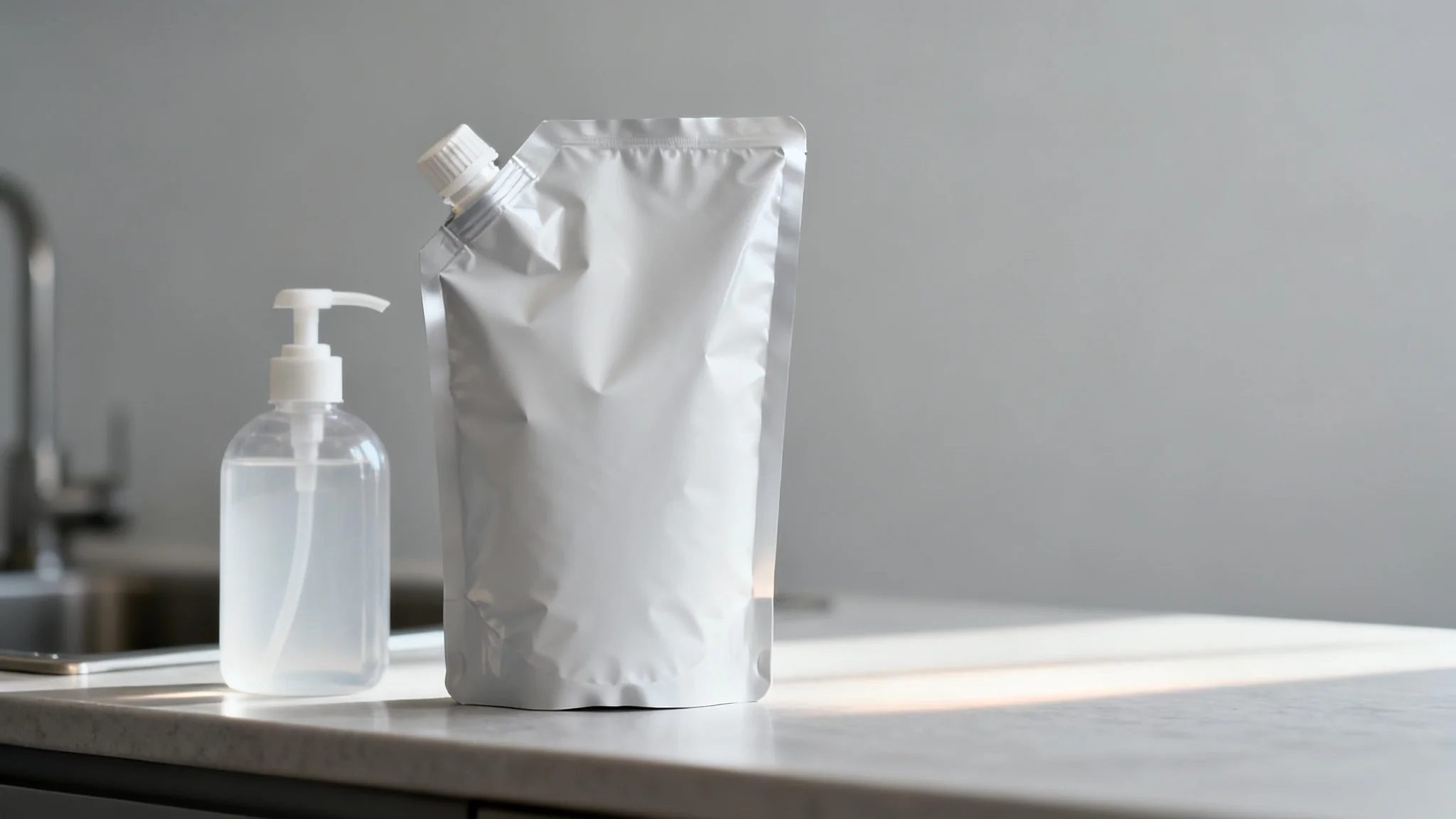
Concept packaging visual generated for editorial use. Not a customer project, not a tested structure.
Signs of Surfactant Attack in a Filled Pouch
Attack is slow and quiet. The first sign is a seal that will not hold its width: the band looks narrower at the corners after storage, and seal strength on a strip pulled at 90° falls between the first week and the eighth. On shelf this becomes a leak at the bottom corner, which consumers read as a bad pouch rather than a bad sealant.
The second sign is delamination at the seal edge. Product wicks into the cut edge, reaches the adhesive between layers, and the film separates in a thin lip that looks like a white halo around the seal. It does not always leak, but it makes later leak tests ambiguous.
Third, the spout. Residue left after pouring dries into a film, and the next time the cap closes that film sits between plug and seat. After a few cycles the cap leaks at the tip while the pouch body is still sound — the failure consumers complain about most, because it happens with product still inside.
Where It Applies, and Where It Does Not
These points apply to concentrated hand dishwashing liquid sold as a refill for a durable bottle, in pouch sizes a consumer carries home by hand. They also apply to refill formats for hand soap, all-purpose cleaner and laundry detergent, since those are all surfactant systems with similar contact behaviour, and the same logic runs through the home and personal care packaging solutions built for those products.
They do not apply unchanged to ready-to-use products diluted at the factory, where surfactant concentration at the seal is lower and contact time shorter, nor to single-use sachets discarded before attack matters. They are also no substitute for a compatibility test: a supplier who offers a structure without asking for the formula, fill temperature and storage condition is guessing on your behalf.
How to Run a Compatibility Check Before Ordering
Ask for three candidate structures rather than one. A standard PE sealant, a metallocene or EVA variant, and an ionomer or other higher-resistance option give you a range to test instead of a single yes-or-no answer.
- Fill each candidate with production-concentration product at the production fill temperature, not with water and not with a diluted sample.
- Store sets at room condition and at an elevated temperature, upright and on the side, so the seal edge is wetted in both orientations.
- Pull seal strength on strips cut from the same area of the pouch at day zero, mid-point and end of the intended shelf life, using a method such as ASTM F88 so results are comparable between suppliers.
- Run a gross-leak check on the same samples after squeezing, for example the bubble emission method in ASTM F2096, and record where any leak appears, not just that one appears.
- Inspect the seal edge, the print near the seal, and the spout seat, and photograph all three at each interval. Photographs settle most later arguments.
The output of that sequence is a structure you can defend, not a structure that happened to pass a two-week trial. If two candidates are close on seal strength, choose on the spout behaviour and on how the pouch empties, because that is what the consumer experiences.
What the Spout and Cap Face After the First Refill
The spout is welded into the pouch, so it inherits two loads: the weld itself and the repeated torque of opening. The options and limits of that joint are covered in this guide to spout pouch packaging. A weld that is adequate on the day of filling can fatigue if the fitment base is thin relative to the pouch panel; whitening at the flange radius is the early signal.
Cap function is a separate design. A flip cap with a plug relies on the plug seating into the bore, and residue on the bore defeats that seal long before the hinge fails. A screw cap with a liner depends on the liner staying flat and the thread not being crossed in a hurry. Both depend on how the spout drains: a spout that holds a drop will always leave residue.
The practical check is a reuse trial, not a torque test. Fill ten pouches, have people open, pour, close and store them upright next to a sink for the number of refills you expect, and note when dripping starts. That matters more than the cap’s specification.
Which Refill Format Fits the Product and the Shelf
Three formats dominate among dish soap refill pouches. A stand-up pouch with a top spout is the easiest to fill and the most familiar on shelf; it empties well if the spout is large enough for the viscosity. A pouch with a corner spout in the base area lets the pouch stand and drain with less tilting, but the corner weld takes more stress when the pouch is squeezed. A wide-mouth screw-cap pouch pours fast and is easy to refill from, yet it needs a stiffer panel or it folds at the neck.
Choose by viscosity and by how the consumer pours, then confirm by filling and emptying ten units by hand. A format that leaves product in the corners will be judged a bad refill, however good the film is.
Conclusion
Specify the dish soap refill pouch from the contact side outward. Fix the sealant candidate against the real formula, confirm it with seal strength and leak checks over time, then choose the spout and cap from a reuse trial rather than a data sheet. Concentrated product with a long shelf life justifies a higher-resistance sealant; a short-life promotional refill may not. What should not happen is choosing the film first and finding out about the seal after the print run.
Frequently Asked Questions
Does a dish soap refill pouch need a foil layer?
No, not for surfactant resistance. A foil or metallised layer is there for oxygen, aroma and light, so it belongs in the structure when the perfume or the colour is sensitive to those, not because the product attacks film. Many hand dishwashing liquids are sold in clear or white pouches without any metallised layer. What the pouch does need is a sealant that resists the surfactant and seals through any product in the seal zone, and that is decided by the inner layer and the filling condition, not by the barrier layer.
How many times can the spout cap be reopened before it leaks?
There is no fixed number, because it depends on the cap design, the spout bore and how cleanly the pouch pours. A plug-type flip cap that traps residue can start dripping well before the hinge wears out, while a screw cap with a flat liner may hold much longer. The only reliable answer comes from a reuse trial with your own product: fill ten pouches, cycle them the number of times a refill is expected to be used, and record when the first drip appears at the tip.
Can we use the same structure as our laundry detergent refill pouch?
Usually not without a check, even though both are surfactant systems. Hand dishwashing liquid and laundry detergent differ in active level, pH, salt content and perfume load, and each of those changes how the sealant behaves over time. A structure that has held up in a laundry refill is a strong candidate and worth testing first, but it should still go through a fill-and-store trial with the dish formula. Reusing a validated structure shortens the work; it does not remove the test.
What should we send a supplier before asking for a refill pouch quotation?
Send five things: the formula or at least its surfactant type and active range, the fill temperature, the intended shelf life and storage condition, the fill volume with the headspace you plan to leave, and how the consumer will pour. With those, a supplier can propose candidate sealants and a spout size instead of quoting a generic pouch. Without them, every quotation is a guess and the samples you receive will not be comparable, which costs more time than the information would have.