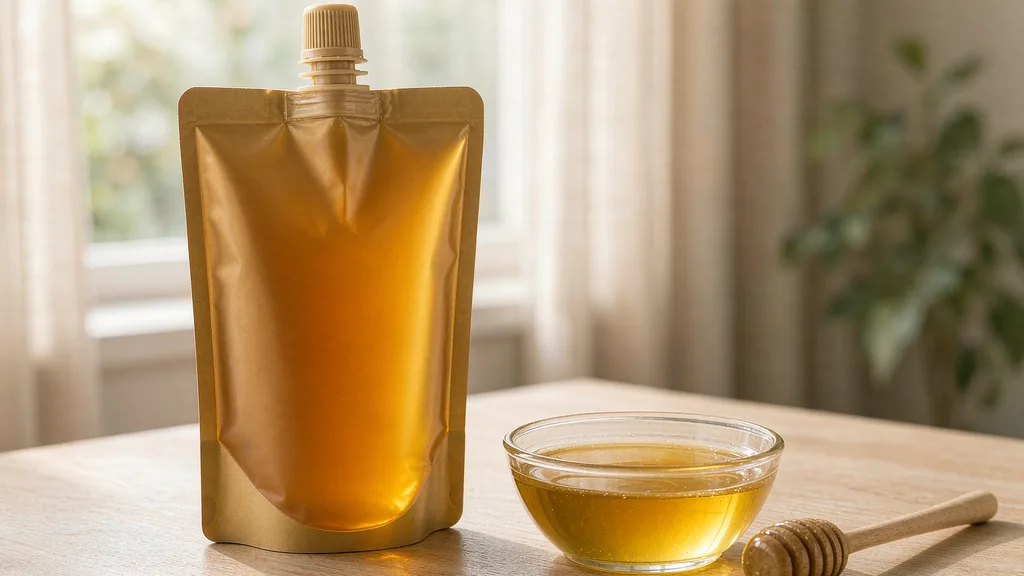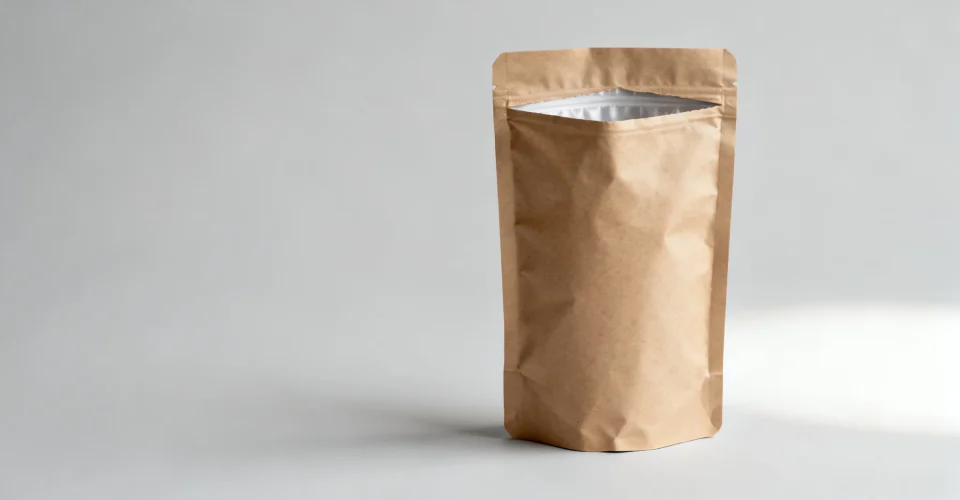
Custom kraft paper pouches for food are paper-first flexible structures: an unbleached paper face, a thin sealing layer on the inside, and a barrier layer between them when the product needs one. The paper choice rarely decides how the pouch performs — the inner structure does. This guide covers the paper grades, liner options and print methods used in kraft food pouches, and the checks worth finishing before a specification is frozen.
Key Takeaways
- Kraft paper supplies stiffness, tear resistance and a natural surface. It does not supply moisture or oxygen barrier by itself.
- Almost every food kraft pouch is a multi-layer build: paper extrusion-coated or laminated to a polymer, metallized film or foil layer.
- The liner follows the product. Dry shelf-stable goods tolerate a thin sealing layer; greasy, aromatic or moisture-sensitive goods need a real barrier layer.
- Paper weight, liner, seal side and print method form one decision set. Changing one usually changes the other three.
What Counts as a Kraft Paper Pouch?
Kraft paper is made by the sulfate process from wood pulp and left unbleached, which gives it the brown tone and the strength that made it a packaging staple. In a flexible pouch the paper normally sits on the outside as the visible face; it is not the food-contact layer. Two builds cover most food work — extrusion-coated kraft, where polymer is melted directly onto the paper, and laminated kraft, where the paper is bonded to a film with adhesive. A third group, coated kraft-look papers, uses bleached stock with a brown coating and copies the appearance without the fibre structure underneath. When a brief says kraft pouch, the first practical question is which of those three is on the table, because they behave differently in print and on the filling line.
Which Paper Grades and Weights Are Used?
Food kraft pouches normally use a food-grade paper, either virgin fibre or a controlled recycled grade with the right documentation. Basis weight is the first number a supplier quotes, and industry practice for pouch work stays in a fairly narrow band: lighter papers for small sachets that must fold and flex, heavier papers for stand-up and flat-bottom formats that need to hold a shelf shape. Extensible grades resist cracking where a pouch is repeatedly creased, which matters for anything shipped loose in an outer case. Where recycled content is used, the fibre source and any risk of mineral-oil or printing-ink carryover belong in the food-contact discussion rather than at the end of it. Ask the mill or converter for a declaration that covers the paper, the adhesive and any coating together, since food-contact compliance is assessed on the finished article — the EU framework for these materials is summarised by EFSA’s food contact materials topic.
| Inner layer | Heat sealing | Moisture resistance | Oxygen and light barrier |
|---|---|---|---|
| PE extrusion coating | Yes | Moderate | Low |
| Metallized PET laminate | Through a seal layer | High | Moderate |
| Aluminium foil laminate | Through a seal layer | Very high | Very high |
| PLA or bio-based coating | Yes | Moderate | Low |
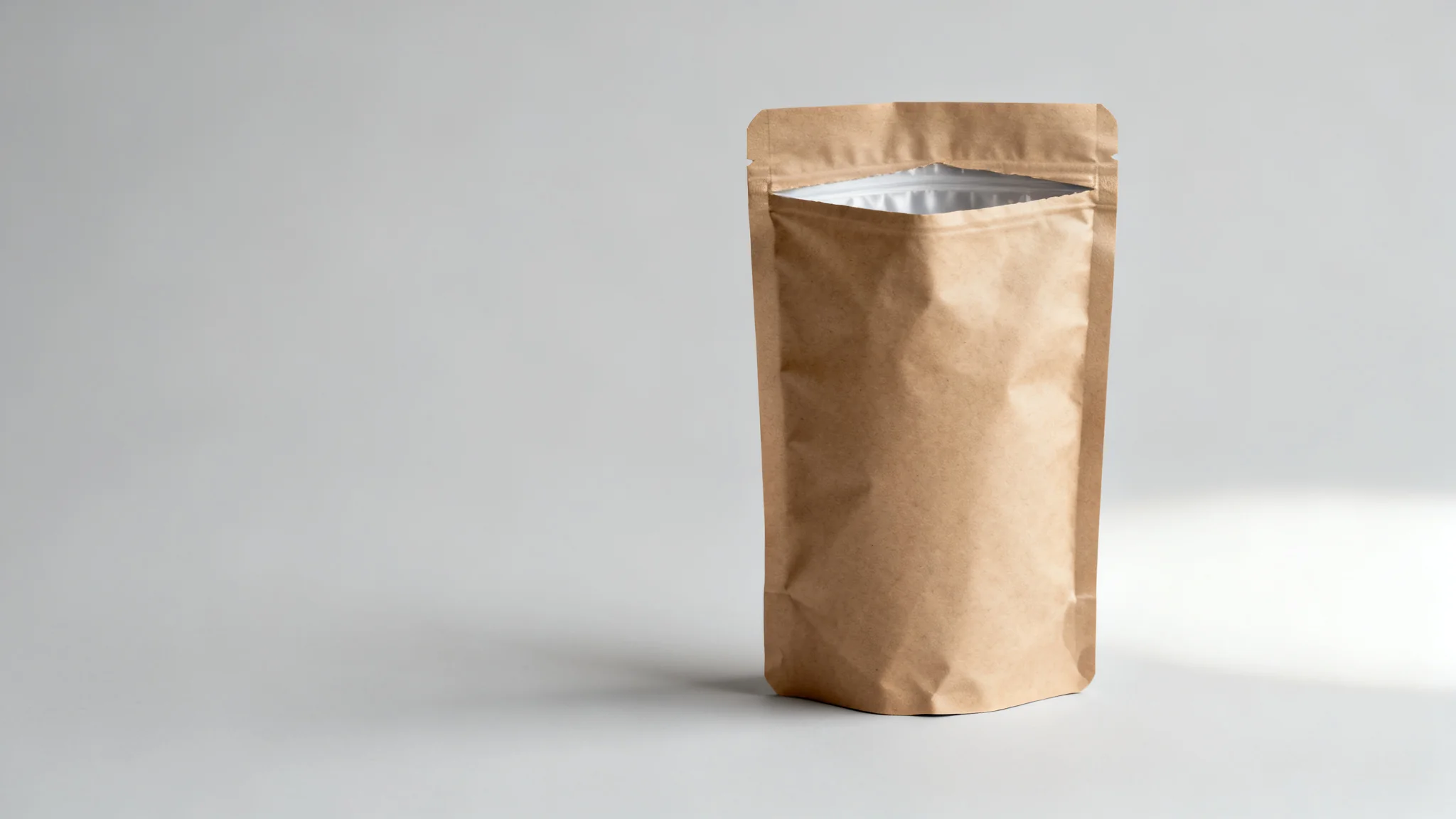
Concept visual for editorial use, not a customer project.
How the Liner Decides Barrier Performance
Barrier in a kraft pouch comes from the layer behind the paper. A polyethylene coating gives the pouch a heat-seal surface and slows moisture movement, but it is not an oxygen barrier. A metallized polyester laminate adds light and oxygen resistance. An aluminium foil laminate gives the highest barrier in all three directions and is the usual answer for coffee, nuts and fried snacks, at the cost of recyclability and a greater risk of flex cracking. Bio-based coatings suit compostable builds, and their barrier sits closer to a light sealing layer than to foil. Water vapour and oxygen transmission should be requested as measured values on the finished laminate rather than inferred from the paper, because the paper’s own contribution is small and shifts with ambient humidity.
Which Foods Actually Use Kraft Pouches?
Kraft works where the shelf look matters and the product is not aggressive: tea and loose-leaf blends, dried fruit and nuts sold through specialty channels, granola and biscuit packs, pet treats, and coffee sold on a craft or small-batch story. It also suits dry powders and baking ingredients where a PE or PLA seal layer is enough. When the filling is greasy, strongly aromatic, or sold with a long ambient shelf life, the kraft face can stay but the rest of the structure has to change. Two useful reference points are the candy and snack packaging solutions we build for dry snack formats, and the custom kraft tea and nut pouches that use this face material as a standard shape.
Where Kraft Alone Falls Short
Paper is hygroscopic. It takes on and releases moisture with ambient humidity, and it does not block oxygen or aroma. A kraft pouch carrying only a thin polymer coating lets a fried snack go soft and lets roasted coffee lose aroma inside a short window, because both failure routes run through the layer the paper cannot provide. Grease is the second limit: untreated paper is not greaseproof, and oil migrating into the face shows up as translucent patches as well as a barrier failure. A heavier paper solves neither problem — the answer is structural, add a barrier layer or change the face material. End-of-life follows the same logic: a paper-faced pouch with a welded polymer or foil layer does not behave like plain paper in a recycling stream, and the stream it can enter is defined at EU level in the packaging and packaging waste framework. Formats such as agricultural product packaging often start from paper for exactly this reason and then add the layer the filling demands.
Print Methods That Suit Kraft Surfaces
Kraft is absorbent and uncoated, so ink spreads slightly and solids look mottled compared with the same artwork on white film. Flexo printing handles one to three colours and bold line work well and remains the common route for kraft. Digital printing is viable for short runs and multiple versions, though the substrate still limits contrast. When bright or photographic colour is required, a white or opaque underprint is laid down first so the ink does not sink into the brown fibre. In design terms, treat the brown as a colour rather than as a background that must be covered, keep type weight up rather than down, and avoid large solid dark areas, which show fibre mottle and registration drift.
What to Confirm Before Ordering
An order-ready brief covers product and expected storage conditions; the failure route that matters most (moisture, oxygen, light, aroma or grease); pouch format, dimensions and fill weight; liner type and which surface seals; print method and the artwork limits that follow; fill method and machine, roll-fed or premade; and food-contact documentation for the paper, liner, adhesive and inks. Settling format first shortens the rest of the conversation — the food packaging bag selection guide works through that step in more detail.
Sampling and Approval Checks
Approve the laminate build in writing before tooling is cut. Then check seal strength on the finished pouch with the real product inside, and seal quality where powder or crumbs sit in the seal area, since kraft-face pouches are often filled on a vertical form-fill-seal line where contamination is a real risk. Crease and flex the paper face to confirm it does not crack at the fold. Print should be reviewed on the actual kraft stock rather than a white-paper proof, because ink laydown and colour shift between the two. A short run at line speed closes the loop.
Conclusion
For food products, a kraft paper pouch is a barrier decision wearing a paper face. Start from the failure route the product suffers — moisture, oxygen, light, aroma or grease — then choose the liner that blocks it, and only then settle paper weight and print. Kraft is a good fit for tea, dried fruit, granola, pet treats and craft-positioned coffee, where the natural surface carries brand meaning and a light seal layer is sufficient. It is a poor fit for greasy, highly aromatic or long-ambient products unless a metallized or foil layer is added, and in that case the recyclability story changes with it. Confirming paper, liner, seal side and print as one set, before tooling, avoids most of the rework that shows up at the fill trial.
Frequently Asked Questions
Do custom kraft paper pouches protect food on their own?
No. Custom kraft paper pouches provide no meaningful moisture or oxygen barrier on their own, so protection comes entirely from the layer behind it. A build with only a thin polymer coating suits dry, shelf-stable goods with a short ambient window; a greasy snack, roasted coffee or anything that must resist oxygen uptake needs a metallized or foil layer in the structure. The practical way to settle it is to name the failure route first — softening, rancidity, aroma loss or grease wicking — and then confirm the laminate actually addresses that route before a specification is agreed.
Which liner should be specified for a greasy or aromatic filling?
An aluminium foil laminate is the usual starting point, because it resists moisture, oxygen and light at the same time. A metallized polyester laminate is a middle option that improves light and oxygen resistance at lower cost and with better recycling prospects, though it is not equivalent to foil. Neither choice can be confirmed from a datasheet alone: the product’s fat content, fill temperature and expected ambient shelf conditions all move the answer, so the decision should be validated with water vapour and oxygen transmission measured on the finished laminate rather than on the film.
Can a kraft paper pouch be recycled as paper?
Rarely as plain paper. The polymer coating, adhesive or foil layer that makes the pouch sealable also changes how it behaves once it reaches a collection stream, and paper mills reject fibre with heavy polymer or foil contamination. A mono-material or paper-dominant structure stands a much better chance than a foil laminate. Because the accepted stream is defined by local rules rather than by the pouch itself, the reliable approach is to check the collection requirements in the destination market before the artwork or the structure is finalised.
Does kraft paper meet food-contact requirements?
Yes, but only when every layer does. Compliance is judged on the finished article, so the paper, the adhesive or coating, and the printing inks each have to be suitable for direct or indirect food contact under the rules of the destination market. Suppliers should be able to issue a declaration covering all three. Where recycled fibre is used, the fibre source deserves a closer look, because mineral-oil and ink carryover are the usual concerns. A declaration that addresses only the paper, while leaving the coating and inks unnamed, is incomplete.