
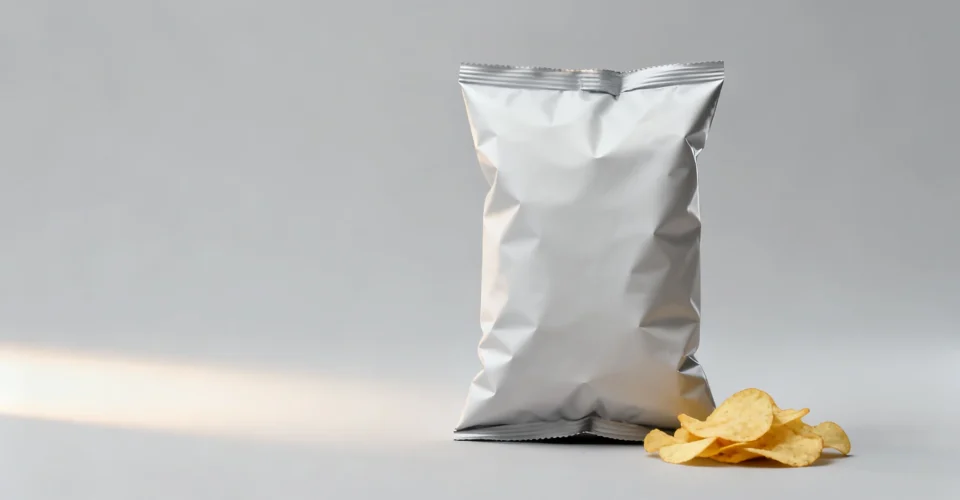
Potato chip packaging fails at the seal and at the puncture point far more often than it fails in the middle of the film. Cushioning and seal quality behave as one system: the nitrogen fill that protects the chips also loads the end seals, and the headspace you choose decides how much of that load travels through stacking and transport. This guide is for brand owners, packaging engineers and procurement teams who need a chip bag specification that holds on the line and on the pallet. It sets out the boundaries of that decision as well as the settings.
How Nitrogen Fill and Seal Strength Interact
Nitrogen does two jobs in a chip bag. It displaces oxygen, which slows oil oxidation, and it creates internal volume that absorbs part of the compression the bag meets under stacking. Both jobs are paid for at the seal. Every increment of internal pressure pushes outward on the end seal and the back seal, and it pushes on the carton walls as the bag tries to expand.
That is why a fill level chosen on a bench machine behaves differently on a high-speed line. Forming and sealing times are shorter, the seal has less time to cool under pressure, and the film is still warm when the bag drops into the case. A nitrogen volume that looked reasonable in a hand sample becomes a load the seal never had time to build strength against.
A pillow pouch formed on a vertical form-fill-seal machine concentrates that load differently from a flat-bottom or quad-seal bag. Seal geometry matters as much as seal temperature, and the center seal and back seal pouch structures used for most chip bags hold the widest unsupported panel directly against the case wall.
Key Takeaways
- Specify cushioning and seal strength together. A fill level that improves drop performance can reduce seal reliability at line speed.
- The end seal, not the film body, is the usual failure point on gas-flushed chip bags.
- Hot tack and cooling time matter more than the final seal strength number once line speed changes.
- Any change to fill volume, bag width or film gauge should be re-verified with a transit test instead of extrapolated from an earlier sample.
Why Chip Bags Fail at Four Predictable Points
Field complaints on chip bags cluster around a small number of positions. Sorting the complaint by position before touching the film structure saves weeks that would otherwise be spent changing material that was never the cause.
| Position | Typical complaint | What to verify first | Data nature |
|---|---|---|---|
| End seal (top and bottom) | Bag soft after a week, wrinkled seal edge | Seal window against actual line speed, cooling time, product debris in the seal zone | Field pattern from line trials; example values, not a specification limit |
| Back seal (fin) | Channel leak running along the fin | Jaw alignment, film tension, print or lacquer inside the seal zone | Field pattern; requires verification on your own machine |
| Film body and folds | Pinholes at the gusset, puncture at the corner | Puncture resistance, corner radius, film stiffness at low humidity | Candidate material property; confirm with your own test |
| Case and pallet | Broken chips, bag intact and holding pressure | Fill volume against case fill rate, stacking height, orientation in the carton | Example comparison only; depends on your distribution route |
If two of these positions fail at the same time, treat the seal as the primary suspect and the film as secondary. Seal defects release internal pressure, and the softer bag then transmits more shock to the chips. The packaging direction that fits this product family is set out in our snack and candy packaging solutions, and the choices there still have to be tuned to your filler.
Concept packaging visual generated for editorial use. Not a customer project, not a tested structure.
What Headspace Pressure Does to End Seals
Headspace is a pressure decision, not a cosmetic one. A bag that is firm to the touch holds an internal pressure above ambient, and that pressure acts on the seal area continuously from the moment the bag leaves the jaw until the case is opened. Under a stack, the bag also transmits vertical load through the same seals.
Two failure modes follow. A seal that was marginally bonded creeps open over days rather than failing immediately, which is why a factory leak test on day one can pass and a customer complaint can arrive in week three. A seal that holds can still fail at the fold where the bag bends against the case edge, because that crease concentrates strain on one line of the seal rather than spreading it.
Line Settings: Fill, Seal, and Cool in Sequence
Adjust in this order, and change one item at a time so the result stays readable:
- Fix the fill volume against the case, not against the bag. Work out the stacking height and case count first, then find the fill level that fits without forcing the carton closed.
- Set seal temperature and pressure from the film supplier’s window, then shorten the dwell time in steps until the seal starts to look weak. Back off one step. That position defines your real margin at current speed.
- Check cooling. Confirm the seal is below the point where it can be pulled apart before the bag is handled, and add cooling time or reduce speed if it is not.
- Inspect the seal zone visually at full speed for product debris. Salt, seasoning powder and broken chip fragments are the most common contamination that creates a channel.
- Record what you changed and re-measure. A seal setting without a speed reference cannot be repeated tomorrow.
Cushioning Limits: Where It Stops Helping
More internal volume is not automatically better. Past a certain point, a firmer bag reduces the number of units that fit in a case, raises the stacking height, and transfers more force into the seal and the carton. A bag that is too soft has the opposite problem: the film sits directly on the chips and the pillow pouch loses the air gap that was meant to absorb impact.
The practical test is the whole package, not the bag alone. Compare fill volumes by recording bag thickness, units per case, stacking height and the proportion of broken chips after a simulated distribution run. That is also where the center seal versus back seal pouch comparison is useful, because the two structures reach the same firmness with different seal loading.
How Do You Verify a Spec Before Scaling?
Verify the package, not the film. A film data sheet describes a flat, unprinted sample; a finished bag has folds, seals, print and an internal pressure. Test the finished package against the distribution hazards it will actually meet, and use a recognised practice so the result can be compared with a later run.
ASTM D4169, the standard practice for performance testing of shipping containers and systems, gives a structure for that work: it defines a distribution cycle and the test sequence applied to a shipping unit, so a result can be traced to a defined set of inputs instead of an internal habit. Running the sequence on the packed case, not on loose bags, is what makes the number meaningful for a chip product.
Write the result into the specification with its conditions. The transport protection sequence for export packaging shows how those inputs stack up when a product travels more than one leg.
Why Chip Bags Leak in Transit but Pass at the Factory
Factory leak testing usually runs at a single point in time on a bag that has just been made, and the two most common reasons it misses a later failure are pressure and moisture history. A bag that loses pressure slowly passes a short test and fails a customer check weeks later. A bag that meets a humid distribution route takes up water, and the seal and the film respond to that moisture in ways the dry sample did not.
Both properties are measurable on the material before the bag is made, which is why they belong in the specification rather than in a complaint report. Water vapour transmission through plastic film is covered by ASTM F1249, and oxygen transmission by ASTM D3985. Neither test predicts seal behaviour on its own. Used together with a transit test on the finished package, they tell you whether the film or the seal is the weak link.
Conclusion
Cushioning and seal quality should be treated as one decision, because the fill volume that protects the chips is the same fill volume that loads the end seal. Set the fill level from the case first, find the seal margin at real line speed, and confirm cooling before handling. If you are changing bag width, gauge or fill volume, re-run a distribution test on the packed case rather than relying on an earlier sample. Where the film is already at its limit and the complaint is breakage rather than leakage, the answer is usually a change of pouch geometry or case configuration, not a thicker film.
Frequently Asked Questions
Does a chip bag need nitrogen, or is air enough?
Nitrogen is not required for every chip product. It is the default when the recipe contains a meaningful amount of oil and the target shelf life runs into months, because the gas displaces oxygen, which is the main driver of rancidity in fried snacks, and it also gives the bag an internal volume that cushions compression in the case. Air can work for very short distribution cycles or for products with a strong antioxidant system. A potato chip packaging specification should decide this from how much oxygen the product tolerates over its stated life rather than from a fixed rule.
How much headspace should a chip bag have?
There is no universal figure, because headspace is set by the case and the distribution route rather than by the bag alone. Work backwards from the case: a firmer bag reduces units per case and raises stacking height, which increases the load the seals carry. Measure bag thickness, units per case, stacking height and broken-chip proportion after a simulated run, then choose the fill level that protects the product without forcing the carton closed. Change one variable at a time so the cause of any improvement stays visible.
Why does a bag that passes seal testing still leak in transit?
Seal testing usually measures a new bag at a single moment, while transit exposes it to repeated compression, vibration and temperature change. A marginally bonded seal can creep open over days instead of failing at once, and a fold pressed against a case edge concentrates strain on one line of the seal. Handle this by testing the packed case through a defined distribution cycle, and by checking the seal at the fold rather than only at the flat centre of the fin.
Can you increase cushioning without changing the film structure?
Often yes, within limits. The fill volume is the first variable, followed by the case configuration and stacking height. Increasing the fill level raises internal pressure that the seal must hold, so it should be re-verified with a leak check and a transit test rather than assumed to be an improvement. When the film is already operating near its limit at the seal, changing pouch geometry or the case layout gives more room than adding thickness to a structure that is not the weak point.



