
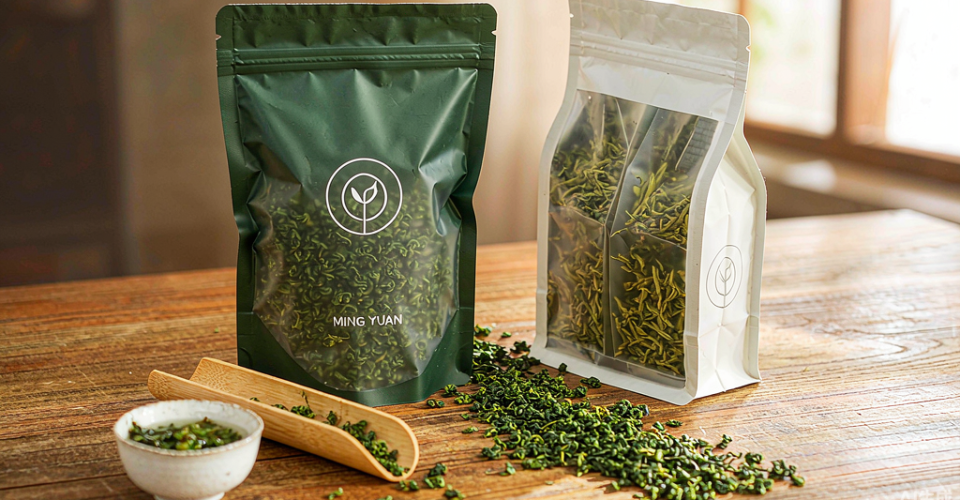
Why tea loses its character before it reaches the cup
Ask anyone who sells tea and they will recognise the moment. A batch leaves the producer bright and aromatic; three months later the same tea opens flat, the freshness gone and only a dull, hay-like note left behind. The tea has not changed. What changed is everything that happened between the sealing machine and the cup — and most of it comes down to tea packaging bags that did not protect what was inside.
Tea is a genuinely sensitive product. It absorbs moisture, it absorbs odours, it reacts with oxygen, it fades under light, and it does not enjoy heat. A well specified pouch is essentially a small, stable environment built around the leaf. This guide goes through it in the order that matters: what tea is afraid of, which material stops it, which pouch format suits your pack size, the details that decide whether the pack is pleasant to live with, and finally how small brands can get all of this without burning cash.
The three things tea fears most: oxygen, moisture and light
Oxygen — the first enemy of aroma and colour
Polyphenols, amino acids, vitamin C and the volatile compounds that carry aroma all oxidise readily. Once they do, green tea loses its fresh edge and turns “aged”, the liquor shifts from bright green to a dull amber, and the sweetness of a black tea thins out. A widely used target in the trade is to keep residual oxygen inside the pack below about 2% after nitrogen flushing — combined with a high-barrier film, that difference alone noticeably extends the period during which the tea tastes like it did on day one.
Further reading: Nitrogen flushing and how it protects aroma, in What Is Nitrogen-Flush Packaging? Why Coffee Needs Nitrogen Flushing.
Moisture — the 6% line you do not want to cross
Finished tea usually sits at around 5%–6% moisture content. Push it much past 8% and the mould risk climbs sharply, especially through a humid southern summer. It follows that the right answer is rarely “add another sachet of desiccant” — it is to keep water vapour out in the first place.
The number to look at is the water vapour transmission rate (WVTR), normally measured with a standard method such as ASTM F1249. For tea that has to sit on a shelf at ambient temperature for many months, a common target is below 1 g per square metre per day. Short-life formats such as single-serve sachets or sample packs can be more relaxed — up to roughly 3 g/m²/day — but it is rarely wise to go beyond that.
Light — the invisible source of off-flavours
Daylight and supermarket spotlights carry UV that breaks down chlorophyll and oxidises lipids. Yellowing of a green tea and a flattened aroma are the visible results. This is why premium greens almost never sit in fully transparent packaging. Aluminium foil blocks close to 100% of light; metallised films also perform well. If you do want customers to see the leaf, keep the window small — well under a sixth of the front panel — and place it away from where a display light hits hardest.
Further reading: how moisture barriers are specified in practice, in our guide to Moisture-Proof Packaging Bags for Electronics and Food.
Choosing the material for tea packaging bags
Material sets the ceiling on how well your tea is protected. Three structures cover most of the market.
Foil laminates: the safe choice for long shelf life
Structures such as PET/AL/PE or BOPP/AL/PE put an aluminium foil layer in the middle, delivering three barriers at once — oxygen, moisture and light — with an oxygen transmission rate (measured by ASTM D3985) low enough that a shelf life beyond 18 months is straightforward. The trade-offs are opacity, a slightly stiffer hand feel and a higher unit cost. Best suited to gift tea, high-value single-origin lots, and anything crossing an ocean by sea freight.
Metallised and transparent high-barrier films: looks versus protection
Metallised structures such as PET/VMPET/PE keep the metallic look at lower cost, with good light blocking and barrier performance, and are the workhorse of mid-range tea packaging bags. If seeing the leaf matters for a herbal, fruit or blooming tea, transparent films coated with silicon oxide or aluminium oxide are an option: clearer than conventional films, better barriers too, and priced above standard transparent structures.
Mono-material recyclable structures: sustainability without giving up too much
All-PE or all-PP constructions bring the whole pouch into a single polyolefin family so it can enter existing recycling streams — the option brand owners ask about most often right now. Their barrier level is below foil, so they are usually paired with a barrier coating or a high-barrier polyolefin grade. They suit lines with a sustainability story, fast stock rotation and a shelf life target inside 12 months.
Further reading: where mono-material works and where it does not, in Mono-Material Recyclable Packaging: Why PE Pouches Are the Sustainable Choice for Coffee & Food Brands.
Pouch formats and details: treating the tea gently
The material protects the leaf; the format decides what the customer experiences. Tea has one habit worth designing around: one pouch gets opened dozens of times. So “how it behaves after opening” deserves as much attention as “how well it seals”.
Stand-up, flat bottom or gusseted?
- Stand-up pouches — cost friendly, a clean uninterrupted print face, stable on shelf. The default choice for 50 g to 250 g tea packaging bags.
- Flat bottom and quad-seal bags — flat base, five printable panels and a distinctly premium, box-like presence. Good for gift packs and combination sets above 100 g.
- Side gusset pouches — excellent volume efficiency for 250 g to 1 kg formats and food-service sizes, and they stack and case-pack with less wasted space.
Zippers, tear notches and degassing valves
For repeated use a zipper is close to mandatory: it reseals in one motion and spares the customer from hunting for a bag clip. With tear notches, check the geometry during sampling — tear one open and see whether the pouch still stands and whether the tear runs into the zipper track.
Valves need a caveat for tea. Degassing valves exist to let CO2 out of freshly roasted coffee; tea is normally packed after resting, so most tea formats do not need one. Adding a valve will not rescue a pack whose residual oxygen was never brought under control.
Further reading: choosing between resealable options in Zipper, Easy-Tear or Spout Pouch: How to Choose.
Small runs can still look beautiful: sampling and MOQs
Two questions come up in almost every conversation with an independent tea brand: how small can the first order be, and how long does sampling take?
Typical market practice: gravure printing needs cylinders, so minimum order quantities usually land between 5,000 and 10,000 pouches. Digital printing has no plate cost and can start at roughly 500–1,000 pouches, which suits new SKUs, seasonal editions and channel-specific designs. Sampling normally takes 7–12 days; if a new structure or material is involved, allow another 3–5 days to run a packing trial with actual tea.
The route OMOPACK usually suggests is to validate demand with digital printing first, then move to gravure once a SKU has settled into steady volume. Upfront stock stays small, and the unit cost curve falls at exactly the right moment.
Letting the packaging speak for the brand
Tea is an emotional purchase. People are buying a quiet ten minutes as much as a drink. A few details repay disproportionate attention:
- Restraint in the artwork and the surface feel — a matte or soft-touch film reads calmer and heavier in the hand than full gloss, and suits tea better.
- A clear information hierarchy — keep origin, harvest date and brewing guidance on the sides or back, and leave the front for three things only: brand, type and size.
- The opening ritual — the shape of the tear notch, the colour of the zipper and how the inner pack closes are all places to be distinctive.
- Honest sustainability claims — if you use a mono-material or recycled content film, say it on the pack with an accurate recycling label, and avoid anything a customer could read as greenwashing.
Frequently asked questions
Do tea packaging bags have to use aluminium foil?
No. Foil earns its place when you need long shelf life, a high unit price or long sea freight. Faster-moving lines, value tiers and ranges built on a sustainability story are often better served by metallised or high-barrier mono-material structures. Decide from the shelf-life target and the route to market, not from the assumption that foil is simply “better”.
Does a transparent window make tea spoil faster?
It has an effect, but it can be managed. Keep the window under roughly 15% of the front panel, avoid shelf positions under direct light, and use a high-barrier transparent film — for most products that is an acceptable balance between visibility and protection. For premium green teas and delicate white teas, we would usually advise leaving the window out.
What cost is easiest to overlook on a small run?
Beyond the plate charge, it is usually repeated sampling and skipped structure validation. Going into production without validating the structure is how you get seal misalignment, zippers that do not track, or a pouch that will not stand once filled — and reworking that costs far more than paying for one extra round of samples.
Closing note
Choosing tea packaging bags comes down to three questions: where will this tea be sold, how long will it sit there, and how will the customer open it? Answer those honestly and the decisions about material, format and finishes start to resolve themselves.
OMOPACK builds custom tea packaging bags for independent tea brands, coffee roasters and e-commerce sellers — from structure and material selection through sampling trials to short-run digital printing. If you are planning tea packaging for a new season, tell us the tea type, pack size and expected volume, and we will turn it into a specification you can cost.
Further reading: the wider selection logic for flexible food packaging, in How to Choose Food Packaging Bags: A Decision Guide.



