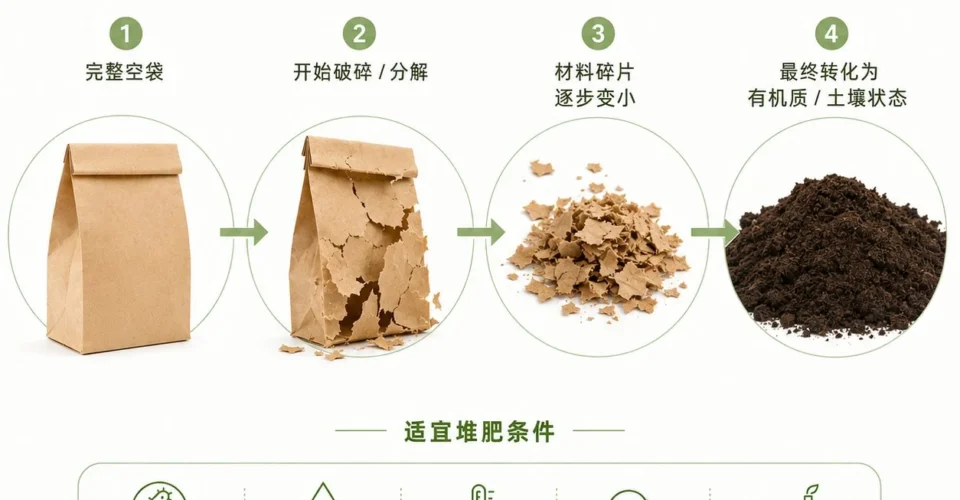
“Biodegradable packaging disappears in the soil within months.” You have probably seen claims like this, but the reality is more complicated. Biodegradable packaging in natural environments can take anywhere from months to several years to degrade, depending on the material, the environment and the certification standard. This article uses real test data to explain how long biodegradable packaging actually takes to degrade and how to read degradation labels without being misled.
Biodegradable Is Not a Single Material
Many people treat “biodegradable” as one material, but it is actually a category covering several technologies. The mainstream options include PLA (polylactic acid), PBAT, PBS, PHA and starch-based plastics, and their degradation mechanisms and speeds differ enormously. PLA, made from corn or cassava starch, is currently the largest-volume bio-based biodegradable material. PBAT is a petroleum-based biodegradable material with good flexibility, often blended with PLA. PHA is a microbial polyester with excellent degradation performance but higher cost.
More importantly, a material being “biodegradable” does not mean it breaks down quickly when tossed into nature. Degradation requires specific conditions: temperature, humidity, microbial activity and oxygen. Without those conditions, biodegradable materials may take years to degrade, sometimes even longer than conventional plastics.
Industrial Composting: Real Test Data
Industrial composting offers the best conditions. Composting facilities control temperatures of 55 to 60 degrees Celsius, humidity above 50 percent, and maintain continuous aeration and turning, which keeps microbial activity extremely high. Under these conditions, certified PLA and PBAT products typically degrade more than 90 percent within 90 to 180 days, meeting EU EN 13432 and US ASTM D6400 standards. Pure PLA products degrade substantially within 3 to 6 months, PLA/PBAT blends in about 4 to 6 months, and PHA can degrade most of its mass in 2 to 3 months.
It must be emphasized that these figures come from controlled laboratory tests under industrial composting conditions, not from natural environments. Degradation also requires the product to be certified and actually delivered to a composting facility. Industrial composting infrastructure is still limited in many countries, and most biodegradable packaging never reaches a compost plant, so real-world results fall far short of laboratory data.
Soil and Seawater: Much Slower in the Real World
If biodegradable packaging is simply discarded in natural soil, the picture changes completely. Soil temperature, humidity and microbial conditions are far less favorable than industrial composting. Research shows that PLA degrades very slowly in ordinary soil; after one year buried, only a small fraction may have broken down, and the degradation cycle is measured in years, sometimes several. This is why the academic community is cautious about claims of PLA “natural degradation”. PBAT degrades faster in warm, humid, microbially active soil, showing clear degradation within months to a year, but much more slowly in dry or cold regions.
The marine environment is even less promising. Low temperature, low oxygen and high salinity inhibit microbial activity, so biodegradable materials degrade more slowly in seawater than in soil. Studies show that most materials remain largely intact after a year of seawater immersion. The claim that “biodegradable packaging disappears in the ocean” simply does not match the facts.
Home Composting: Between the Two
Home composting is the scenario most consumers actually encounter. Home compost bins typically run at 20 to 40 degrees Celsius with fewer microbial species than industrial facilities. Materials certified for home composting are mainly certain PHA, modified PBAT and bio-based products. Under home composting conditions, these materials generally take 6 to 12 months to degrade, more than twice as long as industrial composting, and ordinary PLA products usually do not pass home composting certification because they degrade too slowly at low temperatures.
When buying “compostable” products, check whether the label says “industrial compostable” or “home compostable”, because the required conditions are completely different. Home composting results also depend on bin maintenance: if you open the bin after several months and see little change, the conditions may not have been met rather than the material being defective.
Why Degradation Claims Vary So Much
Claims about degradation time range from three months to two years. The first reason is test environment: industrial composting, home composting, soil, seawater and laboratory simulation all produce different numbers, and using industrial composting data to advertise “fast natural degradation” is a classic bait-and-switch. The second reason is product form: thin films degrade much faster than thick-walled articles because of their larger surface area, so a shopping bag and a food container made of the same material can differ by several times in degradation time.
The third reason is certification. A product certified for industrial composting only meets the standard under industrial conditions; it does not promise fast degradation in nature. Learning to read certification marks is key: the EU “seedling” logo and the US “compostable” logo correspond to specific test standards and conditions, and are far more credible than the vague word “biodegradable”.
What Consumers and Brands Should Know
Consumers should understand that the correct way to handle biodegradable packaging is to send it to composting facilities, not to discard it anywhere. If your city has no composting collection system, biodegradable packaging ends up in landfills where degradation conditions are not met, and its fate is little different from conventional plastic. The real issue is not whether packaging is “biodegradable”, but whether a proper recovery and treatment system exists. For brands, ask three questions before choosing biodegradable packaging: what material is it, what certification does it hold, and what is the recommended disposal route? Then clearly state this information on the packaging instead of printing a vague “biodegradable” label.
The environmental value of biodegradable packaging can only be assessed within the whole recovery system. To learn more, read our analysis of whether biodegradable plastic pouches are really eco-friendly, and our guide to identifying genuine biodegradable bags.
Conclusion
How long does biodegradable packaging take to degrade? The answer depends on material, environment and disposal method: months under industrial composting, years in soil, even slower in seawater. Understanding these differences is the only way to use biodegradable packaging correctly and to recognize exaggerated marketing. Sustainability is not solved by a single material; scientific understanding, proper infrastructure and correct disposal are all essential.
Interested in eco-friendly packaging customization or cross-border packaging solutions? Contact OMOPACK at Contact Us, or visit OMOpack.com for our global packaging solutions.