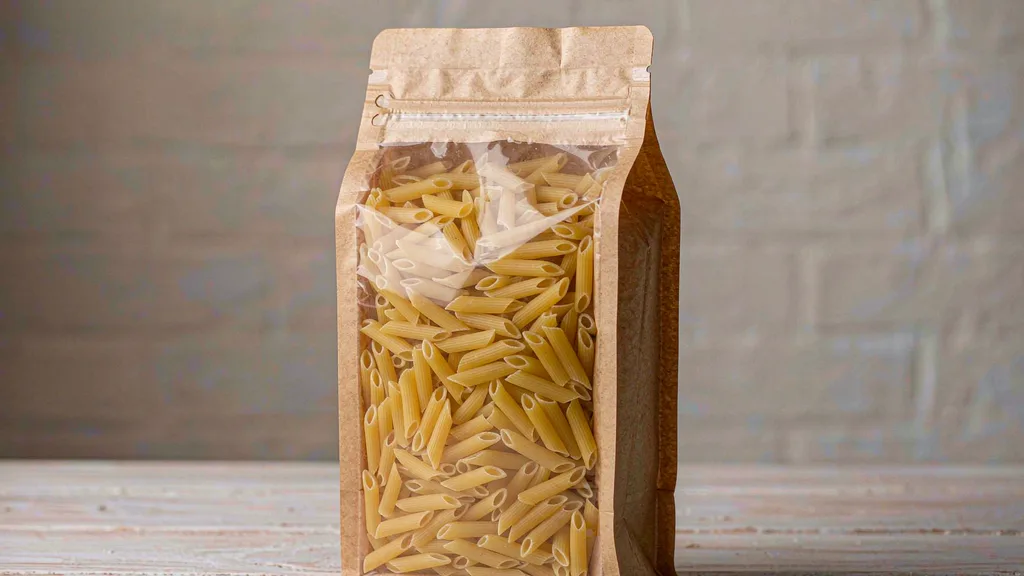
The appeal of this freeze-dried fruit packaging is immediate. A yellow kraft-paper header gives JoySeason a distinct place for its logo, while the transparent PE composite-film pouch puts the colorful fruit pieces in full view. For a brand developing a similar pack, the design raises a practical question: how do you keep that clear display while protecting the crisp texture inside?
A clear front makes the product part of the design
The pouch does not need a printed illustration of fruit. Its contents supply the color and texture, and the yellow header keeps the branding legible above them. The folded paper top and narrow sticker give the pack a tidy finish without competing with what shoppers came to see.
A generous clear area works best when the filled product continues to look good after packing and transport. Fruit pieces can settle, and fragile slices can produce crumbs. Pack dimensions, fill weight and handling should therefore be judged using filled samples, not an empty pouch laid flat on a desk.
The construction also separates two jobs. The kraft-paper header carries the visual identity. The PE composite-film pouch contains the food. For a production specification, the film and its seals—not the decorative paper fold—are where the protection requirements belong.
Moisture barrier comes first
Freeze-dried fruit is sensitive to moisture pickup. The University of Minnesota Extension notes that freeze-dried foods readily absorb moisture, which is why packaging promptly in a suitable, well-sealed container matters. In a retail snack, moisture ingress can soften pieces that are meant to be crisp.
The first barrier figure to request is water vapor transmission rate (WVTR). It describes how much water vapor passes through a given area of film over time under stated test conditions. A lower result can be useful, but a number has little meaning without the material thickness, temperature and relative humidity at which it was measured. ASTM F1249 is one recognized method for measuring WVTR in flexible barrier materials.
Oxygen transmission rate (OTR) may also matter, depending on the fruit blend, ingredients and desired shelf life. It measures oxygen passing through the film; ASTM D3985 provides a test method. WVTR and OTR should be reviewed against the actual product rather than treated as interchangeable claims of “high barrier.”
Choosing a structure without losing visibility
This example is described as a pouch made from transparent PE composite film with a yellow kraft-paper header. “PE composite film” identifies part of the construction, but a new order still needs a complete layer specification, including thicknesses and the food-contact layer.
Where a clear pouch needs stronger barrier performance, one structure worth evaluating is AlOx-coated PET / PE: a transparent coated PET layer paired with a PE heat-sealing layer. Transparent oxide-coated films are used to combine product visibility with oxygen and moisture barrier properties; TOPPAN’s overview of transparent barrier film describes this approach. It is a candidate for evaluation, not a claim about the exact layers in the JoySeason pouch.
The best structure depends on the required shelf life, pack size, filling process and cost target. Its quoted barrier values should be measured for the proposed laminate, under stated conditions. Performance of the finished, filled pouch also depends on the seals and on damage sustained during handling.
What a buyer should ask to see before approval
A useful supplier review goes beyond a material name or a promise of “food-grade, high-barrier film.” For a freeze-dried fruit pouch, request evidence that addresses four separate risks:
- Moisture and oxygen ingress: WVTR and, where relevant, OTR results for the proposed structure, with units, thickness and test conditions.
- Seal performance: A defined seal width and sealing window, followed by seal-strength results. ASTM F88/F88M provides a method for measuring flexible-package seal strength.
- Handling damage: Review filled pouches after packing and transport simulation. If rigid or pointed pieces may press against the film, penetration resistance can be assessed using a method such as ASTM F1306.
- Food-contact and print documentation: Confirm the documents required for the destination market and, where solvent-based printing or lamination is used, ask how residual solvents are controlled.
These checks answer different questions. A strong film does not compensate for a poor seal; a sound seal does not prevent damage to an unsuitable pouch during distribution. Shelf-life approval should be based on the packed product under its intended conditions.
Turning the design into a production brief
The JoySeason pack shows how effectively a kraft-paper header can frame a clear product display. Recreating its visual effect is straightforward. Specifying a pouch that keeps freeze-dried fruit in good condition takes a more detailed brief.
When asking OMOPACK about a similar format, share the fruit blend, piece size, target fill weight, intended shelf life, filling method, sales markets and estimated order volume. Those details give the packaging team a basis for proposing a structure, preparing filled samples and agreeing on the tests needed before production. You can also compare formats in our snack packaging range.
Frequently asked questions
Can a transparent pouch provide enough barrier for freeze-dried fruit?
Yes, a clear structure can be engineered for barrier performance. Its suitability must be checked through WVTR results, the finished seal and shelf-life testing with the actual fruit.
Is the yellow kraft-paper header the moisture barrier?
The header serves the pack’s branding and presentation. Moisture protection depends on the specified pouch structure and the integrity of its seals.
Which numbers should I request from a packaging supplier?
Start with WVTR for the proposed laminate and OTR where oxygen exposure is relevant. Ask for the test conditions alongside every result. Seal-strength data, the full layer structure and suitable food-contact documentation complete a more useful comparison between quotations.