Pet food packaging materials are usually chosen by copying human food specifications, and that shortcut fails more often than any other decision in the category. Kibble carries far more surface oil, the bag is opened and resealed dozens of times, and the regulatory route is different from food. The result of a wrong structure is rarely visible at delivery: it shows up three months later as a rancid smell complaint that no amount of customer service can undo.
Why pet food is a harder packaging problem
Extruded kibble is coated with animal fat, typically 8 to 15 percent by weight. Fat oxidises in the presence of oxygen and light, producing aldehydes and ketones, which is exactly what consumers describe as a stale or rancid smell. For that reason the oxygen and light barrier requirement for pet food often exceeds what biscuits or nuts need, even though the product itself is cheaper.
Odour works in both directions. The product has a strong smell that must stay inside the pack, and printing inks, adhesives and slip additives must not migrate inward. Cats in particular are sensitive to odour changes, and a faint solvent note at opening can affect acceptance of an otherwise correct product.
Building the barrier structure
The standard dry pet food structure is PET/AL/PE or PET/VMPET/PE: an outer print layer, a barrier core, and a PE sealant that also resists grease. For high-fat recipes, pure aluminium foil is the safer choice. Metallised PET develops pinholes along folds and gussets, and barrier performance drops quietly over months of storage.
Where cost pressure is real, an EVOH coextrusion can replace part of the foil. Oxygen barrier is close, but EVOH loses performance in high humidity, which matters in warehouse conditions across southern China and in tropical export markets. A common compromise is a thin foil layer plus an EVOH layer, keeping the foil as the humidity-independent backstop.
Wet food, fresh food and frozen pet food follow a different logic. These need retort resistance or low-temperature toughness, so PA/AL/CPP and PA/PE structures dominate. Here the priorities are seal strength, drop resistance and migration behaviour at temperature rather than oxygen transmission alone. The testing principles are the same ones described in our guide to food contact material migration testing.
Bag formats that match how the product is used
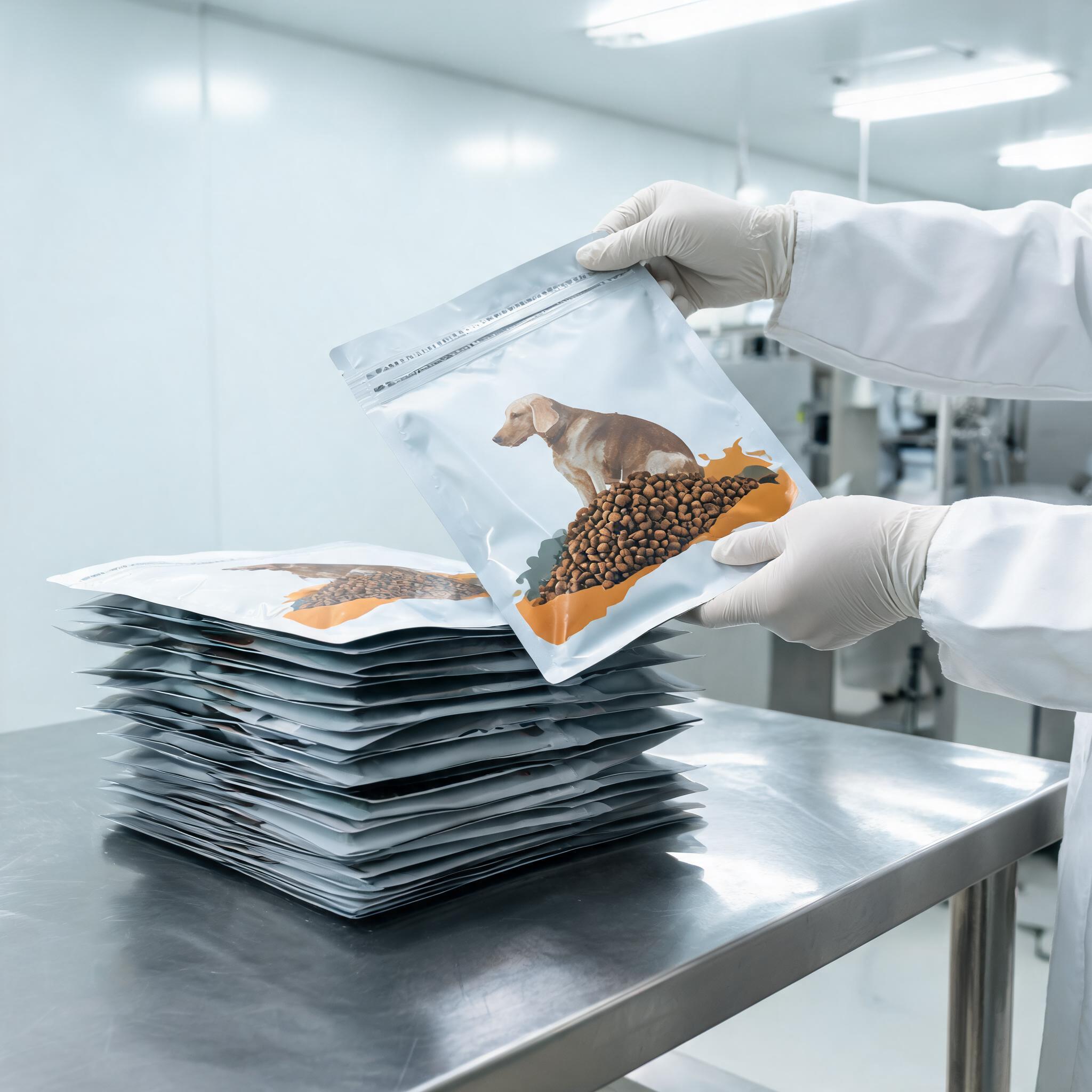
Large dry food packs usually go into flat bottom pouches, from 2 kg to 15 kg. The format stands on shelf, holds a wide print area, and with a zipper plus a side handle it survives the two to four weeks a household needs to finish the bag. Smaller retail sizes are more often stand-up zipper pouches, which fill faster and cost less per unit.
Treats and wet food sachets are usually three-side or four-side seal pouches, where the real quality markers are tear notch consistency and seal strength rather than appearance. The most under-specified component is the zipper: it must survive repeated opening, and it must not trap kibble between the profiles, which is the single most common cause of a leaking “resealed” bag. Ask for cycle test data instead of a visual sample.
Print, adhesive and odour control
Pet packaging is usually heavily printed, often full coverage with spot colours. Large ink coverage raises solvent retention risk, and retained solvent in the adhesive or ink can migrate through the seal area into the product. Control measures are unglamorous: low-retention inks, adequate curing time, and retained solvent testing with records kept per batch.
The inner film is often overlooked. Low molecular weight volatiles, anti-block and slip additives in the PE layer all carry odour, and with chicken or fish recipes that odour is amplified. Run a blind smell test at sample stage across three states: inner film, finished empty bag, and the bag seven days after filling.
Compliance for domestic and export orders
Domestically, packaging for pet food still has to meet the base safety requirements for food contact materials, so keep material compliance declarations and migration test reports on file. Export is more complex: the EU regulates feed and food contact materials separately, the US combines FDA requirements with state feed laws, and Southeast Asian markets differ by country.
The practical fix is to ask for the destination market at quotation stage and list every required test in one go. Adding tests after the packaging is produced typically costs two to four weeks, which is exactly the window that breaks a shipping schedule. The compliance checklist in our food packaging bag selection guide follows the same sequence.
Cost and volume reality
Pet food packaging is more cost sensitive than human food packaging because the pack represents a larger share of retail price. The effective order of cost reduction is: simplify structure and reduce gauge first, then reduce print colours, and only then change material grade. Switching to a thinner sealant layer is the most dangerous shortcut, because seal strength and grease resistance fall together.
New brands with small volumes should start with digital print on a standard pouch format; once volume grows, gravure printing can cut unit cost by 30 to 50 percent. Moisture control for dry products, including desiccant use, is covered in our moisture-proof packaging bag guide.
Four specifications to settle before quoting
Most disputes trace back to four numbers that were never fixed: fat and moisture content of the product, target shelf life, the number of days the pack stays open in a household, and the destination market. Once those are written down, structure, gauge and format follow almost automatically, and a converter can quote against a real specification instead of a guess.
If you are developing a pet food pack and want a structure recommendation with barrier data and cost per thousand bags, contact the OMOpack technical team with your current specification and annual volume. Additional reference material and product ranges are available on our sister site OMOpack.com.