Dried pasta is shelf-stable, low-moisture and cheap per kilo, which makes brands assume it is easy to pack. It is not. Pasta packaging bags fail at two points: the seal, where starch dust blocks fusion, and the film, where brittle pasta edges punch pinholes. Everything else is secondary.
Why dried pasta punishes packaging more than its shelf life suggests
Pasta is hygroscopic. Durum semolina is dried down to roughly 12.5% moisture, and Italian regulations cap dry pasta moisture at that level for good reason: above about 13%, texture shifts from firm to mealy and mould risk climbs. The product therefore sits in a permanent state of wanting water back, and it will take that water from the film, the headspace or the ambient air the moment the seal leaks.
The second problem is mechanical. A single piece of penne has hard, angular ends. In a 500 g pack there are roughly 250 to 300 pieces, and every vibration during transport drives those ends into the same few square centimetres of film. A 12 µm metallised layer or a 15 µm sealant will not survive that for eighteen months without help.
The third problem is dust. Pasta rubs against itself in the filling line and releases fine semolina powder. That powder lands exactly where the jaws close.
What starch dust does at the seal
A contaminated seal is a weak seal, and the failure is invisible at packing speed. Starch granules sit between the two sealant surfaces and act as a release agent. The pack looks closed, holds vacuum, and leaks three weeks later in a distribution centre.
Three practical countermeasures work, and they are usually applied together:
- Angle the fill nozzle so product falls to the side of the pouch rather than straight down the seal zone.
- Add a dust extraction shoe at the jaw entry; even a small vacuum pick-up removes most airborne semolina.
- Specify a wider seal of 8–10 mm instead of 5 mm, so a partial dust stripe does not span the full seal width.
Why brittle edges cause pinholes, not tears
Pasta does not tear film in one dramatic event. It creates pinholes through repeated low-energy impacts, mostly at the bottom gusset fold and at the top shoulder, where the film is already under tension. By the time a consumer notices, oxygen has been entering for months.
Flex-crack resistance is a film property, but pinhole resistance is a structure property. A 12 µm PET outer layer resists puncture far better than a 12 µm BOPP layer of the same thickness, and a 9 µm nylon core absorbs impact energy that a metallised PET cannot. For pasta above 1 kg, a nylon-containing structure usually pays for itself in reduced leakage claims.
Which structure fits which pasta product
The table below reflects common practice for retail pasta in stand-up and flat-bottom pouches. “High barrier” here means an OTR below 5 cc/m²/day and a WVTR below 2 g/m²/day at 38 °C and 90% RH.
| Product | Main risk | Typical structure | Barrier level |
|---|---|---|---|
| Plain dry pasta, 500 g | Moisture, pinholes | PET12 / ink / PE70 | Medium |
| Long pasta, 1 kg | Breakage, pinholes | PET12 / NY15 / PE70 | Medium |
| Egg pasta, flavoured | Oxidation of fat, aroma loss | PET12 / AL7 / PE70 | High |
| Instant noodles with sachet | Fat oxidation, sachet abrasion | PET12 / AL7 / NY15 / CPP60 | High |
| Gluten-free blends | Moisture, caking of flour | PET12 / MET-PET12 / PE70 | High |
Two things are worth noting. First, instant noodles need the nylon layer not for the noodles but for the seasoning sachet, whose corners abrade the inner sealant from the inside. Second, gluten-free pasta often contains rice or corn flour that cakes faster than semolina, so the moisture limit is tighter even though the product looks similar.
Does pasta need a clear window?
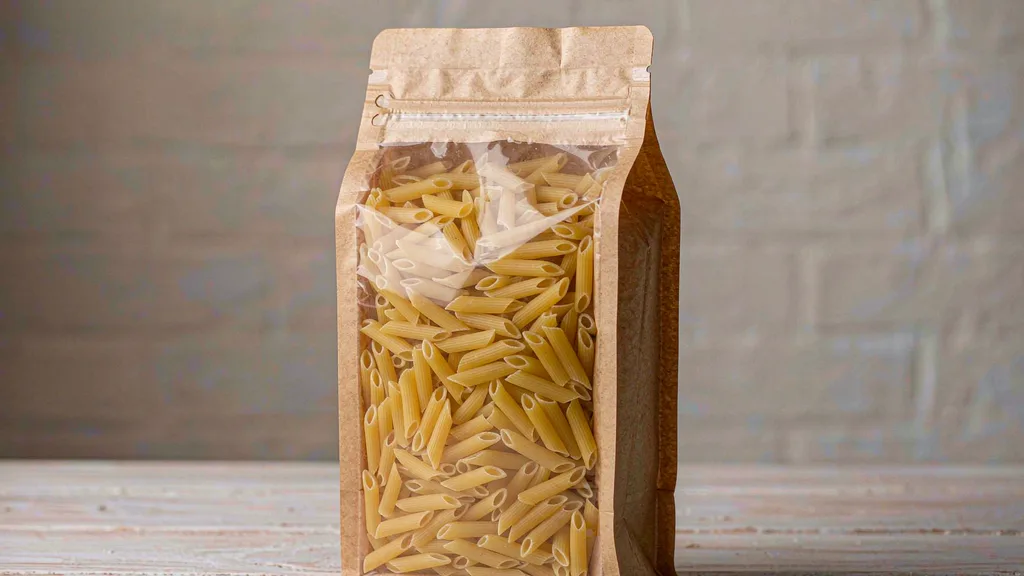
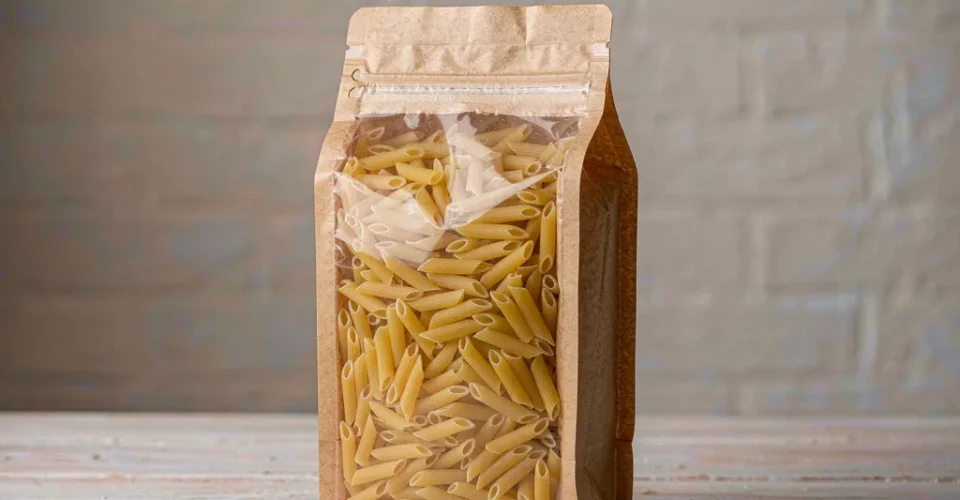
A window costs barrier, and it costs it exactly where the product touches the film. Most pasta windows use a 12 µm PET/PE laminate, which has an OTR around 100 cc/m²/day, against under 5 for a foil structure. That is a real trade, so the decision should follow the product, not the shelf.
A window makes sense when the shape of the pasta is the selling point: rigatoni, casarecce, coloured vegetable pasta. It makes less sense for spaghetti, which reads as a texture only when the pack is standing and the strands are visible through a full clear panel rather than a small round window.
If you do specify a window, place it on the front panel only and keep the back panel fully metallised or foil-laminated; the back is where packs rub each other in a carton. Our guide to custom kraft paper pouches covers the same front-versus-back logic for paper-faced structures.
Nitrogen flushing: worth it for pasta, or not?
For plain dry pasta, nitrogen flushing delivers less than most brands expect. The product is already at low water activity, its fat content is around 1.5–2%, and the dominant spoilage mechanism is moisture, not oxidation. Replacing headspace oxygen slows rancidity in egg pasta and in anything containing added oil, but it does nothing against a leaking seal.
Flushing earns its cost in three cases:
- Egg pasta and pasta with added olive oil, where fat content exceeds 5%.
- Pasta with cheese or dairy-based seasoning, where oxidation produces detectable off-flavours within six months.
For plain semolina pasta, spending on gas to compensate for a dust-contaminated seal is the wrong order of investment.
Fill weight, headspace and the gusset
Pasta settles. A pouch filled to 500 g at the filler can measure 520 g of apparent volume after two weeks of vibration, which flattens the gusset and makes the pack stand badly on shelf. Two adjustments fix this more cheaply than a wider bag:
- Underfill by 3–5% of volume and let the pack settle before case packing.
- Use a flat-bottom pouch rather than a stand-up pouch above 750 g; the four-corner base holds shape under load where a single gusset collapses.
Print, scuff and the shelf-life question
Pasta packs scuff more than coffee packs because they are lighter, packed in larger cases and handled more often per kilo. A matte lacquer hides scuffing better than gloss, but it also shows fingerprints. For a full discussion of surface finish trade-offs, the principles in our packaging shelf life guide apply directly: the surface you choose is part of the barrier, not just the decoration.
On the film supply side, most pinhole complaints trace back to roll quality rather than structure choice. Gauge bands and blocked rolls cause tracking errors that crease the film before it ever reaches the jaws; the checklist in this guide to film roll defects is a useful incoming inspection reference. Brands running short seasonal pasta ranges should also read about short-run rollstock production before committing to a large film order.
Frequently Asked Questions (FAQ)
What film structure is best for pasta packaging bags?
For plain dry pasta under 1 kg, a PET12/PE70 laminate is sufficient and economical. Above 1 kg, or for long pasta shapes, add a 15 µm nylon layer to resist pinholes. For egg pasta or pasta with added oil, use a foil or metallised structure to control fat oxidation.
How long can dried pasta last in a plastic pouch?
Plain dry pasta typically reaches 18 to 24 months in a medium-barrier pouch, and 30 to 36 months in a high-barrier foil structure. The limiting factor is almost always seal integrity rather than the barrier of the film.
Why do pasta pouches leak even though the seal looks complete?
Starch dust trapped in the seal zone prevents the sealant layers from fusing across their full width. The pack holds pressure at the moment of packing but fails later. Wider seals, dust extraction and nozzle positioning solve most of these cases.
Do pasta packaging bags need a degassing valve?
No. Unlike coffee, dried pasta does not release carbon dioxide after packing, so a one-way valve would only add cost and a potential leak path. Valves belong to fresh-roasted coffee, fermented products and some cheeses.
Is a clear window bad for pasta shelf life?
A window reduces barrier performance in the area it covers, so it shortens shelf life relative to a fully metallised or foil panel. On a 500 g pack with a modest window and a sound seal, the practical difference is usually a few months, which is acceptable for products sold within a year.
Can the same pouch run on a vertical and a horizontal filling machine?
Usually not without changes. Vertical form-fill-seal machines need a wider seal zone and a stiffer film to track straight, while horizontal machines tolerate thinner sealants. Specify the machine type when you request a quote, because it changes both the film gauge and the seal specification.