Cheese packaging fails for three reasons: fat, gas and mold. Fat migrates into the seal and weakens it, carbon dioxide from continuing ripening inflates or collapses the pack, and mold colonises any surface that still sees oxygen. A thicker pouch fixes none of these. The answer is matching barrier level, seal geometry and closure to the cheese you actually sell.
Why Cheese Is Harder on a Pouch Than Coffee or Snacks
Cheese is not inert. Per 100 g, cheddar contains roughly 33 g of fat and about 37 g of moisture (USDA FoodData Central); mozzarella sits near 22 g of fat and about 50 g of moisture. Water activity of most cheese falls between 0.85 and 0.99, above the threshold where common spoilage molds and yeasts grow. That creates three simultaneous demands: oxygen control, because fat oxidises and mold needs air; moisture control, because weight loss hardens the surface; and seal reliability, because free fat coats the seal area during filling. A seal made through fat is a seal waiting to open.
What Cheese Type Changes About the Specification
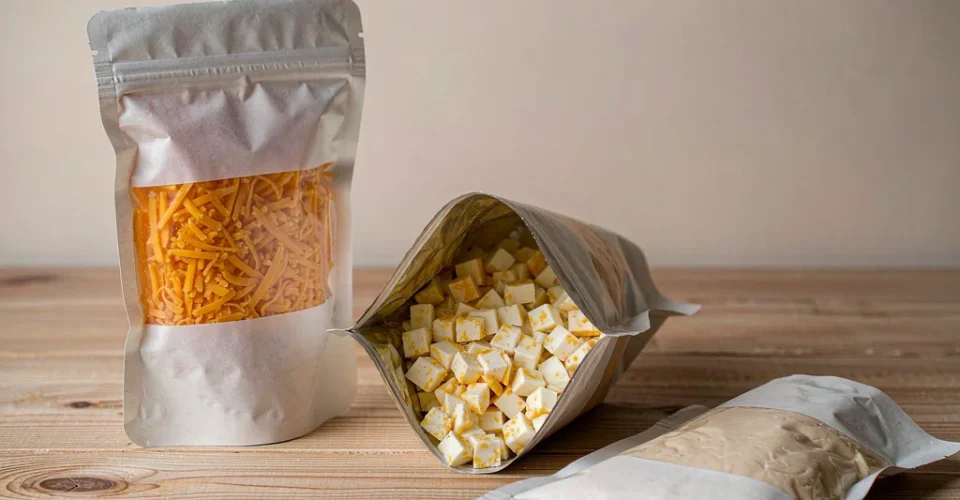
Shredded cheese has the largest surface area per kilogram, so it oxidises and molds fastest; it is also the format most often gas flushed, typically around 30% carbon dioxide and 70% nitrogen. Soft and fresh cheese such as cream cheese and ricotta carry the most moisture and fail first to surface yeast. Hard, aged cheese tolerates oxygen better but produces the gas that distorts packs. Cheese powder and sauce bases behave like other fatty powders: caking at the seal and moisture pickup, not oxygen, are the enemies.
| Cheese format | Main failure | Priority in the spec | Structure direction |
|---|---|---|---|
| Soft / fresh | Surface yeast and mold | Oxygen barrier, clean fill | PET or PA outer, EVOH or metallised core, PE sealant |
| Shredded | Oxidation and mold | Highest oxygen barrier, anti-fog | Metallised PET or foil core, anti-fog PE sealant |
| Hard, aged | Gas pressure, moisture loss | Gas handling, moderate barrier | PA or PET outer, EVOH or PA core, PE sealant |
| Powder / sauce base | Caking, moisture pickup | Water vapour barrier | PET or BOPP outer, metallised or foil core, PE sealant |
How Much Barrier Does Cheese Packaging Need?
Most small brands over-specify the film and under-specify the seal. Oxygen transmission for shredded and soft cheese is commonly specified between 5 and 30 cc/m² per 24 hours at 23°C and 0% relative humidity, with water vapour transmission under about 1 to 5 g/m² per 24 hours at 38°C and 90% RH. Two rules make those numbers useful: always state the test conditions, because the same film reports very different values at 23°C/0% RH and 38°C/90% RH; and buy barrier you can verify, with a test report naming the method. A framework for judging when barrier is genuinely required is in High-Barrier Packaging Materials Explained.
Fat: The Seal Contamination Problem
Fat is why cheese pouches leak more often than snack pouches made from the same film. During filling, free fat and cheese fines coat the seal; a heat seal made through that layer bonds fat to fat rather than polymer to polymer. Four controls work on a real line: keep the seal area clean at the moment of sealing with a wipe, an air knife, or a nozzle that deposits product below the jaw; specify a seal-through-contamination sealant, since some PE grades and ionomer sealants tolerate product far better than standard PE; set sealing parameters to the film rather than the machine default; and test seals on filled packs, because an empty pouch tells you almost nothing.
Gas: Ripening, Carbon Dioxide and Pack Collapse
Cheese keeps producing carbon dioxide after packing, especially fresh and soft styles. In a fully sealed high-barrier pouch that gas inflates the pack; in a heavily flushed pack it dissolves into the fat and water phase and the pack collapses into a brick. Both are specification problems, not film defects. Options include accepting small controlled expansion with a moderate barrier; fitting a one-way degassing valve where gas output is continuous; lowering the carbon dioxide fraction and substituting nitrogen; or adding an oxygen scavenger, covered in Active Packaging Guide: Oxygen Scavengers and Desiccants.
Mold: What Packaging Can and Cannot Fix
Packaging controls the oxygen mold needs; it does not sterilise anything. If the filling environment, product temperature or initial microbial load is wrong, the best barrier film only delays visible failure by days. Cold chain is part of the package: a pouch rated for a target shelf life at 4°C will not deliver it at 12°C. Headspace oxygen matters early, so verify residual oxygen on the line rather than trusting the machine setting. And the lower your barrier, the more shelf life depends on fill hygiene and temperature stability.
Closures and Reseal for Cheese Pouches
Cheese is opened and returned to the refrigerator many times, so the closure is part of the barrier system. Shredded cheese needs a wide press-to-close zipper above the tear notch, because fines block narrow tracks. Block or wedge cheese often performs better in a tray with a peelable lidding film, which protects shape and opens cleanly. Soft cheese converts well to a spout or wide-mouth fitment, removing the zipper entirely.
Compliance: High-Fat Foods Change the Migration Test
Cheese is a fatty food, and fatty foods are tested differently. Under EU Regulation 10/2011 the overall migration limit is 60 mg/kg of simulant, and fatty foods are tested against simulant D2, a vegetable oil or an accepted substitute such as isooctane or 95% ethanol. A film that passes a water-based simulant can still fail an oil-based one. FDA food-contact guidance treats cheese the same way. Practical consequence: a declaration tested only with 10% ethanol or 3% acetic acid does not cover cheese. Background is in Food Contact Material Migration Testing Explained and Food Contact Migration Testing: What a Food Factory Should Require; if you are still shortlisting films, Flexible Packaging Materials Explained is the fastest comparison.
Barrier choice and date coding are one decision: a pouch that controls oxygen but carries an optimistic date simply converts a mold problem into a returns problem. The method is covered in Shelf Life and Best-Before Dates.
Cheese Packaging FAQ
Does cheese packaging need aluminum foil?
Usually not. Foil gives an almost absolute barrier but adds cost, crease sensitivity and recycling difficulty, and most retail cheese does not need that level. Metallised films and EVOH structures reach the barrier most cheese requires. Foil earns its place for very long shelf life, hot-climate export, or high-value aged products where any oxidation is unacceptable.
Do I need a degassing valve on a cheese pouch?
Only if the cheese still produces measurable carbon dioxide after packing. Fresh, soft and young cheeses are the usual candidates; well-aged hard cheese produces far less. Seal samples without a valve, hold them at the top of your expected distribution temperature for two weeks, and measure the expansion.
Can I use a mono-material PE pouch for cheese?
Yes for shorter shelf life and chilled distribution, but all-PE oxygen barrier is lower than metallised or EVOH structures, so the shelf-life target must come down or the cold chain must tighten. An all-PE pouch with an EVOH barrier layer is the usual compromise for recyclability claims.
What causes a cheese pouch to puff up?
Three causes, in order of likelihood: continuing carbon dioxide production, microbial growth, or trapped air from a poor vacuum or flush. Hold one sample at 4°C and one at 25°C. If only the warm sample swells and smells acidic or yeasty, the cause is microbial; if both swell equally and smell normal, it is ripening gas.
Why does the seal on my cheese pouch peel open?
Fat or fines in the seal area is the most common cause, followed by seal temperature too low for the sealant grade and dwell time too short. Check the seal surface for a greasy band, then raise temperature in small steps and re-test on filled packs.
Is clear packaging safe for cheese?
Safe, but light accelerates fat oxidation and bleaches surface colour. Use a UV-blocking layer or accept a shorter shelf life. Clear windows are especially risky on shredded cheese, where exposed surface area is already large.