Dry vs solvent-free lamination is one of the most common questions we hear from packaging buyers. Dry lamination uses solvent-based adhesives that must be dried in ovens, while solvent-free lamination uses 100 percent solid adhesives that cure by chemical reaction. The two processes differ in cost, environmental impact and finished quality, and the right choice depends on your product. For a deeper look at the newer process, see our solvent-free lamination guide before reading the comparison below.
How the Two Lamination Processes Work
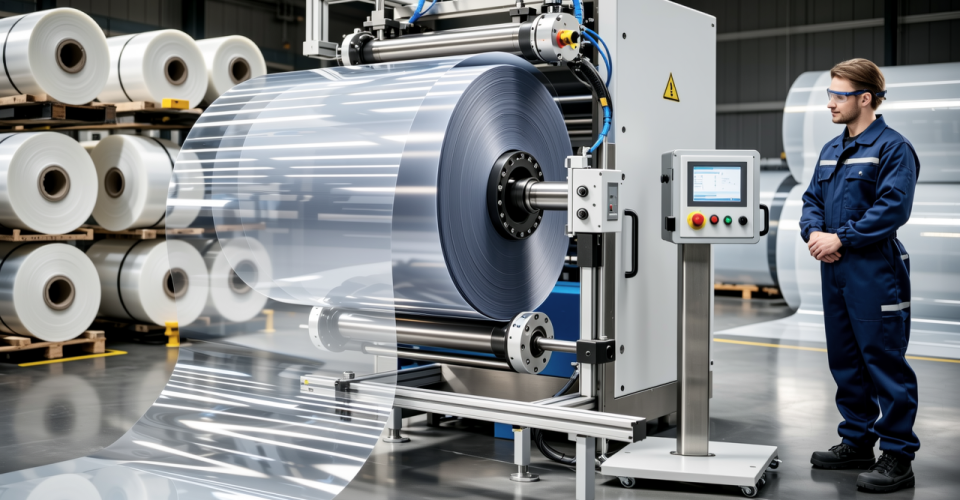
Dry lamination applies solvent-based polyurethane adhesive to the first film, passes it through a drying oven to evaporate the solvent, then bonds it to the second film under heat and pressure. Solvent-free lamination applies adhesive with 100 percent solid content and bonds the films immediately; the adhesive cures over time through a chemical reaction, with no drying oven required. That single difference — the presence or absence of an oven — drives everything else: equipment cost, energy consumption, emissions and product quality.
Cost Comparison: Equipment, Adhesive and Energy
On equipment, solvent-free laminators have a simpler structure with no drying ovens or solvent recovery systems, so capital investment is typically lower. On adhesives, solvent-free adhesive has a higher unit price, but near-100 percent solid content means far less adhesive is needed per square meter, lowering total adhesive cost. On energy, solvent-free lamination needs no oven heating, which significantly reduces electricity consumption. In total, solvent-free lamination usually saves 10 to 20 percent in production cost compared with dry lamination — the main reason for its rapid adoption around the world.
Environmental Comparison: VOC, Residual Solvent and Workshop
This is where the two processes differ most. Dry lamination emits VOC during production, requiring solvent recovery or exhaust treatment equipment, and finished film can retain trace solvent residues. Solvent-free lamination uses no solvent at all: VOC emissions are near zero, residual solvent is negligible, and the workshop environment is cleaner and safer for workers. For food packaging, lower residual solvent means better compliance with migration limits. With environmental regulations tightening in China, Europe and North America, solvent-free lamination is now the default choice for new production lines.
Quality Comparison: Bond Strength, Clarity and Applications
Each process has its strengths. Dry lamination delivers high initial bond strength and excellent adhesion to foil and metallized films, making it suitable for complex high-barrier structures. Solvent-free lamination produces clearer, flatter laminates, but initial bond strength is lower and curing takes longer; it also demands precise surface tension and skilled operators. As solvent-free adhesive chemistry improves, the quality gap is narrowing, but dry lamination still holds an edge in ultra-high-barrier and retort applications where bond integrity under heat and pressure is critical.
How to Choose: Recommendations by Application
As a general rule, choose solvent-free lamination for light food packaging, daily chemical packaging and general industrial packaging — it is cheaper and more sustainable. Choose dry lamination, or a combination of both, for aluminum foil pouches, retort pouches and structures requiring maximum peel strength. For products exported to Europe and North America, solvent-free lamination is strongly recommended to meet strict environmental and food-contact requirements. If you are still unsure, our moisture-proof packaging guide shows how barrier structures relate to real product needs.
Summary and Recommendations
Dry vs solvent-free lamination is not about which process is better in absolute terms — it is about which fits your product, market and budget. Solvent-free lamination leads on cost and sustainability and represents the industry’s main direction, while dry lamination remains valuable for premium barrier and specialty structures. Discuss your requirements with your supplier early, and validate samples before committing to large production runs. Ready to start? Contact OMOpack and our process engineers will recommend the right lamination solution for your packaging.
Visit OMOpack.com for more packaging knowledge and industry insights.