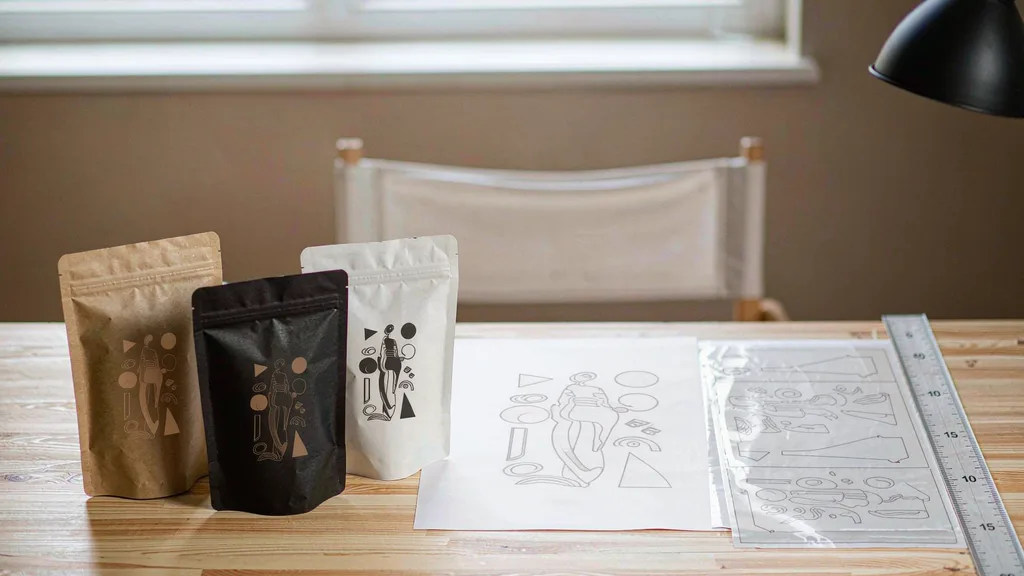
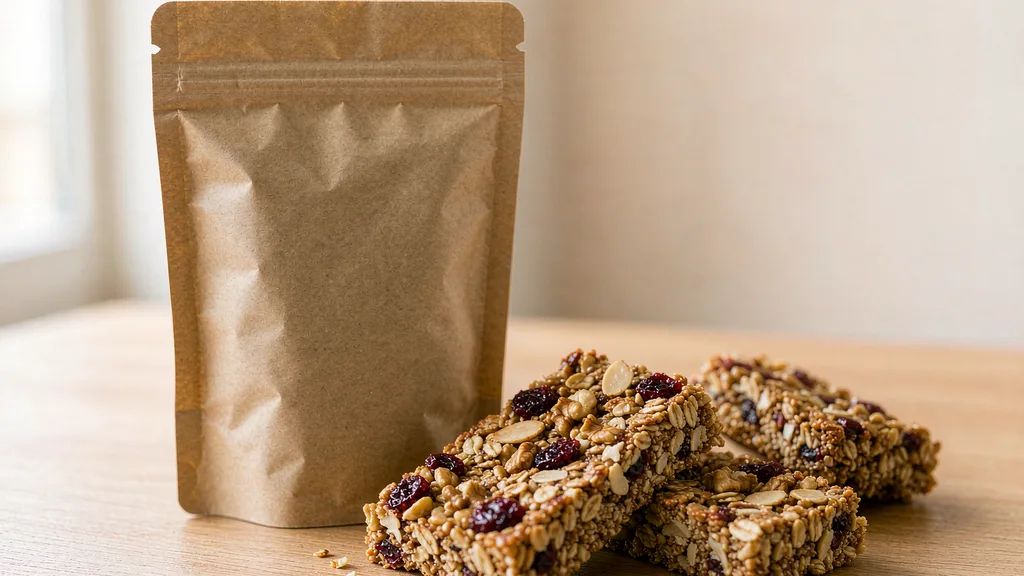
A protein powder pouch rarely fails because the film was cheap. It fails because fine dust reached the seal, moisture crossed the laminate over a few months, or the zipper that customers open fifty times stopped closing after the tenth scoop. Each of those problems is decided before the first bag is printed, inside the format, the layer structure and the filling interface. This article works through the three failure modes in the order they appear in production, then sets out what to confirm before a trial order.
What Does Fine Powder Dust Do to a Pouch Line?
Protein powder is milled fine, often with a median particle size in the tens of micrometers, and it behaves like a fluid when it drops. The dosing head releases a dust cloud that settles on the forming collar, on the seal jaws and inside the partly open bag. Any particle trapped between two sealant surfaces acts as a spacer: the polymer chains on either side cannot diffuse into each other across that gap, and the seal that forms is a mechanical bridge rather than a welded joint. It may pass a visual check and still leak in transit.
The same dust accumulates on the forming tube through a shift. A film that runs clean for the first two hundred bags can start pulling the vertical seal off centre by mid-shift, because the tube diameter has effectively grown by a layer of powder. Cleaning schedules help, but the pouch design decides how much dust the seal zone tolerates. A wide seal band and a thicker sealant layer both buy tolerance, at a material cost.
Tolerance depends on the dosing method. Auger fillers throw less dust than gravity-fed volumetric cups, and an extraction collar reduces the cloud before it reaches the jaws. Our notes on powdered seasoning packaging describe the same mechanism on another product.
Moisture Entry Points in a Protein Powder Pouch
Water vapour enters a sealed pouch through three routes, and they are not equally important. The film face covers most of the area but has the lowest permeability if the structure is sensible. The seal edges are small, yet a channel defect there leaks continuously. The zipper is usually the weakest route: every open-and-close cycle moves powder into the track.
Protein powder responds to that moisture in a way customers notice quickly. Whey and blends with high sugar content pick up water, cake into lumps, and stop flowing out of the pouch; vitamin C and some flavour systems also lose potency faster in a humid headspace. Water vapour transmission rate is measured under controlled conditions, and ASTM F1249 is the method most specifications cite, so asking for a tested value on the actual laminate is more useful than asking for a barrier class label.
Distribution climate matters as much as the film. A pouch sold in a humid coastal market faces a vapour pressure difference a dry inland market never produces, so the same laminate can behave differently over the same shelf life. Write the route into the specification.
Why Does the Zipper Fail Before the Film?
Zipper failure is mechanical, not chemical. A press-to-close profile needs the ribs to align; a single grain of powder in the groove prevents full engagement, and a sticky layer of damp powder prevents it entirely. Customers then press harder, deform the profile and make the next closure worse.
Three design choices change how quickly this happens. Moving the zipper a little further below the top seal keeps the fill zone and the closure apart, so dust that lands during filling is less likely to sit in the track. A dust flap above the zipper gives the powder somewhere to accumulate that is not the closure. Wider profile pitch closes with less alignment precision, which suits a bag that will be opened by hand with a scoop. Our guide to resealable pouch types covers the profile options and where each one usually fits.
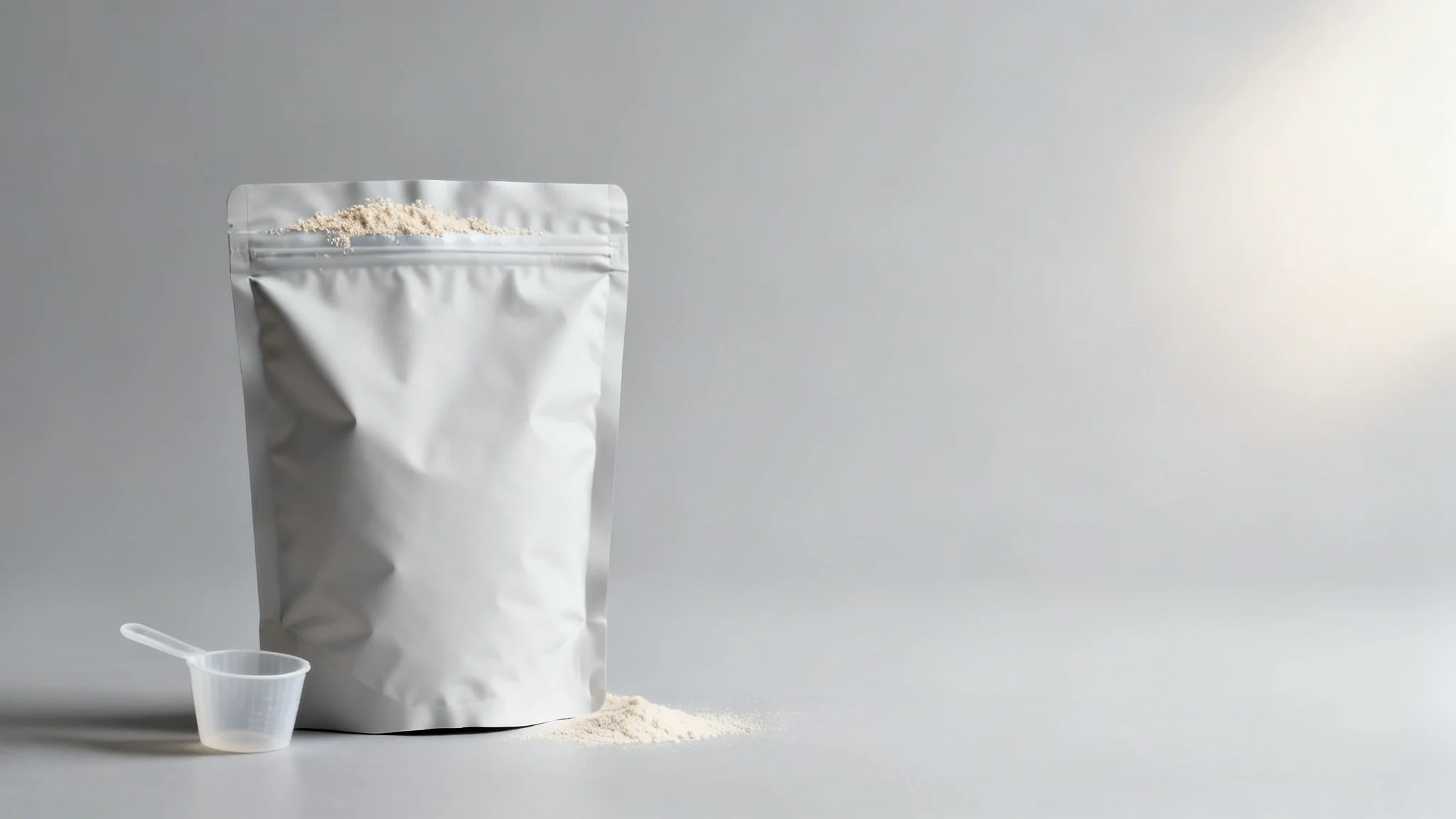
Concept packaging visual generated for editorial use. Not a customer project, not a tested structure.
How Do Scoopable Formats Change the Pouch?
A pouch built around a scoop is a different object from a pouch built around a pour spout. The opening has to fit a hand and a scoop, which pushes the top seal towards a wide flat opening rather than a narrow pour corner, and pushes the format towards structures that stand up when the bag is half empty.
Stand-up pouches with a wide bottom gusset handle 500 g to 2 kg well. Flat-bottom pouches offer more shelf presence and a squarer footprint, at a higher material cost per unit and a more demanding forming set. Quad seal bags carry the larger 2 kg to 5 kg range, where the pack needs a handle or a lifting point and the fill weight makes a single bottom seal unreliable. Below 500 g, a scoop is unusual, and the format debate moves to sachets and stick packs instead.
Pouch Formats Compared for Powder
| Format | Typical fill range | Scoop access | Standing stability | Main watch point |
|---|---|---|---|---|
| Stand-up pouch, wide gusset | 500 g to 2 kg | Good when top opening is wide | Good while filled, weaker when half empty | Bottom gusset seal carries the load |
| Flat-bottom pouch | 500 g to 3 kg | Good, opening stays square | Best of the flexible formats | Higher unit material cost, forming set precision |
| Quad seal bag | 1 kg to 5 kg | Good, wide opening | Good, needs handle above 3 kg | Four seals to control, corner dust traps |
| Side gusset with zipper | 250 g to 1 kg | Moderate, gusset folds interfere | Low | Zipper alignment across the gusset |
The table is a starting point. A 1 kg program can run in three of the four formats, and the tie-breaker is usually the filling line already installed.
Which Material Layers Carry the Barrier?
In a powder pouch the middle layer does the barrier work and the inner layer does the sealing work. Foil-containing structures give the highest moisture and oxygen resistance and remain the default for long shelf life or for products with sensitive actives. Metallized polyester sits below foil and depends heavily on coating quality, which means two suppliers can quote the same structure name with very different measured performance. Structures built on EVOH offer good oxygen barrier in a transparent pack, with the caveat that oxygen barrier falls sharply as humidity rises, which is exactly the condition inside a powder pouch in a humid market.
The inner sealant layer decides the seal window, the hot tack, the tolerance to dust and how the zipper behaves. Thicker sealant tolerates contamination better and seals at lower pressure, at some cost in stiffness. For food contact compliance, the relevant framework in the EU is Regulation 10/2011 and the supporting EFSA evaluations, summarised on the EFSA food contact materials topic page; a supplier should be able to map every layer to a compliant grade rather than quoting the finished laminate as a whole.
Scope: What This Applies To, and What It Does Not
This applies to protein powders, meal replacement blends and collagen products in the 500 g to 5 kg range, sold in a pack the customer opens repeatedly and doses with a scoop. It fits programs where the brand can specify a fill weight range, a shelf-life target and a distribution route before sampling.
It falls short in three situations. Extremely fine spray-dried powders generate a dust cloud no seal band can absorb, and those programs need a different filling approach before a different pouch. Products with high surface fat deposit a film on the seal that behaves differently from dry dust and needs its own trial. Programs requiring aseptic filling sit outside the scope of a dry powder pouch entirely.
How Do You Verify a Pouch Before Committing?
- Fix the fill weight range, the scoop volume and the shelf-life target in writing, because all three change the format and the barrier requirement.
- Run a filling trial on the actual line and count seal rejects, not just visual defects. Record where the dust lands and if the vertical seal drifts through the shift.
- Test seal strength and integrity on contaminated seals deliberately: pull samples with a known pinch of powder in the seal zone and compare with clean samples from the same roll.
- Put retained pouches through the intended distribution route and open them at intervals, checking for caking at the zipper and at the bottom corners rather than only at the surface.
- Run a customer closure test with the real scoop, because a zipper that passes a lab cycle test can still fail in a kitchen with damp hands.
Key Takeaways
- Seal contamination from fine dust is a design tolerance question, decided by seal band width, sealant thickness and the distance between fill zone and zipper.
- Moisture usually enters through seal defects and the zipper before it crosses the film face on a well-built structure.
- Scoop access drives format choice more than fill weight does, and the format has to stand up when the bag is half empty.
- Verify with contaminated-seal samples and a real distribution route; clean-sample seal tests hide the failure that matters.
Conclusion
Choose a protein powder pouch by starting from the three failures rather than from a film sample book: decide how much dust the seal must tolerate, where moisture will get in first, and how the customer will actually close the bag after the tenth scoop. Then pick the format that gives the scoop room, and the layer structure that carries the barrier for your route and shelf life. Brands comparing options can review our packaging solutions overview for adjacent food categories, or look at a specific build such as custom powder packaging pouches to see how the layers and the zipper position are combined in practice.
Frequently Asked Questions
Does a protein powder pouch need a foil layer?
Only when the shelf-life target or the actives justify it. A protein powder pouch for a twelve-month ambient program with sensitive vitamins usually points towards foil or a high-barrier metallized structure, while a shorter program sold in a dry market can work with a metallized or EVOH-based laminate. Decide from measured water vapour and oxygen transmission on the actual laminate rather than from the structure name, because two laminates with the same name can differ by a wide margin.
Why does the zipper clog even when the bag is sealed properly?
Because powder reaches the track during filling, not after sealing. A few grains trapped in the profile prevent full engagement, and once the customer presses harder to compensate, the ribs deform and the closure gets worse with every cycle. Moving the zipper further from the fill opening, adding a dust flap, or choosing a wider profile pitch addresses the cause; cleaning the track at the customer end does not.
What fill weight suits a stand-up pouch with a scoop?
Between 500 g and 2 kg in most programs, with a wide top opening and a bottom gusset that keeps the bag upright once it is half empty. Below 500 g a scoop is uncommon and the pack usually moves to a sachet or stick. Above 2 kg the bag starts to need a handle or a change to a quad seal format, because the fill weight puts more load on the bottom seal than a gusset pouch is designed to carry comfortably.
How do I test seal tolerance to powder dust?
Deliberately contaminate the seal. Take samples from the production run, place a measured pinch of the actual powder in the seal zone, seal on the same parameters as normal, and compare strength and leak performance against clean seals from the same roll. A drop from clean to contaminated of more than a modest margin tells you the seal band is too narrow or the sealant too thin for the dust level your filler produces.