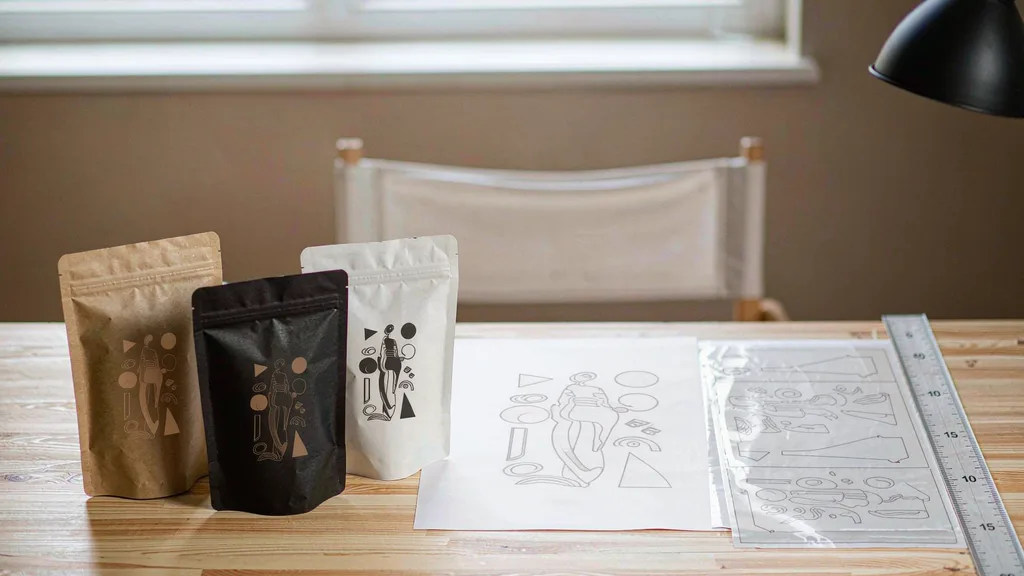
A multi-flavor pouch program is one film structure, one pouch size and one cylinder set shared by several flavors, with only the variable print areas changed between SKUs. Brands that set it up properly typically cut plate cost and effective minimum order quantity per flavor by 50–80%. It only pays off when every flavor in the line shares the same barrier need, fill weight and sealing window.
What Is a Multi-Flavor Pouch Program?
A multi-flavor program groups SKUs that differ in taste, color or formulation but not in pack format. Instead of commissioning a separate print job for each flavor, you build one base artwork and one dieline, then change the few elements that genuinely differ: the flavor name, a color block, a nutrition panel, sometimes a legal declaration.
The economic logic is simple. Printing tooling is a fixed cost paid once per printed version. Packaging material is a variable cost paid per thousand bags. When a brand has six flavors and each flavor is treated as a separate print job, the fixed cost is paid six times. When six flavors share a program, most of that fixed cost is paid once.
This matters more than it looks for small and mid-size food brands. Smithers has repeatedly noted in its flexible packaging outlooks that run lengths in food flexible packaging keep shortening while SKU counts keep rising. Short runs plus many SKUs is exactly the combination that punishes per-version tooling.
Why “one flavor, one print job” quietly multiplies cost
Gravure printing needs one engraved cylinder per color per printed version. A typical eight-color pouch design therefore needs eight cylinders. Cylinder cost for pouch-width jobs in China commonly runs RMB 800–2,000 per cylinder (roughly USD 110–280), depending on width, engraving method and chrome-plating life.
Now take a five-flavor line with an eight-color design. If nothing is shared, that is 40 cylinders. If six of the eight colors are identical across all flavors and only two color separations change, the shared part needs 6 cylinders and the variable part needs 2 × 5 = 10. The total drops from 40 to 16, a 60% reduction before a single bag is printed.
How to Share One Film Across a Flavor Line
There are three practical structures, and most brands end up using two of them at different stages of growth.
Option A: Shared cylinders plus a variable color
Keep the background, brand mark, photography and legal block identical. Change one or two spot colors per flavor. This is the highest-volume solution and the cheapest per bag, because the press runs the same job with only a cylinder swap. The constraint is that the flavor differences must be expressible in one or two separations.
Option B: Neutral base film plus a label
Print a single neutral film with brand identity only, then apply a pressure-sensitive label, a shrink sleeve or a variable-data overprint for the flavor. This removes the cylinder problem almost entirely and lets you launch a flavor with a label MOQ instead of a film MOQ. The trade-off is a higher unit cost per bag and an extra process step, plus you must check that the label adhesive survives your cold chain and that the label stock does not break the recyclability story of the base film.
Option C: Digital printing for the whole program
Electrophotographic and inkjet presses for flexible packaging now handle runs from a few hundred bags upward with no cylinders at all. Unit cost is typically 30–80% higher than gravure at equivalent volume, but the fixed cost is close to zero and artwork changes are free. This is the right structure while you are still finding out which flavors sell.
| Structure | Fixed cost per flavor | Unit cost | Best for |
|---|---|---|---|
| Shared cylinders + variable color | Low after first setup | Lowest | Stable lines above roughly 10,000 bags per flavor |
| Neutral film + label | Very low | Medium | Testing flavors, frequent artwork change |
| Full digital print | Near zero | Highest | Launch phase, seasonal and limited runs |
What Has to Stay Identical for the Plan to Work
A shared program fails when one hidden variable changes between flavors. Five things must be locked before artwork starts:
- Barrier requirement. The most demanding flavor sets the structure for the whole line. A high-fat flavor and a dry flavor rarely belong in the same program.
- Fill weight and pouch size. Same dieline means same volume. If one flavor is denser, the fill height changes and the top seal position moves with it.
- Sealant layer and seal window. One sealant means one sealing temperature, dwell and pressure setting. Mixing sealants forces a line changeover for every flavor.
- Surface finish and dyne level. Matte, gloss and soft-touch coatings change friction and print adhesion. Keep the finish constant or you will re-qualify the film.
- Food-contact documentation. One structure means one declaration of compliance covering all flavors, which is an advantage during audits.
Where the Savings Actually Show Up
| Cost line | Five separate print jobs | One shared program |
|---|---|---|
| Cylinders | Up to 40 units | Around 16 units |
| Plate / setup fees | Charged five times | Charged once |
| Minimum order per version | Full MOQ × 5 | Shared base + smaller flavor splits |
| Obsolete stock risk | High, per flavor | Lower, base film is reusable |
| Artwork and proofing time | Five cycles | One cycle plus variable layer |
The last row is the one buyers underestimate. Every print job carries a proofing round, a colour-approval round and a press-check decision. Five jobs consume five times the calendar time, and calendar time is what delays a launch.
Mistakes That Break a Multi-Flavor Program
- Letting one flavor drive everyone else’s barrier. A single oily or high-water-activity flavor can force an aluminium or metallised layer onto a whole line that never needed it.
- Assuming a small text change is free. On gravure, any changed separation means a new cylinder for that color.
- Ordering full MOQ for every flavor. If the base film is shared, the factory can often split a single production run across flavors, provided the variable layer is printed in-line.
- Changing pouch size between flavors. A different size means a different dieline and a different set of forming tooling.
- Ignoring how the split affects the line changeover. Sharing a film removes material changeovers, but you still need a clean identification step so the right flavor goes into the right bag.
Frequently Asked Questions (FAQ)
Does a multi-flavor pouch program always save money?
No. It saves money when the flavors genuinely share a barrier need, a pouch size and a sealant. If one flavor needs a completely different structure, splitting it out and running it separately is cheaper than over-specifying the rest of the line.
How many colors can change between flavors before the idea stops working?
As a rule of thumb, up to two separations keeps the economics attractive. Beyond three or four changed colors per flavor, the cylinder saving disappears and you are effectively running separate jobs with extra coordination attached.
Can I use one film for flavors with very different fat content?
Usually not. Fat migration and oxidation drive barrier choice, and the most demanding flavor sets the specification. Grouping a high-fat flavor with a dry one almost always means paying for barrier the dry flavor does not need.
What is a realistic minimum order per flavor?
With gravure and shared cylinders, factories commonly accept splits of a few thousand bags per flavor within one base run. With a neutral base film plus labels, the effective minimum per flavor drops to the label minimum, often 1,000–2,000 pieces.
Does digital printing remove the cylinder problem completely?
It removes cylinders, yes, but not cost. Digital unit prices run roughly 30–80% above gravure, so it is the right answer during launch and for seasonal work rather than a stable high-volume line.
Will sharing a film affect my recyclability claim?
It usually helps. A single-material structure shared across the line is easier to declare than five different laminates. Under the EU Packaging and Packaging Waste Regulation (Regulation (EU) 2025/40), recyclability claims are tied to design-for-recycling criteria, and fewer distinct structures means a simpler evidence file.
How far ahead should I order a shared program?
Plan the base film on the longest lead time in the line, typically four to eight weeks including curing and bag making, then treat flavor splits as a shorter, later decision. That is the whole point of sharing: the slow part happens once.
At 欧姆包装 (OMOPACK), we review flavor lines as a single program rather than a list of separate quotes, because the savings are almost always in the tooling rather than in the film.
More reading on packaging decisions: limited-edition pouch runs, stand-up pouch sizing, how to structure a packaging quote and cutting changeover time on the packing line.