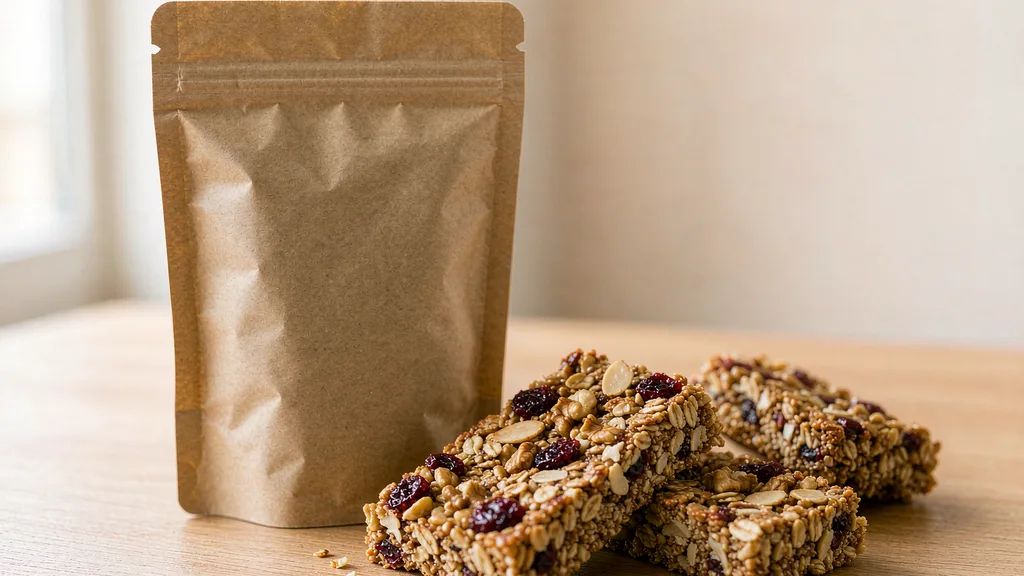
Granola bar packaging fails in three predictable ways: syrup and honey smear onto the seal, hard baked edges punch holes in thin film, and nut fat migrates outward and dulls the print. Specify a sealant that seals through contamination, add a puncture-resistant ply, and hold oxygen transmission under about 30 cc/m²/24 h, and a bar stays crisp for nine to twelve months.
What Is Inside a Granola Bar, and Why That Dictates the Pouch
A granola bar is not a dry snack. It is a compressed block of rolled oats, nuts, seeds and dried fruit held together by a binder of honey, glucose syrup or rice syrup, then baked or cold-pressed. That chemistry drives every packaging decision.
- Water activity sits around 0.30–0.55. Most molds need water activity above 0.60 to grow, so spoilage is rarely the issue. Texture is: absorb moisture and the bar goes soft; lose moisture and it turns rock hard.
- Fat content runs 15–30% by weight, much of it unsaturated oil from nuts and seeds. Oxygen is what makes that fat go rancid, not microbes.
- The binder is a sugar glass. It is rigid when cool and becomes tacky again as temperature climbs or as the bar picks up moisture.
- The geometry is sharp. A baked bar has square corners and a hard, angular face that concentrates force on a very small area of film.
Low water activity means the film must keep moisture out. High unsaturated fat means oxygen is the enemy. The sticky binder means the seal area will be contaminated at filling. And the sharp edges mean puncture resistance matters more than tensile strength.
Why Do Granola Bar Pouches Leak at the Seal?
Because the product gets between the sealing surfaces. Even a well-run line leaves a thin film of syrup, oat dust or nut oil on the seal band, and standard polyethylene will not form a reliable bond through that layer.
Where the contamination comes from
- Smear from the bar’s cut face as it slides into the pouch
- Fines and dust shed by oats, seeds and dried fruit
- Binder squeeze-out during compression and cutting
- Oil wicking along the inner film surface during filling
What to specify instead
- Sealant layer: ionomer (Surlyn-type) or metallocene-catalyzed PE. Both are engineered for seal-through-contamination and hold bond strength where ordinary PE fails.
- Seal geometry: 8–10 mm seal width with serrated or crimp jaws, which push contamination out of the seal band rather than sealing over it.
- Process window: run a seal-strength curve rather than a single setting. Measure seal strength by ASTM F88 at three temperatures and pick the plateau, not the peak.
- Verification: dye penetration per ASTM F1929 on a sample pull every hour. It takes two minutes and catches channel leaks that visual inspection never will.
How Sharp Edges Puncture a Pouch
Puncture is a point-load problem, not a tear problem. A 40 g bar resting on one corner during a parcel drop concentrates its whole weight on a few square millimetres of film, which is why pouches that survive a 1 m drop on the flat fail on the corner.
- Add a 15 µm biaxially oriented polyamide (BOPA/PA) ply. Nylon is the standard puncture layer in flexible packaging and roughly doubles resistance to point loading for a modest cost increase.
- Move total thickness to 100–140 µm for stand-up formats holding bars with nuts or large dried fruit pieces.
- Specify a corner radius on the bar itself where the recipe allows it. A 2 mm radius on the cut face removes most corner punctures without changing the eating experience.
- For e-commerce parcels, test the packed shipper to ASTM D5276 drop procedure at the height your carrier actually uses, not a laboratory default.
What Fat Migration Does to Print and Film
Nut and seed oil migrates through the inner polyolefin layer over weeks. On the shelf it shows up as dark, translucent patches on the print side, a softened ink film, and in bad cases blocking between stacked pouches.
- Keep ink and adhesive systems compatible with fatty products; ask for a fat-resistance test, not just a rub test.
- Hold the print surface at 38–42 dynes/cm after corona treatment so ink anchors properly. Below 36 dynes on a fatty product, print starts lifting within weeks.
- Where the oil load is high, an overprint varnish or a reverse-printed structure puts the ink behind the film instead of on the surface it rubs against.
Film Structures That Work for Granola Bars
| Structure | Best for | Barrier | Notes |
|---|---|---|---|
| PET / printing / PE | Dry bars, short distribution, single-serve | Medium | Cheapest, adequate for 4–6 months |
| PET / printing / BOPA / PE | Multipack bars with nuts, e-commerce | Medium-high | Adds puncture resistance, ~10–15% more material cost |
| PET / printing / AL / PE | Long shelf life, high-fat recipes, tropical markets | Very high | Blocks light and oxygen completely; opaque |
| Metallised PET / BOPA / PE | Retail shelf impact with extended life | High | Good light barrier, lower cost than foil |
| Mono-material PE/EVOH-PE | Recyclability claims in PE streams | High (dry) | Check seal-through-contamination behaviour before committing |
Closure and Opening: Single Bar Versus Multipack
The format follows the portion, not the brand.
- Single-serve bar: a flow-wrap or pillow pouch with a tear notch. A zipper is wasted cost on something eaten in one sitting.
- Multipack of 5–8 bars: a stand-up pouch with a press-to-close zipper. Budget roughly 8–15% added pouch cost for the zipper, and confirm the zipper survives the oil film — some press-to-close profiles lose grip once coated.
- Club-size format: zipper plus a carry handle or hang hole, since weight per pack rises past 400 g and the top seal carries real load in transit.
The Numbers Worth Putting in a Written Spec
A specification that only lists “food-grade pouch, 120 µm” will not survive a supplier change. Put measurable targets in the document:
- Oxygen transmission rate: below 30 cc/m²/24 h at 23°C and 50% RH for a 9-month target
- Water vapour transmission rate: below 1.0 g/m²/24 h at 38°C and 90% RH
- Seal strength: 20–35 N/15 mm per ASTM F88, with a defined minimum per batch
- Leak detection: ASTM F1929 dye penetration, zero channel leaks in a 32-pouch pull
- Migration: EU 10/2011 overall migration limit of 10 mg/dm², or FDA 21 CFR 177.1520 olefin polymer compliance for the US market
- Residual solvent: total below 5 mg/m², with benzene-class solvents non-detectable
OMOPACK(欧姆包装)quotes against these six lines because they are testable. A supplier who will not quote to a number is quoting to a guess.
Frequently Asked Questions (FAQ)
How long does a granola bar last in a stand-up pouch?
Nine to twelve months is realistic when oxygen transmission stays below 30 cc/m²/24 h and water vapour transmission below 1.0 g/m²/24 h. Bars with chocolate coatings or high nut content sit at the short end of that range because fat oxidation, not moisture, sets the limit.
Do granola bars need aluminium foil packaging?
Not always. Foil is worth it when shelf life exceeds 12 months, when distribution passes through hot or humid climates, or when the recipe carries chocolate or nut butter. For a 6–9 month ambient product, metallised PET with a nylon ply usually performs well enough at lower cost.
What film thickness should a granola bar pouch use?
100–120 µm for a standard retail pouch, and 120–140 µm when the bar contains whole nuts, large dried fruit pieces or sharp baked edges. Thickness alone does not fix puncture; a nylon ply does more per micron than extra polyethylene.
Can recycled-content film be used for granola bar packaging?
Yes, but only with a functional barrier or a documented food-grade recycled stream. Post-consumer resin without a food-contact clearance should never sit in the product contact layer, regardless of what the outer layer claims.
What is the realistic minimum order for custom printed granola bar pouches?
Digital printing starts around 500–1,000 pouches per design; rotogravure typically starts at 10,000–20,000 pouches because of cylinder cost. If you run more than four designs a year, digital usually wins on total cost even at higher unit prices.
For closure options in more depth, see resealable pouch formats for snacks and nut packaging: managing oxygen, oils and reclosing. Shelf-life targets interact with closure choice, covered in shelf life and best-before dates. Two factory-side references worth keeping on file: seal integrity testing methods compared and MAP packaging film specification.