Buyers of sustainable flexible packaging often ask us: industrial vs home composting — what is the difference, and which one does a “compostable” claim actually refer to? The answer matters more than most people think. A bag that passes industrial composting tests can sit intact in a backyard compost bin for years, damaging brand trust and creating compliance risk. In this guide, we break down the difference between the two composting routes, the certification labels to look for, and how biodegradable packaging materials behave in each environment.
What Is Industrial Composting?
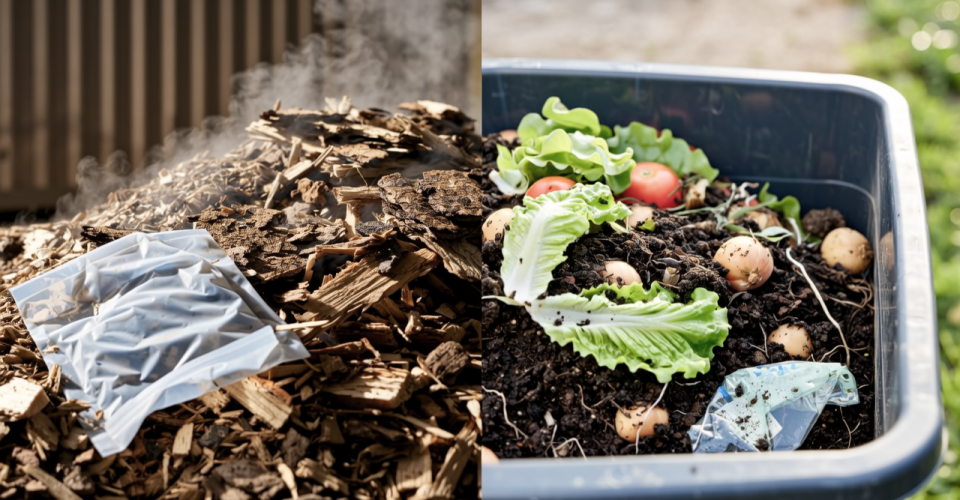
Industrial composting takes place in commercial or municipal composting facilities, where conditions are tightly controlled. Temperatures are held between 55 and 70 degrees Celsius, moisture and oxygen levels are managed, and the carbon-to-nitrogen ratio is adjusted to keep microorganisms active. Under these optimized conditions, compliant materials are expected to biodegrade within 12 weeks; European standard EN 13432, for example, requires defined levels of biodegradation and disintegration within 90 or 180 days.
Because industrial facilities combine heat, humidity and active aeration, they can break down materials — such as PLA — that struggle in cooler environments. This is why most “compostable” packaging on the market today is certified for industrial composting only.
What Is Home Composting?
Home composting is the slow, uncontrolled decomposition that happens in a backyard bin or tumbler. Temperatures typically stay between 20 and 30 degrees Celsius, and there is no professional management of moisture, aeration or microbial inoculation. Degradation takes months, often more than a year, and depends heavily on the local climate and how the bin is maintained.
Standards such as OK compost HOME (TÜV Austria) and France’s NF T51-800 test materials under these realistic ambient conditions, which is a far tougher hurdle than an industrial composting test. Certification to an industrial standard does not automatically mean a material will compost at home.
Certification Standards: What the Labels Actually Mean
The most common industrial composting standards are EN 13432 (Europe), ASTM D6400 (United States) and ISO 18606. Look for the seedling logo issued by DIN CERTCO in Europe or the BPI logo in the United States. These schemes verify biodegradation rate, disintegration and eco-toxicity under controlled high-temperature conditions.
For home composting, the two recognized schemes are OK compost HOME from TÜV Austria and the French NF T51-800 standard. Both require ambient-temperature degradation tests, and far fewer materials qualify. When a package carries a home-composting label, the claim is stronger — and more expensive to earn — than an industrial-only claim.
How Materials Behave: PLA, PBAT and Starch Blends
Material chemistry drives everything. PLA (polylactic acid) degrades well under industrial composting heat but very slowly at ambient temperatures. PBAT, a more flexible polyester, performs better in cooler conditions, which is why many home-compost-certified products use PBAT-based formulations. Starch-based materials start degrading quickly but usually need to be blended with compostable polyesters to meet certification thresholds.
In short, “biodegradable”, “compostable” and “home compostable” are three different promises. For real-world data on how long biodegradable packaging actually takes to break down, see our guide on biodegradable packaging degradation time. And if you are wondering whether the whole category is overhyped, our article is biodegradable packaging a gimmick shares three honest insider perspectives.
What Brands and Consumers Should Check
For brands, start with the target market. France, for example, has pushed for home-compostable certification on certain fruit and vegetable packaging, while industrial composting labels carry more weight in countries with mature municipal composting networks such as Italy and Spain. The package should state clearly which composting route it is designed for, so consumers dispose of it correctly.
For consumers, ignore the big “eco” wording and look for the small print: a recognized logo plus a standard number such as EN 13432 or OK Compost HOME. That combination is the only reliable proof that the packaging will actually compost in the intended system.
Summary
Industrial vs home composting come down to three differences: temperature, time and certification. Before choosing a biodegradable packaging solution, verify that the material formulation matches your target disposal channel, that the label references the correct standard, and that your marketing language clearly distinguishes between the two. Get those three points right, and your eco-packaging will survive both market scrutiny and regulatory review.
Need a compostable packaging solution for your products? Contact OMOpack for material recommendations and certification guidance.
Visit OMOpack.com for more packaging knowledge and industry insights.