Custom Food Pouches: choose the right materials and processes to make your product naturally appealing
How exactly do you choose custom food pouches? Have you ever had this experience: standing in a supermarket aisle, your eyes are drawn to a beautifully packaged snack — you pick it up, read the ingredients and description, and finally put it in your cart? In the food industry, packaging is long past being “a bag to hold things”. It is the product’s first business card, a silent salesperson, and it can even directly decide whether consumers are willing to pay for your product.
According to market research, for more than 70% of consumers buying a food brand for the first time, the visual appeal of the packaging is one of the important factors driving their purchase decision.custom food packaging pouches, which is precisely the key to turning an ordinary product into a “shelf star”. But with so many materials and complex processes on the market, many people do not know where to start on their first custom order. This article walks you through everything from material selection to printing in one go. If you are still unsure about the differences between materials, you can also start with our earlier5 Key Factors in Choosing Food Packaging Pouches as an introductory reference.
1. How to choose the common materials for custom food pouches?
Material selection is the first step in custom pouch making and the one that most affects cost and quality. Choose the right material, andcustom food packaging pouches you are halfway to success. The mainstream food packaging materials today include:
1. Kraft paper pouches
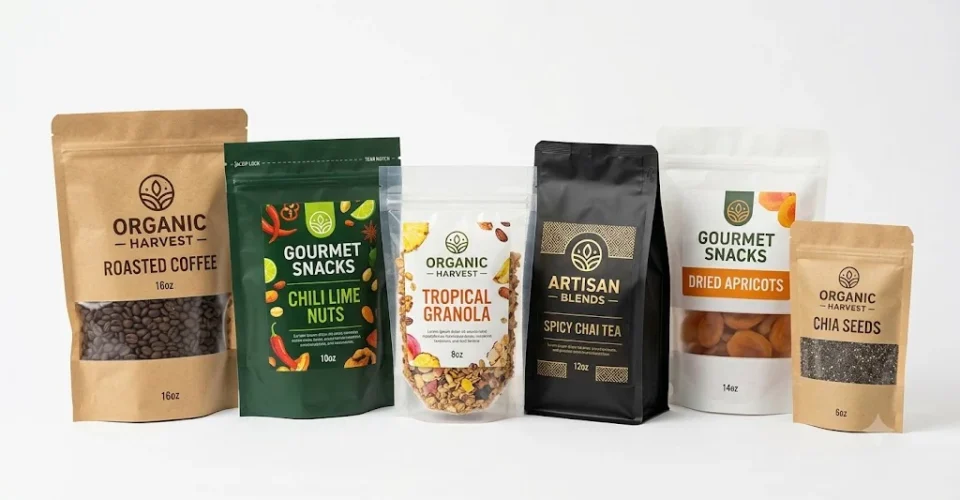
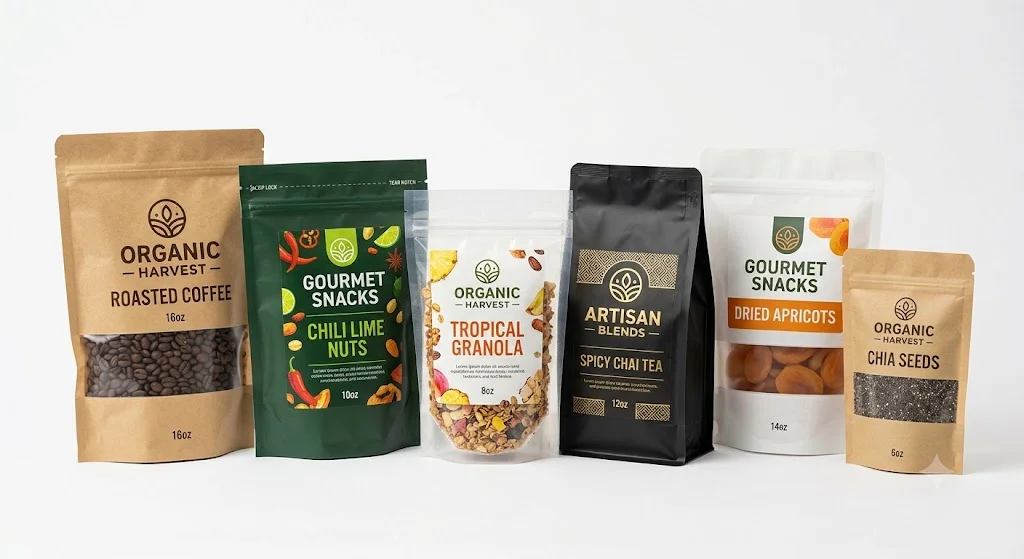
Kraft paper is naturally eco-friendly with a warm texture, suitable for baked goods, dried fruit, tea, grains and cereals. The inner layer can be PE-coated for oil and water resistance, keeping the paper feel while adding function. With the recent rise of the “green packaging” wave, kraft pouches are very popular for coffee beans, artisan bread and organic food. Another advantage is excellent printability — both flexo and digital printing deliver a nice finish. According toUS FDA food contact material standards, kraft paper, as a natural fiber material, has an extensive safety record in food packaging.
2. Aluminum foil pouches
Foil pouches have extremely strong barrier properties, effectively resisting moisture, light and oxygen — ideal for foods needing long-term storage such as tea, milk powder, coffee powder, freeze-dried food and pet treats. The metallic sheen makes them common for mid-to-high-end products. Foil pouches are typically made of three or more laminated layers: outer PET for printing, middle AL foil for barrier, inner PE for heat sealing — a sound structure. This type ofcustom food packaging pouches pouch is especially suited to products with strict shelf-life requirements.
3. Laminated pouches (plastic/nylon laminates)
This is the most versatile pouch type. By laminating different materials (PET/AL/PE, NY/PE, PET/PE, etc.), you can achieve transparency, puncture resistance, retort resistance and other functions. Suitable for snacks, frozen food, cooked food, seasonings and sauce packs. The NY (nylon) layer greatly boosts puncture resistance — recommended for packaging bone-in meat treats. If you want more price comparisons between materials, refer to ourPros and cons comparison of 6 common packaging materials。
4. Biodegradable material pouches
As environmental regulations tighten, biodegradable materials such as PLA (polylactic acid) and PBAT are entering the market. Though currently costlier with limited heat resistance, they fit future consumption trends and suit brands with an eco positioning. Note that biodegradable materials do not degrade in all environments — confirm the degradation conditions with your supplier before use. The EU’sPackaging and Packaging Waste Directive (PPWD) certification requirements for biodegradable packaging are worth referencing.
2. The printing process determines the “appearance” of custom food pouches
Once the material is chosen, the printing process determinescustom food packaging pouches the final result. With custom food pouches, different processes produce wildly different levels of perceived quality. Choosing the process according to your order volume and budget can significantly optimize costs.
Flexographic printing (Flexo)
suits large-volume production with low per-unit cost after plate costs are amortized. Colors are rich and even — the mainstream choice for everyday snack packaging. The drawback is plate-making: minimum runs are usually 5,000+ pieces, and design changes require new plates.
Gravure printing
offers richer color depth, extremely high precision and accurate registration, ideal for premium products and brands with strict color reproduction requirements. The downsides are high plate costs and large minimum runs, making small-batch customization uneconomical. If your product goes through supermarket channels with stable volume, gravure is the optimal choice.
Digital printing
requires no plates and can print from a single piece — the best choice for small-batch customization. Ideal for new product trials, e-commerce small batches, personalized customization and region-limited packaging. Digital printing technology has advanced rapidly in recent years; color and precision now approach gravure levels, and it even supports one-bag-one-code traceability.
Hot foil stamping (gold/silver)
Applies gold or silver foil to part of the packaging, instantly elevating the perceived quality. Ideal for gift boxes, premium souvenir packs and holiday-limited packaging. Foil stamping is usually combined with embossing so logos and patterns have both a metallic sheen and a tactile 3D feel.
3. Four Practical Pitfall-Avoidance Tips for Custom Food Pouches
1. Confirm the food’s properties first: oily foods (nuts, fried chicken, chips) need an oil-resistant coating or OPP lamination; frozen foods need low-temperature-resistant materials to prevent cold cracking; retort foods need pouches that withstand 121°C. Don’t use a one-size-fits-all solution — different foods have completely differentcustom food packaging pouches physical and chemical requirements.
2. Allow enough time for sampling: always confirm with samples before mass production. Color deviation, whether the zipper glides smoothly, whether seal strength meets standards, whether thickness is uniform — you only know these once you hold the physical sample. We recommend reserving at least 7-10 days for sample confirmation and revisions.
3. Pay attention to the sealing method: three-side seal, center seal, stand-up pouch, gusset pouch, zipper pouch, easy-tear opening… Different sealing options affect the user experience. For e-commerce shipping, easy-tear openings are recommended to improve the unboxing experience; products consumed over multiple sessions (such as tea and nuts) should add a zipper for easy resealing and storage.
4. Eco-certification as a bonus: if your packaging uses FSC-certified paper or OK Compost-certified biodegradable materials, you can mark the corresponding labels on the packaging. This not only follows the global sustainability trend but is also an important source of brand premium — more and more consumers are willing to pay 5%-10% more for eco-friendly packaging.
4. Custom food pouches as brand ambassadors
An excellentcustom food packaging pouches must not only “hold the product” but also “sell it”. The following three points are key to strengthening brand power through packaging:
Visual consistency: the packaging’s color scheme, typography and logo placement must be consistent with the brand’s overall visual system. Online and offline channels should especially share one visual language so consumers can recognize your brand at a glance on the shelf. Consider creating a simple brand visual guideline booklet for the packaging design team to follow.
Information hierarchy: put the product name and core selling points on the front (e.g. “no added sugar”, “high protein”), and detailed descriptions, ingredient lists and nutrition facts on the sides or back. Don’t pile everything on the front — consumers’ attention lasts only 3-5 seconds, so give them the most valuable information in the shortest time.
Tactile marketing: touch is the most direct sensory experience after sight. Matte lamination feels more premium than gloss film — no glare, no fingerprints; spot UV raised effects guide fingers to specific areas, adding interactivity; kraft paper’s rough texture itself signals “natural” and “handmade”. These details may seem minor, but consumers feel the difference the moment they hold the package.
Summary: choose the right custom food pouch and make your product stand out
Custom food pouches are a systematic project requiring comprehensive consideration of materials, processes, cost and brand positioning. There is no “best” packaging — only the solution “most suitable” for your product and budget. Before customizing, clarify three questions: which channel do I sell through? Who is my target customer? What is my price range? Walking into discussions with the packaging factory armed with these three answers makes everything far more efficient and avoids detours. For price and performance comparisons between materials, you can also refer to our other detailedGuide to Choosing Custom Pouch Materials。
Forcustom food packaging pouches interested? Welcome toContact OMOPACK. We offer one-stop service from material selection, structural design, printing and sampling to mass production, with our professional team providing free customization advice to help your product stand out on the shelf.