Why Is the Flexible Pouch Type So Important?
Choosing the flexible pouch type is the first step in packaging design. When starting a packaging project, many people’s first reaction is to care about”what design to print and what material to use”, but often overlook a more fundamental question — which pouch type to choose. The pouch type determines how the product is filled, stored and displayed, and directly affects shelf appeal and user experience. Choose the wrong type and even the best design is wasted.
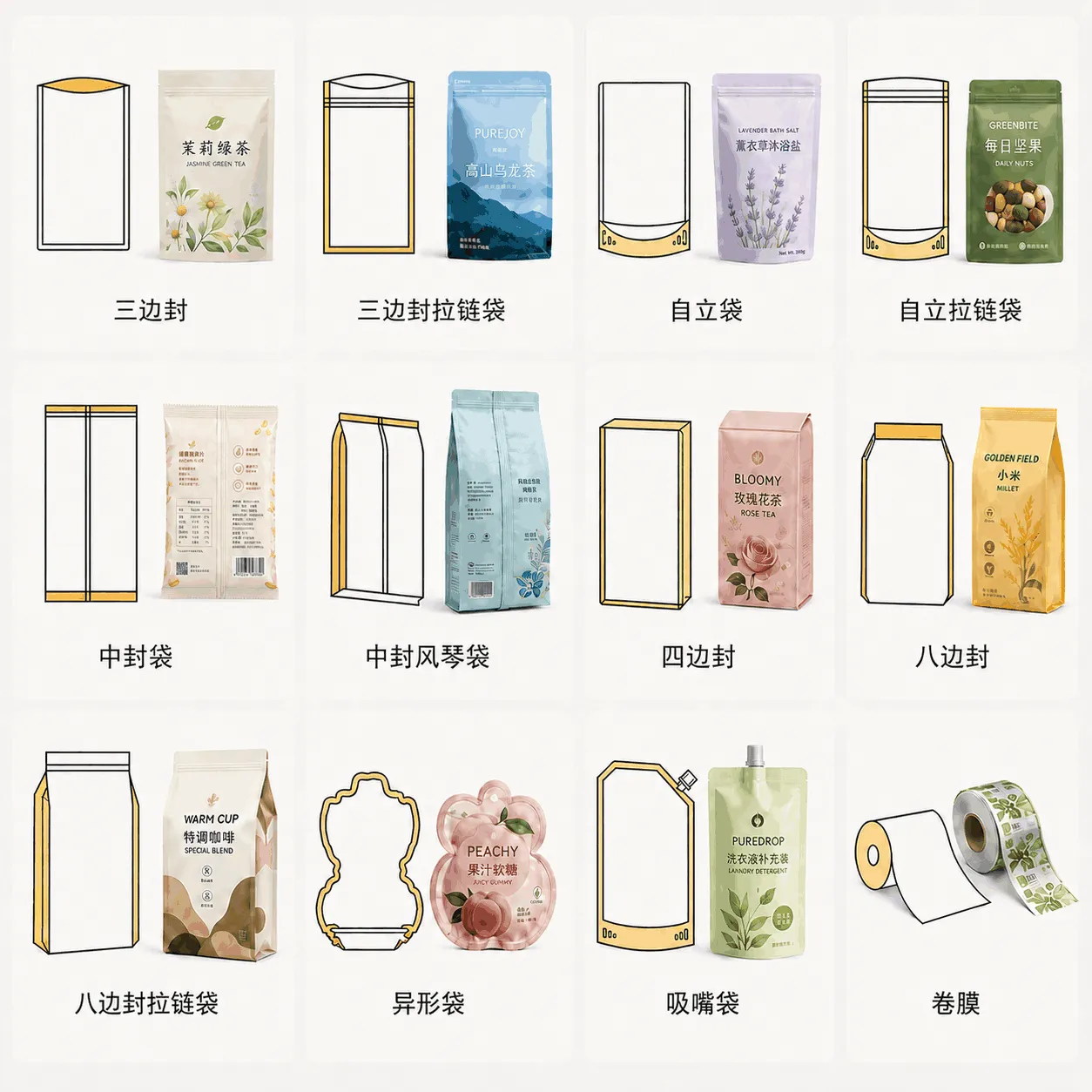
Flexible pouch types may look countless, but only a handful are commonly used. Below we break down the 6 most common types one by one so you can quickly grasp their differences and applications.
Stand-up pouch
Features: has a folded bottom structure that stands steadily on the shelf when opened, with sides that expand like an accordion. Stand-up pouches with zippers can be resealed repeatedly, which is very convenient.
Best for:Coffee beans, tea, freeze-dried food, pet treats, nuts, milk powder, etc. All products that need to”stand up for display” are well suited. Stand-up pouches with transparent windows also let consumers see the product directly, boosting purchase confidence.
Common specifications: From 20g to 5kg, from trial packs to family sizes. Usually paired with PET/AL/PE or PET/MPET/PE structures for barrier performance.
8-Side Seal Pouch (Flat Bottom Pouch / 8-Side Seal)
Features: has a flat bottom and eight sealed edges on the sides, hence the name. Its biggest advantages are a perfectly flat base, the steadiest standing, and the largest front display area with the best print results — the most premium look.
Best for:Specialty coffee (especially 200g+), premium tea, nut snacks, pet food staples, freeze-dried products, etc. The 8-side seal pouch is especially popular in the specialty coffee market because it can”stand” on the shelf as neatly as a small box, creating strong visual impact.
Note:The 8-side seal pouch process is relatively complex and costs 15-30% more than stand-up pouches. If your product has a high unit price and premium positioning, the extra cost is well worth it; for high-volume, low-price products, consider stand-up pouches.
3-Side Seal Pouch
Features:The simplest pouch type — sealed on three sides, open on one.FDA food packaging guidelines pouches cannot stand upright and are mainly laid flat. The process is the simplest, fastest to make and lowest in unit price.
Best for:Trial packs, small sample packs, single-use seasoning sachets, wet wipes, etc. If your product only needs simple flat packaging, or serves as a gift/sample pack, the 3-side seal pouch offers the best value.
4-Side Seal Pouch
Features: sealed on all four sides, with a flat, regular look similar to a small envelope. It cannot stand, but both faces are perfectly flat with good print results.
Best for:Flat products such as seaweed sheets, face masks, dried powder goods and small snacks. The 4-side seal pouch has excellent seal integrity, suitable for products needing long-term storage.
Side gusset bag
Features: has folding structures on the sides or bottom that expand like an accordion — large capacity but compact when folded. Available in bottom-gusset and side-gusset versions.
Best for:Coffee powder (bulk packs), pet food (2.5kg+), bakery ingredients, chemical powders and other products needing large capacity. Gusset pouches offer the largest capacity for the same outer dimensions.
Back Seal Pouch (Center Seal / Back Seal)
Features:The seal runs down the middle of the back, tube-shaped. Chip bags in supermarkets are typical back seal pouches. Production efficiency is extremely high, ideal for large volumes.
Best for:Puffed snacks like chips, frozen food, rice, flour and other high-volume, low-price products. Back seal pouches are one of the most economical mass-production options.
Practical Advice for Choosing a Flexible Pouch Type
When choosing a pouch type, consider these points:
- Product form — granular, powder, liquid or solid? Powders and liquids suit stand-up or 8-side seal pouches; solid blocks can use gusset pouches.
- Display method — sold standing on the shelf or hanging? Choose stand-up or 8-side seal pouches if standing display is needed.
- Brand positioning — premium lines use 8-side seal pouches, value lines use stand-up pouches, sample packs use 3-side seal pouches.
- minimum order quantity (MOQ) — small batches (500-5,000 pcs) recommend stand-up or 3-side seal pouches; for large volumes (10,000+) all types work, and 8-side seal tooling costs can be amortized.
If you are still unsure, the simplest approach is to have the packaging supplier propose a few options for comparison. Seeing an actual sample beats armchair analysis any day.
Questions about pouch selection?Welcome toContact OMOPACK, and we provide free consultation from pouch type recommendation to structural design, helping you find the packaging solution best suited to your product.