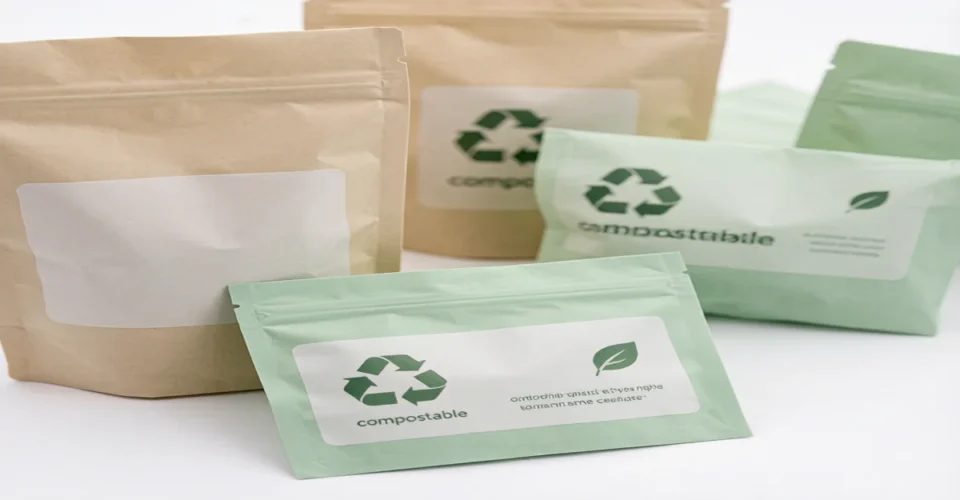
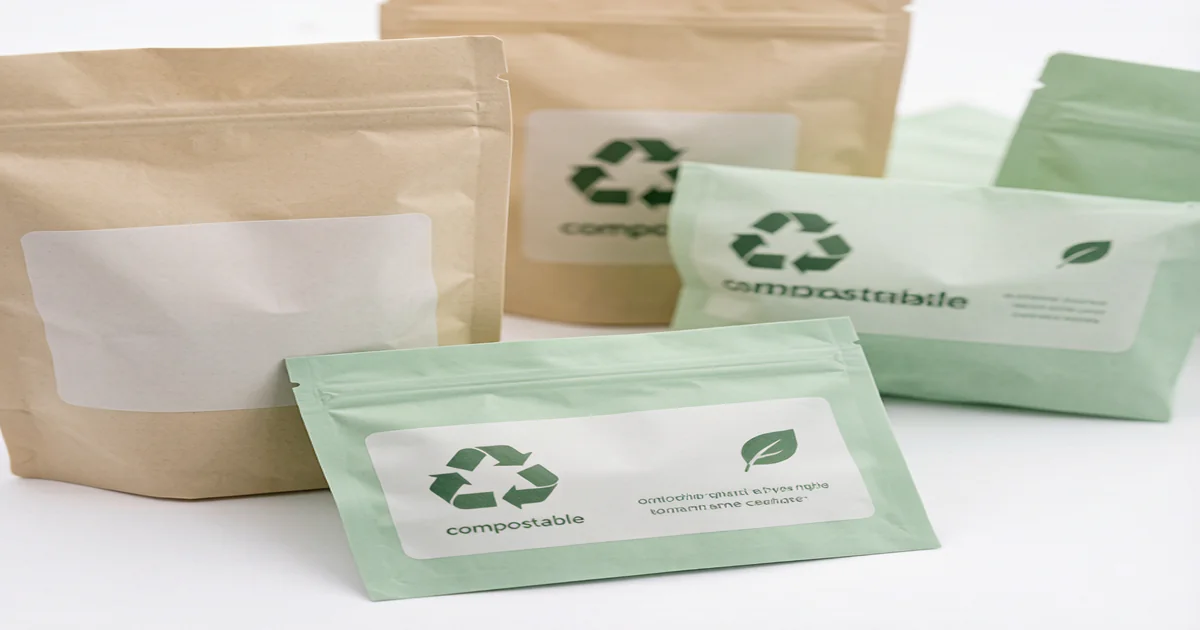
Degradable food packaging poucheswelcomed a true market explosion in 2025. With the”15th Five-Year Plan”setting a 40% target for the proportion of biodegradable materials in e-commerce packaging (mandatory by 2028), and the EU PPWR regulation’s recyclability requirements for imported packaging,Degradable food packaging pouchesFrom”a niche choice”has become”a compliance necessity”。
But in customer consultations, we found that 80% of brands still hold the stereotype that”eco-friendly = expensive”, and are unclear about the performance differences among the three mainstream materials PLA, PBAT and PHA. This article uses comparison data to help you make a rational choice.
PLA, PBAT, PHA: a full comparison of three mainstream degradable materials
Material sources and degradation principles of degradable food pouches
| Material | Raw material source | Degradation conditions | Industrial composting period | Home composting |
|——|———-|———-|————-|———-|
| PLA (polylactic acid) | Corn starch, sugarcane | Industrial composting (58°C+) | 3-6 months | Not supported |
| PBAT (copolyester) | Petrochemical-based + bio-based | Industrial composting + soil | 6-12 months | Partially supported |
| PHA (polyhydroxyalkanoate) | Microbial fermentation | Industrial composting + seawater + soil | 2-4 months | Supported |
> Key takeaway:”degradable”≠”it decomposes when casually discarded”. PLA requires industrial composting conditions above 58°C and degrades extremely slowly in natural environments. Before choosing a material, confirm the composting infrastructure in your sales region.
PLA degradable packaging: the most mature but also the most limited
PLA is the most commercially mature biodegradable material today, with transparency close to traditional BOPP, good printability, and the lowest relative price (CNY 28-35/kg). However, its drawbacks are:
– Poor heat resistance: begins to soften above 50°C, not suitable for hot filling or high-temperature foods
– Average barrier properties: oxygen transmission rate 3-5x higher than PET, requires coating treatment
– Demanding degradation conditions: requires industrial composting facilities, otherwise degradation takes years
Application scenarios: short-shelf-life chilled foods (salads, sandwiches), dry goods (nuts, grains), and non-oily foods that don’t need high barriers.
PBAT biodegradable packaging: PLA’s best”partner”
PBAT itself has average mechanical properties, but it is the most common blend material for PLA modification – PLA/PBAT blended films retain PLA’s transparency and printability while improving toughness and elongation at break through PBAT.
| PLA/PBAT blend ratio | Tensile strength | Elongation at break | Suitable pouch types |
|———————-|———-|————-|———-|
| 70/30 | 45 MPa | 180% | Lightweight food pouches |
| 50/50 | 28 MPa | 350% | High-performance scenarios |
Practical advice: commercially available”Degradable food packaging pouches”over 90% of “biodegradable food pouches” are PLA/PBAT blends, with ratios adjusted by cost and application.
PHA degradable packaging: the future star, but still at a high price point
PHA’s biggest advantage isgenuine degradation in natural environments – it can be broken down by microorganisms in seawater, soil and freshwater, with harmless degradation products. But its current price is 3-4x that of PLA (CNY 100-140/kg), mainly used in premium organic foods and high-value products exported to the EU.
Compliance and certification system for degradable food pouches
Domestic and international certification requirements for degradable food pouches
Degradable food packaging pouchesTo enter the market, at least two hurdles must be cleared: food-contact safety + degradation performance certification.
| Market | Food-contact certification | Degradation performance certification | Label requirements |
|——|————-|————-|———-|
| China | GB 4806.1-2016 | GB/T 19277 (industrial composting) | “”compostable and biodegradable””Chinese text |
| EU | EU 10/2011 | EN 13432 (composting) + OK COMPOST HOME | Seedling label |
| US | FDA 21 CFR | ASTM D6400 | BPI certification mark |
| International sea freight | — | OK BIODEGRADABLE MARINE | Coral mark |
> Hands-on tips: if exporting to the EU, the pouch must hold EN 13432 certification, and the entire pouch (including printing inks) must pass testing – testing only the base film is not enough.
Cost analysis: how much more expensive are degradable pouches?
PLA/PBAT cost comparison for degradable food pouches
| Material structure | Base material cost (¥/kg) | Made-pouch cost comparison | Premium payback period |
|———-|————-|————-|————-|
| PET/PE (traditional) | 18-22 | Baseline | — |
| PLA/PBAT 70/30 | 30-38 | +45%-60% | Covered by brand premium in 3-6 months |
| PLA/PBAT 50/50 | 35-42 | +65%-85% | Covered by brand premium in 6-10 months |
| PHA mono-material | 110-140 | +350%-420% | Only viable for premium positioning |
Key finding: according to Nielsen’s 2025 Chinese consumer survey, 68% of respondents are willing to pay a 10%-15% premium for eco-friendly packaging. This means a +50% packaging cost increase can be fully absorbed within 6 months through product price adjustments.
3 ways to reduce degradable food pouch costs
1. thinner-gauge design: PLA/PBAT film can be made at 12μm (traditional PET/PE needs 15μm); thinner means lower cost
2. mono-material structure: all-PLA structure replaces the three-layer PLA/PBAT/adhesive lamination, raising recycling rate to 95%
3. Lock in prices with large volumes: PLA pellet prices fluctuate significantly; customers using >50 tons per year can lock in annual purchase prices
Decision framework: which one suits your product?
Decision tree for buying degradable food pouches
1. Is the product exported to the EU? -> yes: choose PLA/PBAT (with EN 13432 certification); no: continue
2. Does it contain oil or high moisture? -> yes: need PLA + high-barrier coating; no: continue
3. Is the unit price >CNY 80/kg (food)? -> yes: consider PHA to elevate brand positioning; no: PLA/PBAT is sufficient
4. Are industrial composting facilities available? → Yes: PLA is fully viable; No: consider PHA or traditional recyclable structures
Questions about or need a custom packaging solution? Welcome toContact OMOPACK. We offer one-stop service from material selection and structural design to printing sampling and mass production, and our professional team provides free customization advice.