2025 Food Packaging Regulations: Understanding the Industry Change from the Start
The 2025 food packaging regulations are about to take effect — the most significant regulatory upgrade in China’s food packaging sector in recent years. The new rules impose comprehensive requirements on material selection, labeling, environmental standards and more. If your company is procuring food pouches, understanding and adapting to the 2025 regulations in advance is not just about compliance — it is an important step to seize market opportunities. This article covers four dimensions — materials, labeling, printing and response strategies — to help you see things clearly in one read.
According to the latest information released by the State Administration for Market Regulation,2025 food packaging regulations sets its core direction as”safer, more transparent and more eco-friendly”. This means food producers, brands and packaging suppliers all need to re-examine their existing packaging solutions.
1. Impact of the 2025 food packaging regulations on material selection
2025 food packaging regulations impose stricter limits on materials. First, food contact material safety standards are comprehensively upgraded, with significantly tightened limits on plasticizers, heavy metal residues and other harmful substances. Specifically, common plastics such as PET, PE and PP must provide more detailed migration test reports. This requirement aligns with the international trend — the EUFramework Regulation (EC) No 1935/2004 on food contact materials also has similar provisions on migration testing.
Second, the new rules encourage recyclable, biodegradable eco-materials. This has far-reaching implications for the packaging industry — when selecting materials, companies must consider not only cost and performance but also environmental compliance in their evaluation. If you are evaluating the properties of different materials, refer to our earlierPros and cons comparison of 6 common packaging materials。
In addition,2025 food packaging regulations the regulations also impose quantified requirements on interlayer peel strength, heat seal strength and other physical indicators of composite materials, further raising production quality control standards.
2. New labeling requirements under the 2025 food packaging regulations
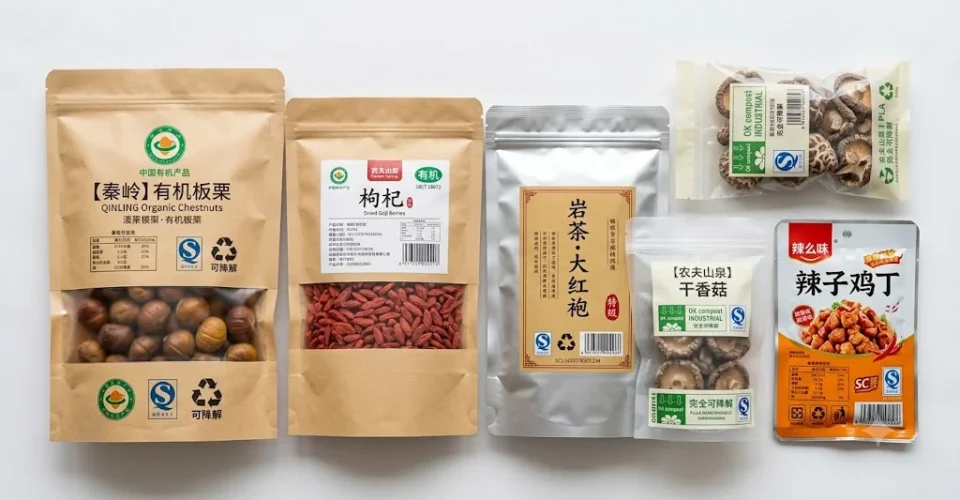
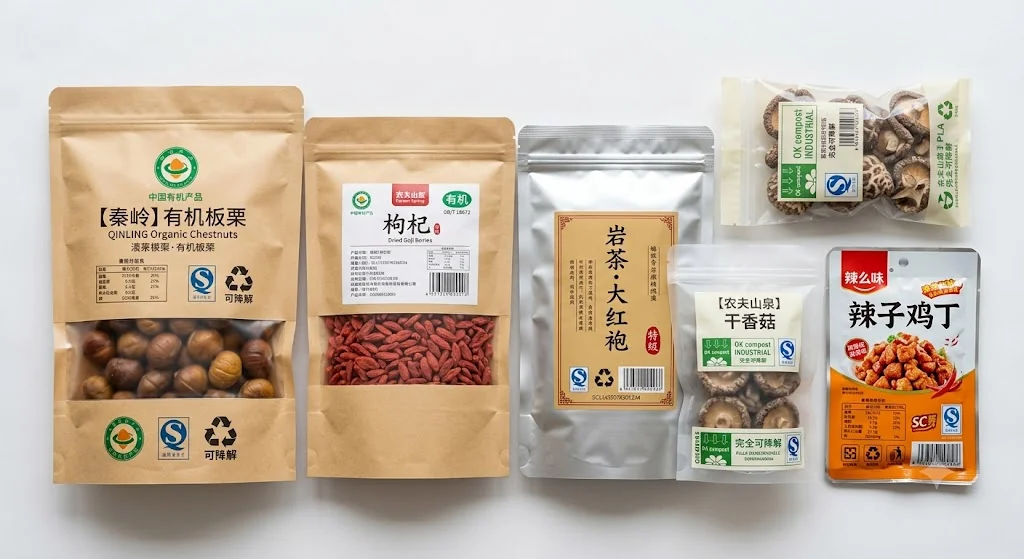
Labeling is2025 food packaging regulations another key focus. The new rules require food packaging to show key information such as material details, recycling marks and production date/batch numbers, with clear rules on font size and placement. Notably, if recycled or biodegradable materials are used, the corresponding certification marks and scope of application must be labeled. Label placement requirements also vary by pouch type — for details, see ourFood Pouch Types and Label Layout Guide。
In addition, the nutrition facts table format has been adjusted to require clearer information hierarchy. Brands need to work closely with packaging design teams to ensure all compliance information is accurately presented within the limited layout. For basic food pouch selection thinking, you can review our5 Key Factors in Choosing Food Packaging Pouches as a reference.
3. How the 2025 food packaging regulations affect printing processes
Printing processes are equally affected by2025 food packaging regulations the new rules. The regulations set higher standards for ink safety, requiring food packaging printing to use benzene-free and ketone-free inks that meet food safety standards. Solvent residue levels are also included in testing, imposing stricter control requirements on gravure and flexographic production processes.
For companies with small-batch customization needs, digital printing’s advantages become even more prominent — no plates, zero solvent residue risk, and variable data printing. These traits give digital printing a natural compliance advantage. After the new rules take effect, more companies are expected to shift toward digital sampling and small-batch digital printing procurement.
4. How companies should respond to the 2025 food packaging regulations
Facing2025 food packaging regulations the new regulations, companies can plan ahead in the following areas:
1. Comprehensively audit existing packaging: inventory all current packaging specifications and check each item against the new rules for material compliance, label completeness and test report validity. For non-compliant packaging, set up a replacement schedule.
2. Validate with samples in advance: switching to new materials requires thorough sample testing — reserve at least 15-20 days for validation to ensure the new packaging works on the production line. For relevant testing standards, refer toState Administration for Market Regulation food-contact material standards。
3. Choose compliant suppliers: work with qualified packaging suppliers that have testing capabilities. Require suppliers to provide complete third-party test reports, including key indicators such as migration testing and solvent residue testing.
4. Build compliance archives: build a complete compliance file for each packaging product, including material certificates, test reports and label design drafts, ready for regulatory inspection.
Summary: the 2025 food packaging regulations are both a challenge and an opportunity
2025 food packaging regulations implementation does bring compliance costs and management pressure in the short term, but in the long run it is a catalyst for the industry’s survival of the fittest. Companies that prepare compliant packaging early will gain higher brand credibility and broader market space. Packaging compliance is not the end, but a new starting point for brand upgrading.
For2025 food packaging regulations -compliant packaging solutions? Welcome toContact OMOPACK. We provide one-stop service from material selection and compliance testing to mass production, helping your products transition smoothly into the new regulatory era.