Material selection is a critical step in custom pouch making. When customizing pouches, do you often get confused by all the material names? What is PE? What is PET? Can kraft paper be used for food packaging? Is PLA biodegradable material reliable? Don’t worry — this article is here to clear it all up. We won’t go into complex chemical formulas; we only look at real-world applications and break down the 6 most common custom pouch materials in plain terms.
1. Kraft paper: the eco-friendly choice and top pick for texture
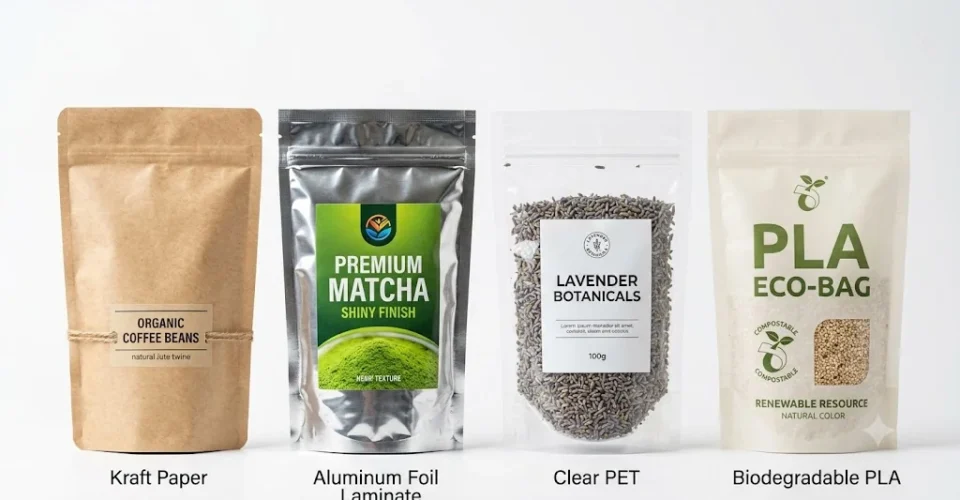
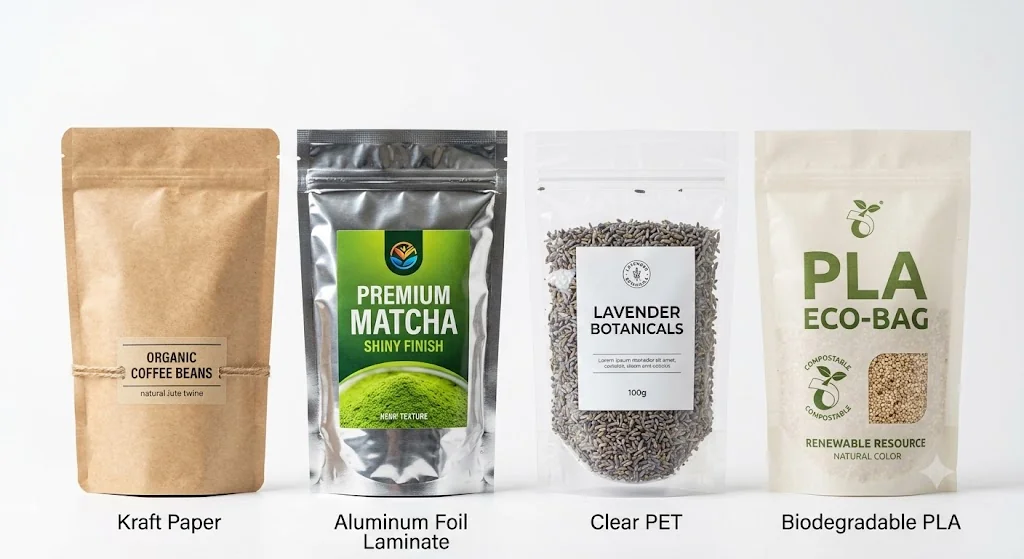
Kraft paper has become one of the most popular packaging materials in recent years because it is naturally eco-friendly, recyclable and biodegradable, fitting today’s green consumption trend. Kraft paper pouches have strong tensile and burst strength with a warm, rustic feel — ideal for bakery, tea and dry goods. However, kraft paper’s moisture and oxygen barrier are poor, making it unsuitable for long-term food storage. In practice, many manufacturers laminate a PE film or aluminum foil inside the kraft layer, keeping the kraft look while solving moisture and freshness issues. When customizing pouches, if you value brand tone and an eco image, kraft paper laminates are an excellent choice.
2. Aluminum foil laminates: the king of freshness
Aluminum foil laminates are among the strongest barrier materials, blocking almost all oxygen, moisture and light. They are typically used as the middle layer laminated with PET, PE and others, forming the classic three-layer PET/AL/PE structure. The outer PET provides the printing surface and mechanical strength, the middle foil provides barrier, and the inner PE handles heat sealing. Foil laminate pouches are widely used for coffee, nuts, tea, milk powder, seasonings and other products with extremely high freshness requirements. The downsides are higher material cost and an opaque foil layer that cannot show the product inside. On the other hand, this is exactly why foil pouches deliver more striking print results — with refined design they project a premium quality feel.
3. PE (polyethylene): the most economical choice
PE (polyethylene) is one of the most common and cheapest packaging materials. PE pouches are soft, moisture-resistant and easy to heat-seal, widely used as outer or inner packaging for dry goods, snacks and frozen food. Transparency can be tuned by formulation, from semi-transparent to highly transparent. Advantages: low price, mature processing, stable supply. Disadvantages: average oxygen barrier, softer feel, not ideal for products needing dimensional display. PE is usually the inner layer of laminated pouches; standalone PE outer pouches are relatively rare. When customizing, if your budget is limited and freshness requirements are low, PE offers excellent value.
4. PET (polyester) film: a transparent, good-looking all-purpose material
PET (polyethylene terephthalate) is a highly transparent, high-strength packaging material with excellent printability and dimensional stability. PET film offers high clarity and gloss, letting consumers see the product directly — ideal for display-focused packaging such as candy, biscuits and frozen goods. PET also has good chemical and oil resistance, suitable for oily products. However, PET’s heat-seal performance is poor, so it usually needs lamination with PE or CPP film for sealing. If you want packaging that both displays the product and offers decent protection, PET laminates are a good choice.
5. PA (nylon): the puncture-resistant powerhouse
PA (nylon) film is known for excellent puncture resistance and flexibility — the first choice for frozen food, vacuum packaging and demanding industrial packaging. Nylon stays flexible at low temperatures without brittle cracking, especially suitable for frozen meat and seafood. Its oxygen barrier is also quite good, and it is often laminated with PE (PA/PE structure) to combine puncture resistance with heat sealing. The downsides: higher cost and average moisture barrier, so it usually needs to be paired with other materials in practice. If your product has sharp edges (frozen chicken wings, bones) or must be shipped at extreme temperatures, PA nylon laminates are the safest choice.
6. PLA biodegradable material: the future of sustainable packaging
PLA (polylactic acid) is a bio-based biodegradable material derived from corn starch or sugarcane (US EPA industrial composting standards), which fully degrades into water and carbon dioxide under industrial composting conditions. In recent years, with global plastic-restriction policies and rising consumer environmental awareness, PLA pouch demand has grown rapidly. PLA’s transparency and processing performance are close to traditional plastics, but it currently has limitations: poor heat resistance (usually not above 50°C), higher cost and demanding degradation conditions. It suits short-shelf-life organic food, fresh produce and bakery products. Choosing PLA for custom pouches can be a strong talking point for a brand’s eco story, but you also need to tell consumers how to dispose of it correctly.
Summary: how to quickly choose the right custom pouch material?
After seeing so many materials above, you may feel even more confused. In factcustom food packaging pouches material selection can be simplified into three steps: first, define the product characteristics — does it need high barrier? Does it have sharp edges? Is transparency required? Second, set the budget range — what is the maximum packaging cost per product? Third, balance brand positioning — premium brands choose foil or kraft laminates, value lines choose PE or PET. If unsure, read ourPackaging Materials Introductory Guide, or contact a custom pouch manufacturer directly for samples and run actual tests before mass production — this is the most reliable approach.
Still have questions about pouch material selection? Welcome toContact OMOPACK. We provide full-process service from material consultation and structural design to sampling and mass production, and will recommend the optimal material solution for you free of charge.