Before you walk down the supermarket aisle, have you ever noticed: bags for the same kind of snacks feel completely different — some are soft, some are stiff, and some can even go straight into the microwave? Behind these differences is the science of packaging materials. Whether you run a food business or are an entrepreneur launching your own brand, understanding the differences between packaging materials will help you avoid wasting money and make smarter choices.
The Three Families of Packaging Materials
The most common flexible packaging materials on the market fall into three categories: plastic, paper and aluminum foil. It sounds simple, but the real magic lies in how they combine — like building blocks, stacking the strengths of different materials produces all kinds of pouches.
Plastics are the most commonly used materials. PE (polyethylene) has good toughness, suitable for the pouch inner layer for heat sealing; PET (polyester) has high stiffness and good print quality, often used as the outer layer to showcase fine graphics; NY (nylon) is puncture-resistant, essential when packaging bone-in or sharp-edged food; PP (polypropylene) has the highest transparency, clearly displaying the product inside.
Paper gives a natural, eco-friendly feel, but paper alone is not moisture-proof or oxygen-barrier, so it is usually laminated with plastic or aluminum foil. Kraft paper pouches feel good in hand and suit coffee beans, tea and dried fruit packaging.
aluminum foil is the best barrier material, blocking out light, oxygen and moisture. Foods needing long-term storage, such as coffee powder, milk powder and spices, all use foil-containing packaging. But aluminum foil has a drawback — it creases and breaks easily, so it also needs to be laminated with plastic to be usable.
The “Stacking Game” of Laminated Materials
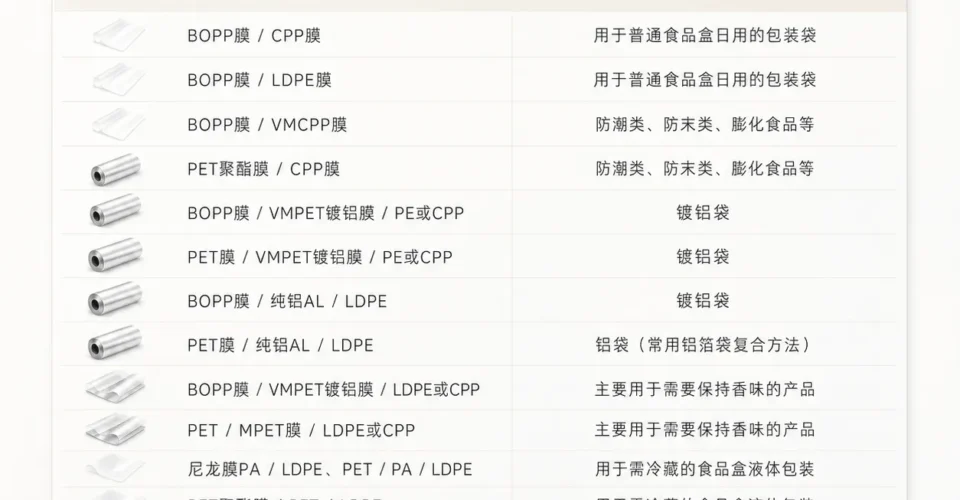
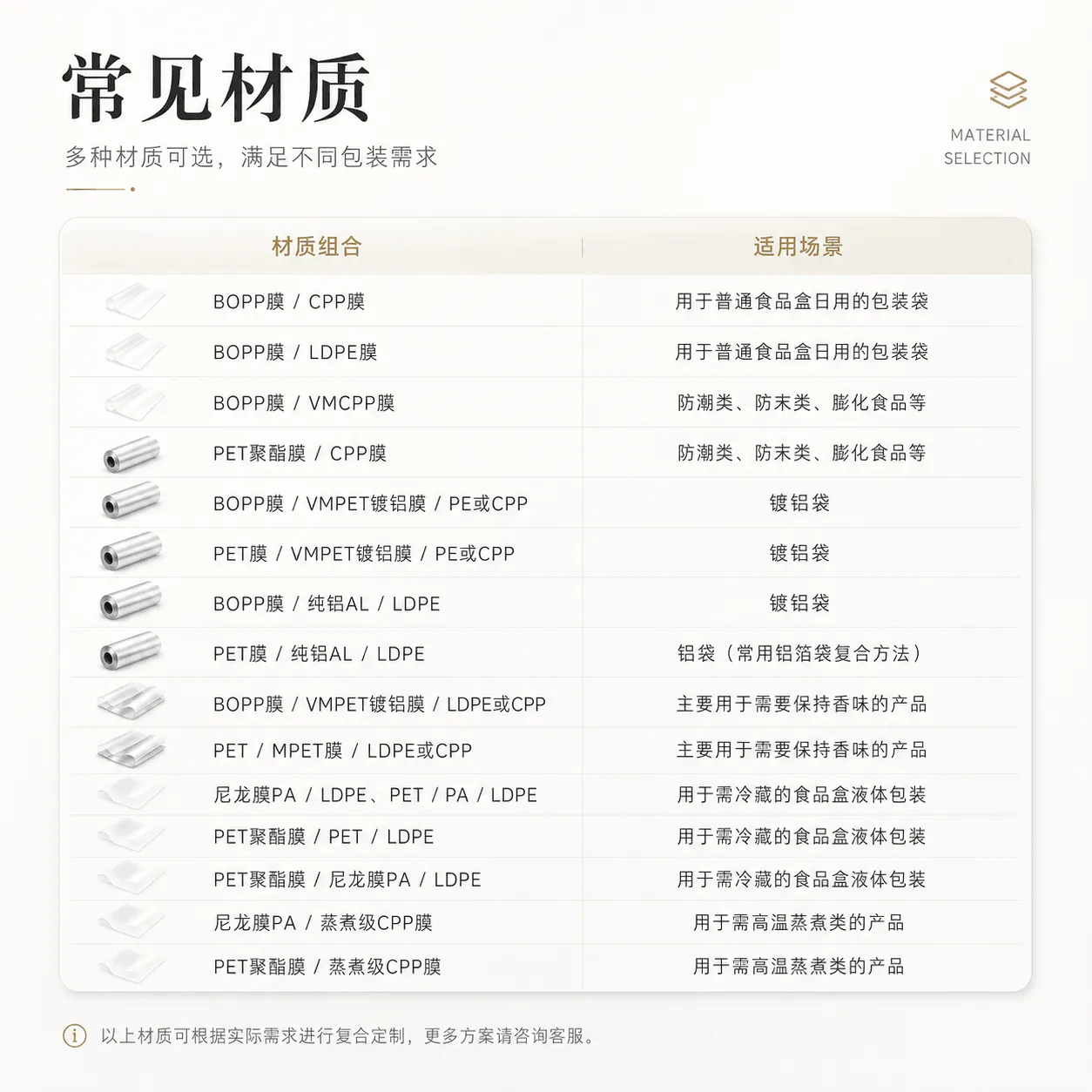
Precisely because every single material has its own weakness, real-world pouches are almost always laminates of several materials. The most common combination is a three-layer structure: outer layer (print layer) + middle layer (barrier layer) + inner layer (heat-seal layer).
For example: the coffee bean pouch in your hand is likely structured as PET + AL + PE. PET is on the outside for high-definition printing, giving the packaging a premium look; a layer of aluminum foil (AL) in the middle blocks light and oxygen to keep the coffee beans fresh; PE is innermost for heat sealing, ensuring no leaks.
If such strong barrier is not needed, replace the aluminum foil with metallized film (VMPET) — similar performance at lower cost. For transparent packaging, PET + PE is enough, letting consumers see the product inside directly.
With so many pouch shapes, how do you choose?
Once the material is chosen, the next step is the pouch type. Different pouch types suit different products and scenarios.
three-side seal pouch is the most basic style — sealed on three sides, regular shape, low cost, suitable for small packs of snacks, powders and granular products.
stand-up pouch has a gusseted bottom and stands up on its own on the shelf, displaying well. Liquids, sauces and laundry detergent all favor this pouch type.
Flat Bottom Pouch / Square Bottom Pouch has a flat bottom, large capacity, and looks like a small box on the shelf. Coffee beans, rice and pet food often use this pouch type.
shaped pouch breaks the mold — penguin pouches, heart-shaped pouches, vertical specialty pouches. These are mainly designed to catch the eye and stand out on the shelf.
Spouted Pouch adds a screw-cap spout for repeated dispensing. Kids’ snacks, juice and liquid detergent all use this format.
If you now understand packaging material basics and want to apply them to your own product, check out OMOPACK’scustom packaging services, or learn more aboutStructural EngineeringandDigital Printing and how they help you bring your product packaging design to life.
Common Mistakes to Avoid
When customizing packaging, a few mistakes recur frequently; knowing them in advance saves a lot of trouble.
Mistake 1: Thicker is better.Many people think a thicker pouch means stronger and better quality. In fact, protective performance mainly depends on the material structure and lamination process, not just thickness. With the right material combination, even a thin pouch protects the product well. What’s more, overly thick pouches are harder to heat-seal and the seals are prone to defects.
Mistake 2: Vacuum packaging suits every food.Vacuum packaging does extend shelf life, but it is not a cure-all. Crisp biscuits and chips get crushed in a vacuum pouch; sharp-cornered foods easily puncture the pouch. Such products are better suited to gas-flush packaging (nitrogen flushed into the pouch), which prevents crushing and preserves freshness.
Mistake 3: Only looking at price, not the MOQ.Custom packaging always has minimum order quantities, which vary greatly by pouch type. Plain three-side seal pouches can go as low as a few thousand pieces, while spouted and flat bottom pouches may require tens of thousands due to complex tooling and processes. Always factor the MOQ into your budget.
A Few Practical Material Selection Principles
After reading the above, you probably have a feel for it — choosing packaging is really about balancing a few factors: protection, cost, display effect and environmental requirements.
First, choose by product characteristics.For dry goods, coffee and milk powder needing long-term storage, choose high-barrier packaging with aluminum foil. For fast-moving snacks that don’t need long storage, a simple transparent laminated pouch is enough. Foods with high oil content (nuts, jerky) must use materials with good oxygen barrier, or they will go stale quickly.
Second, choose by sales channel.For products sold online, the packaging must be sturdy for shipping with strong seals. For in-store shelf display, the packaging must look good and ideally stand upright. For livestream commerce, the unboxing experience matters too.
Third, consider the sustainability trend.More and more consumers now care about packaging sustainability. Recyclable mono-material packaging (such as all-PE structures) is becoming a new trend. Though its barrier is not as good as foil-containing laminates, it is fully adequate for short-shelf-life products and much easier to recycle.
What is the process for custom packaging?
If this is your first custom packaging project, the general process is:
First, discuss your needs with the packaging manufacturer — what product will be packaged? What shelf life is required? What is the budget? The manufacturer will recommend materials and pouch types based on your situation. Then confirm with samples — they will make a sample for you to check the look and test seal integrity. Only after approval does mass production begin.
The whole process seems full of choices, but the core is simple:what protection your product needs and what your budget tier is, and leave the rest to a professional packaging manufacturer. Packaging may look complex, but at heart it is finding a well-fitting “outfit” for your product.
If you have questions about packaging for your specific product, visit Huasu Packaging for more packaging solutions and product cases.
Interested in custom packaging? Welcome to contact Huasu Packaging — we provide one-stop packaging services from material selection and structural design to mass production, with free professional advice.
We hope this article gives you confidence in choosing packaging. If you have any further questions, feel free to leave a comment.