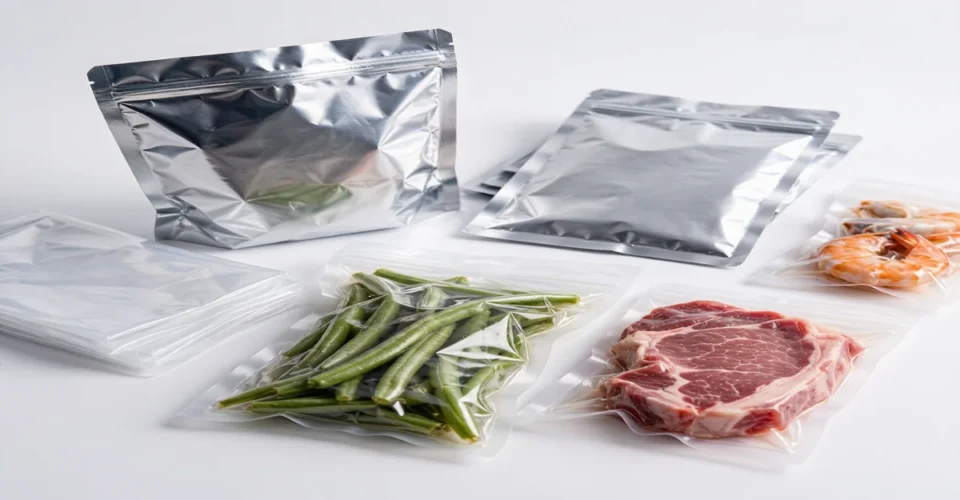
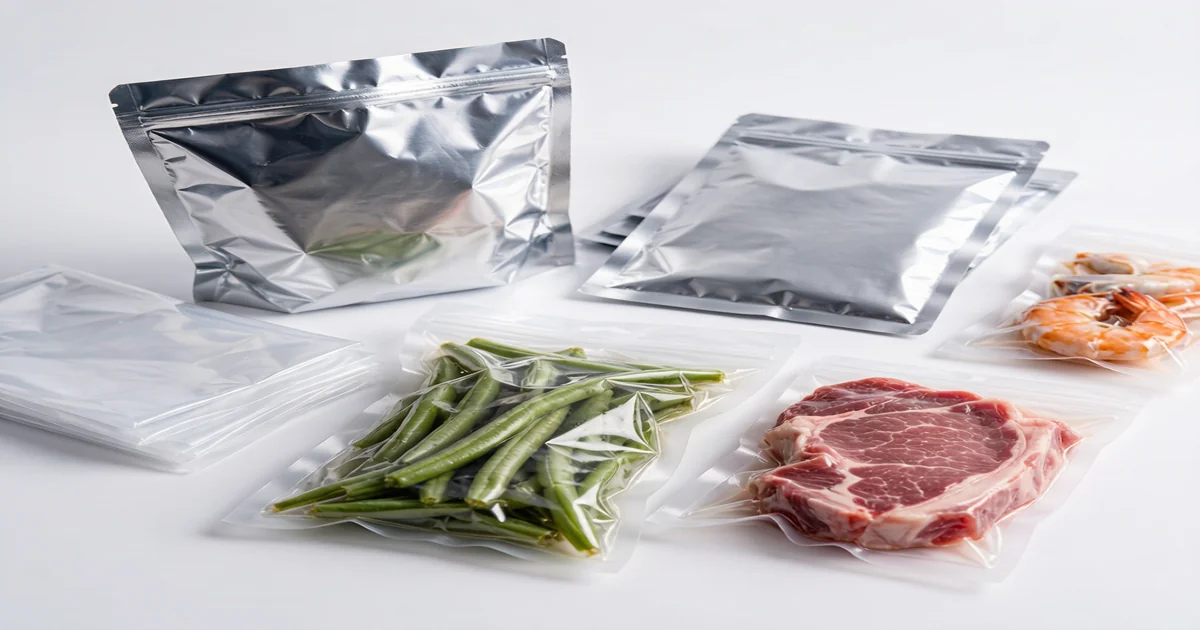
Food vacuum packaging pouchesis standard for fresh meat, frozen food, tea, grains and other categories. But in serving customers, we found that over 40% of vacuum pouches”leak”problems originate not in the equipment but in theFood vacuum packaging poucheslies in material selection and thickness matching.
This article breaks down the complete vacuum pouch selection logic across three dimensions: materials, equipment and operation.
Material selection logic for food vacuum pouches
Core requirements for food vacuum pouches: oxygen barrier + puncture resistance + heat seal strength
The biggest difference between vacuum pouches and ordinary pouches is:the pouch must withstand a temperature range from -40°C to 120°C, as well as strong stretching during vacuuming.
| Material structure | Oxygen transmission rate | Low-temperature resistance | Retort resistance | Suitable scenarios |
|———-|————-|———-|———-|———-|
| PA/PE (co-extruded) | 1-3 | -40°C OK | Not supported | Frozen meat, fresh produce |
| PET/PA/PE (three-layer) | 0.5-1.5 | -40°C OK | 121°C/30min | High-temperature retort food |
| PET/AL/PA/PE (four-layer) |<0.5 | -40°C OK | 135°C/20min | Long-shelf-life premium foods |
| Mono-material PE (recyclable) | 5-8 | -40°C OK | Not supported | Short-shelf-life, recyclable scenarios |
> Selection rule of thumb: frozen foods use PA/PE, retort foods use PET/PA/PE, long-shelf-life products use four-layer foil, and recyclable options use mono-material PE.
Practical thickness selection advice for food vacuum pouches
Pouch thickness directly affects vacuuming performance:
| Product type | Recommended thickness (single PE layer) | Total pouch thickness | Vacuum retention period |
|———-|———————-|————-|————-|
| Fresh meat (refrigerated 3-7 days) | 80-100μm | 120-160μm | 7-10 days |
| Frozen meat (3-12 months) | 100-120μm | 160-200μm | 12-24 months |
| Tea, grains (12-24 months) | 120μm | 200μm+ | 24-36 months |
Matching vacuum packaging equipment with pouch types
Common vacuum packaging equipment types
| Equipment type | Suitable pouch types | Vacuum speed | Reference price |
|———-|———-|————-|———-|
| External suction vacuum machine| All pre-formed pouches | 15-30 sec/cycle | ¥800-3,000 |
| Chamber vacuum machine| Pre-formed pouches | 10-20 sec/cycle | ¥2,000-8,000 |
| Vacuum packaging line (automatic)| Roll film on-site pouch making | 40-60 packs/min | ¥150,000-500,000 |
| Modified atmosphere packaging (MAP) machine | Pre-formed pouches + MAP | 20-40 sec/cycle | CNY 5,000-20,000 |
Equipment and material matching notes for food vacuum pouches
1. PA/PE pouches-> compatible with all equipment types; the most versatile material
2. Pouches containing foil-> cannot use”induction heating”-type sealers; must use impulse sealing or heat-press sealing
3. Pouches thicker than 150μm → ensure the equipment’s heat seal bar power is ≥500W, otherwise the seal will be weak
Operation pitfall guide for food vacuum pouches
5 common vacuum packaging operation mistakes
1. Pouch size too small-> during vacuuming, contents squeeze the seal area, causing incomplete seals
2. Pouch has wrinkles before vacuuming-> air easily remains in creases, forming”air pockets”
3. Wrong heat seal temperature-> PE layer heat-seal temperature is 110-150°C; PA layer needs higher temperature; wrong parameters cause weak seals or burn-through
4. Oil/moisture on the pouch opening-> seal area contamination directly causes leakage; reserve a clean 5-8cm seal area when filling
5. Pouches compressed during storage → vacuum pouches become brittle after vacuuming; stacking height recommended at<1.5 meters
Incoming inspection process for food vacuum pouches
| Test item | Test method | Acceptance standard |
|———-|———-|———-|
| Seal strength | Tensile testing machine | >=35N/15mm |
| Barrier | Oxygen transmission rate meter | PA/PE<3 cm³/m²·24h |
| Puncture resistance | Puncture test | ≥18N |
| Heat seal strength | Heat seal tester | ≥30N/15mm |
Cost optimization for custom food vacuum pouches
3 ways to reduce vacuum packaging costs
1. thinner-gauge design: through co-extrusion, PA/PE structures can achieve a single PE layer of 70μm (110μm total), 20% thinner than traditional lamination with 15% cost reduction
2. Roll film instead of pre-formed pouches: if daily usage is >5,000 pieces, on-site pouch making (Form-Fill-Seal) is 30%-40% cheaper than pre-formed pouches
3. Mono-material instead of multi-layer laminates: although an all-PE structure has slightly lower barrier properties, it cuts material costs by 20% and is recyclable, suitable for short-shelf-life products
Questions about or need a custom packaging solution? Welcome toContact OMOPACK. We offer one-stop service from material selection and structural design to printing sampling and mass production, and our professional team provides free customization advice.