Custom pet treat pouches. Huasu Packaging’s guide to custom pet food packaging: material safety, pouch type selection and print design
The pet economy keeps heating up, and pet treat brands’ packaging upgrade demand is growing fast. Unlike main food packaging,Custom pet treat packagingit must balance both the pet owner’s purchase decision logic and the product’s functional needs — attracting owners with attractive packaging while ensuring the materials are safe for pets. This article provides pet treat brands with a complete packaging customization guide across three dimensions: material safety, pouch type functionality and print design.
Material safety standards for custom pet treat packaging
Pet treats come into direct contact with animals’ mouths, and some products (such as freeze-dried or fresh meat treats) may be swallowed whole, soCustom pet treat packagingmaterial selection must prioritize food-contact safety. In the EU and North American markets, pet food packaging must comply with the same food-contact material regulations as human food (such as EU 10/2011 and FDA 21 CFR).
For the inner heat-seal layer, we recommendfood-grade PE (polyethylene)oror non-plasticized CPP (cast polypropylene), avoiding recycled or industrial-grade films. For premium pet treat brands, you can also add aPVDC coatingoror high-barrier EVOH layer, to further improve barrier performance against oil and odors.
In recent years, as pet owners pay more attention to sustainability,Custom pet treat packaginghas increasingly adoptedmono-material (mono-material PE or PP)structures. Free of aluminum foil and 100% recyclable, these structures meet basic barrier needs while helping brands build an eco-friendly image.
Pouch type comparison and selection advice for custom pet treat packaging
Different forms of pet treats suit different pouch types. Below is a comparison of the four most commonly used pouch types inCustom pet treat packagingcustom pet treat packaging:
1. Stand-up Pouch
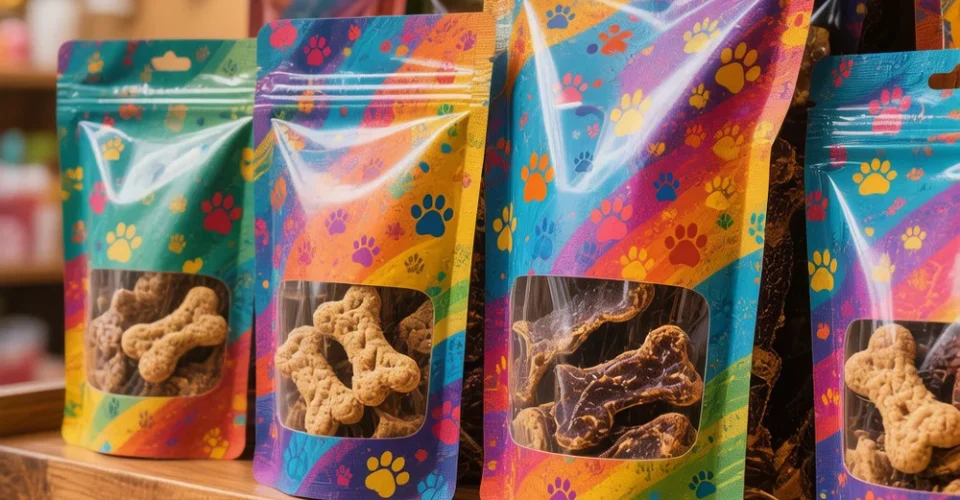
The most versatile pouch type, suitable for pet treats from 50g to 2kg. Optionallockable zipperprevents pets from tearing the package open themselves. A transparent window lets consumers see the treat pieces directly, helping lift purchase conversion. We recommend reserving at least 30% of the front print area for brand color blocks to strengthen shelf recognition.
2. Flat Bottom Pouch
With a flat bottom and upright sides, it offers excellent shelf stability. Suitable for large dog treat packs over 1kg or mixed gift sets. The front and both sides of the eight-side seal pouch can serve as print display surfaces, making it the best pouch type forthree-sided brand storytelling— the front shows the brand logo and hero visual, the left side describes product selling points, and the right side shows the ingredient list or feeding advice.
3. Quad Seal Pouch
The quad seal structure gives a strong three-dimensional form, suitable for products requiring high stacking strength. For large pet treat packs over 3kg, the quad seal pouch outperforms stand-up pouches in load-bearing capacity and resists compression better in e-commerce logistics.
4. Stick Pack / Sachet
Suitable for small training reward treats (such as freeze-dried chicken pieces or single teething sticks). Sachets are easy to carry, and every opening is a fresh package, avoiding the moisture problems of repeatedly opening a large pack. In recent years,”daily training packs”of sachet bundles have become an important format for new pet treat products.
Print design essentials for custom pet treat packaging: how to win over pet owners
Custom pet treat packagingprint design targets pet owners, not the pets themselves. The design logic should center on the psychology of”owners want to give their pets the best”:
- Real ingredient photography: high-resolution photos of the main ingredients on the front (such as whole chicken breast or salmon slices) trigger more purchase desire than abstract illustrations.
- Clear functional labels: use eye-catching color blocks to highlight claims such as”grain-free”、”single protein source”、”suitable for sensitive stomachs”, helping owners decide quickly at the shelf.
- Innovative window shapes: designing the window as a bone, paw print or small fish shape adds playfulness and reinforces the connection between the product and pets.
- Color psychology: dog treat packaging often uses warm tones (red, orange, yellow) to convey energy and appetite, while cat treat packaging leans toward cool tones (blue, purple, gray) to convey refinement and premium quality.
In printing processes,digital printingis becomingCustom pet treat packagingthe first choice for custom pet treat packaging. Pet treats have many SKUs that ramp up slowly per item; digital printing’s no-plate-making feature and minimum order as low as 500 pieces exactly match the industry’s production rhythm. For DTC pet brands that frequently launch new flavors and packaging, the flexibility advantage of digital printing is particularly prominent.
Functional accessory configuration: zippers, degassing and anti-counterfeiting
The choice of functional accessories for pet treat packaging directly affects consumer experience:
Zipper: we recommend adouble-track self-locking zipper, whose press-to-close design withstands pet scratching better than traditional slider zippers. For small packs such as cat treats, you can also chooseresealable adhesive tape closuresat a lower cost.
Questions about or need a custom packaging solution? Welcome toContact OMOPACK. We offer one-stop service from material selection and structural design to printing sampling and mass production, and our professional team provides free customization advice.